PLANTS & ANIMALS IN & AROUND
CENOTE YOKDZONOT
The Yucatan Peninsula is arid in the northwest, but becomes rainier as you move toward the east and south. In the arid northwest you find low-growing, spiny-stemmed scrub forest in which many cactus species, often endemic ones, are found. In southeastern Yucatan the forest is much taller. Inside those forests it's much more shaded and moist, and species diversity there also is much higher than in the northwest. On the branches of trees grow many orchids, bromeliads and other epiphytes. In Yokdzonot we're in the center of the Peninsular, and the vegetation shows it. Vegetation here isn't too spiny and scrubby, but neither is it as lush and rich in species as to the southeast.
Inside the cenote several plant species can be found not growing outside. That's because inside the cenote there is less wind and sun, therefore it's more humid. Inside the cenote you find species more common to the rainier southeast.
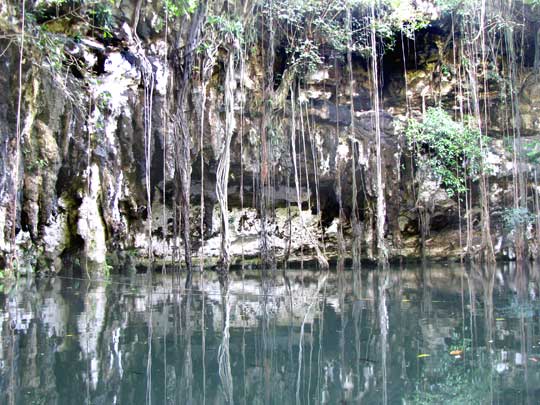
It's beautiful how things looking like gray ropes drape the cenote's walls . Most of these are "roots" of strangler fig trees growing at the cenote's rim. Actually they're neither roots or stems, but rather something in-between, peculiar to strangler figs. When they reach water they produce large bunches of real roots that absorb water to be transported to the tree above.
Here are some of the most common trees around the cenote:
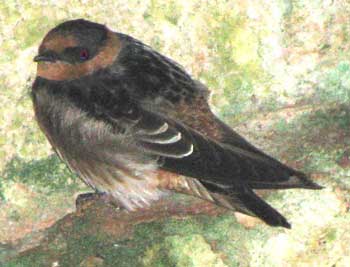
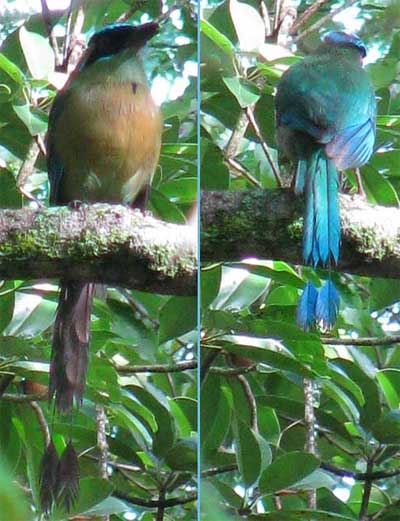
The most conspicuous bird inside the cenote is usually the Cave Swallow, Hirundo fulva, shown above. All year round hundreds of them live in nooks and crannies at the cenote's bottom. Early each morning they start swirling around inside the cenote. When there's a big flock of them flying around they leave the cenote for their day's work. When the sun sets they return, while bats fly out. Also common around the cenote are woodpeckers, doves of two kind, the Tropical Mockingbird, gnatcatchers, orioles, wrens, flycatchers of various species, hummingbirds, and the Toh, or Turquoise-browed Motmot, shown below, photographed at the cenote's rim. Notice the strange way the Toh's long tail feathers are missing parts of their veins toward their ends.
From October to May many migratory birds from North America live here. Especially you can look for warblers, such as Magnolia and Black-and-white Warblers, and vireos, such as the White-eyed Vireo. Of course when these migrants are present at the cenote they don't sing or produce nests, so they keep a low profile and you really have to look for them.
Sometimes you see squirrels but most of the cenotes mammals are nocturnal -- come out only in the nights. At night you might see raccoons and armadillos.
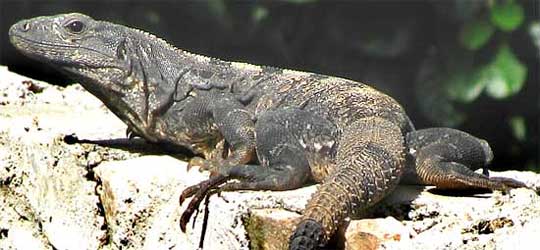
On sunny days often you can see large Black Iguanas, Ctenosaura similis, half a meter long and much more, as seen above. Look for them atop the stone wall on the cenote's north side, as well high in treetops eating fruit.
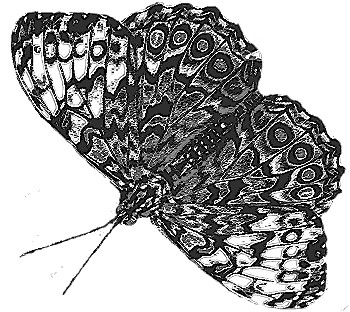
It's worth keeping an eye out for insects, too. The one shown above is especially common. It's Hamadryas februa, which you're likely to see rushing from tree trunk to tree trunk in a fast, erratic manner. If you want to admire its intricate markings, pay attention to where it lands, for once it's perched quietly on a tree trunk it's so well camouflaged surrounded by lichens and other splotchings that sometimes you can't see it, even though it's right in front of you!