June 24, 2012
OPEN & CLOSED TRUMPET CREEPER FLOWERS
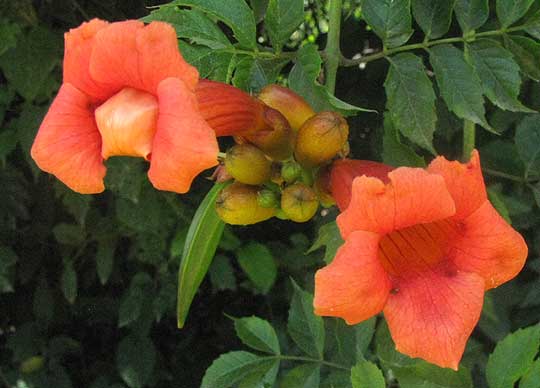
At https://www.backyardnature.net/n/w/campsis.htm our Trumpet Creeper page shows something remarkable about Trumpet Creeper flowers: Their stigmas close when touched. There's more about that on the page. Now take a look at two Trumpet Creeper flowers encountered this week at https://www.backyardnature.net/n/12/120624tc.jpg.
The flower at the right is open for business, but the one on the left has its lower corolla lobe bent upward closing off the blossom's interior.
I'm assuming that this is a mechanism for preventing pollinators from trying to pollinate a blossom whose sexual parts are too immature for fertilization to take place. The Trumpet Creeper "wants" the pollinator to invest its time and energy in visiting flowers where pollination transfer will do some good, not where pollen from another flower will serve no purpose.
Several times lately we've seen plants helping their pollinators decide which blossoms to visit. This is certainly one of the more spectacular examples.
*****
EBONY JEWELWING DAMSELFLY
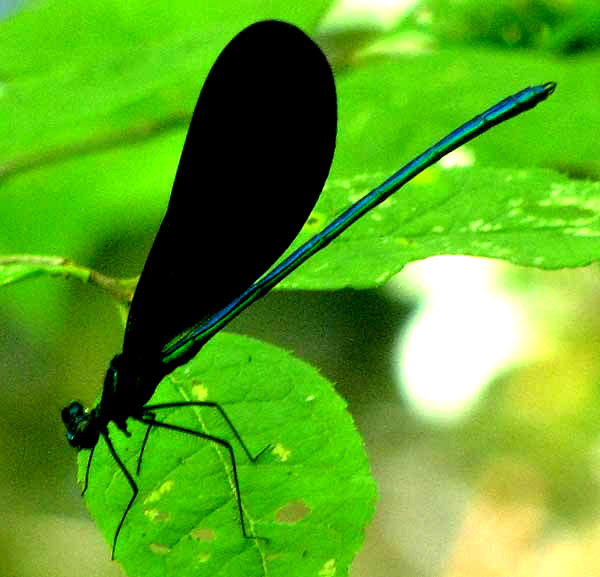
Deep in nearby Homochitto National Forest's swamps where Baldcypresses and their knees rise from black water, things are quiet, almost somber, except for the black-winged damselflies. Nearly always at least one or two can be seen darting about snatching mosquitoes from mid air or fluttering from plant to plant. Often those without little white dots at the tips of their wings (the males) flirt with those bearing white dots, and sometimes the dotteds and un-dotteds couple, forming heart-shaped unions as they mate. You can see an un-dotted male, his slender, metallic-blue body shining in the swamp's dim light at https://www.backyardnature.net/n/12/120624df.jpg.
Volunteer identifier Bea in Ontario recognized the species at sight because it's a common species in most of eastern and central North America, including Bea's Ontario. It's the Ebony Jewelwing, CALOPTERYX MACULATA. The technical name, or binomial, practically describes the species -- calo-pteryx in classical Greek meaning "beautiful-wing," and maculata referring to the white spots.
Despite looking so dainty, Ebony Jewelwings are voracious predators. During their aquatic larval stage, when they are known as naiads and vaguely look like wingless, leggy mosquitoes, they prey on many kinds of tiny aquatic organisms, including rotifers, copepods, hydras, water fleas and aquatic worms. When the naiads are ready to metamorphose into adults they climb to the water's edge, their external skeleton, or exoskeleton, splits open and the winged adult emerges. Then the winged adult preys not only on mosquitoes but also gnats, crane flies, aphids and other small invertebrates. In turn, birds such as flycatchers, as well as bats, frogs and many other insect eaters prey on them. So heavily involved in "eating and being eaten," Ebony Jewelwings are an important nexus in the swamp's web of life.
*****
GOLDEN SILK SPIDER
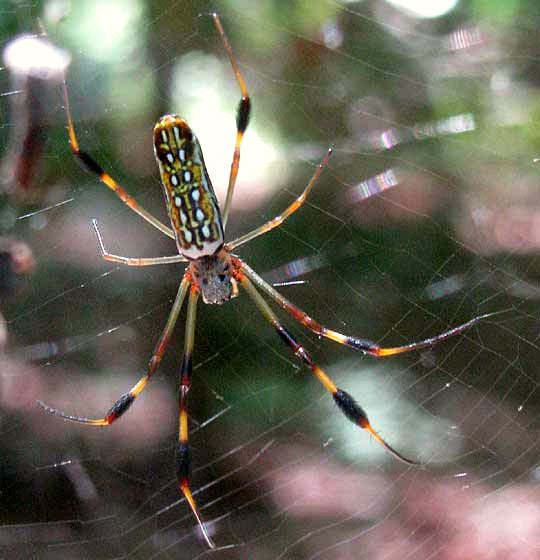
During earlier visits here during the fall we've commented on communities of large Golden Silk Spiders, NEPHILA CLAVIPES, stretching very big webs across roads and between trees. Local folks don't recall such conspicuous outbreaks in the past. Golden Silk Spiders are mostly a tropical and subtropical species so we've wondered whether their appearance may be the result of global warming; many hot-climate species are expanding their distributions into historically temperate climes nowadays. Among the Golden Silk Spiders' adaptations for hot places are their pale, light-reflecting colors, and their long, narrow bodies, the tips of which can be pointed directly toward the sun in order to reduce the surface area of sunlight exposure along their sides.
This week, rather early in the season for them, I got some nice pictures, in case you want to be looking for them in your own area. A view of the mostly white and golden top is at https://www.backyardnature.net/n/12/120624ss.jpg.
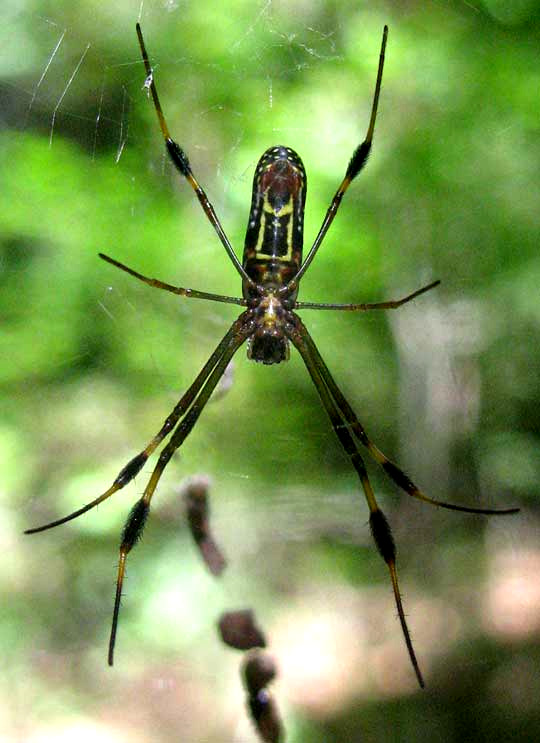
A bottom view showing a distinctive yellowish marking is at https://www.backyardnature.net/n/12/120624st.jpg.
*****
BROAD-HEADED SKINK
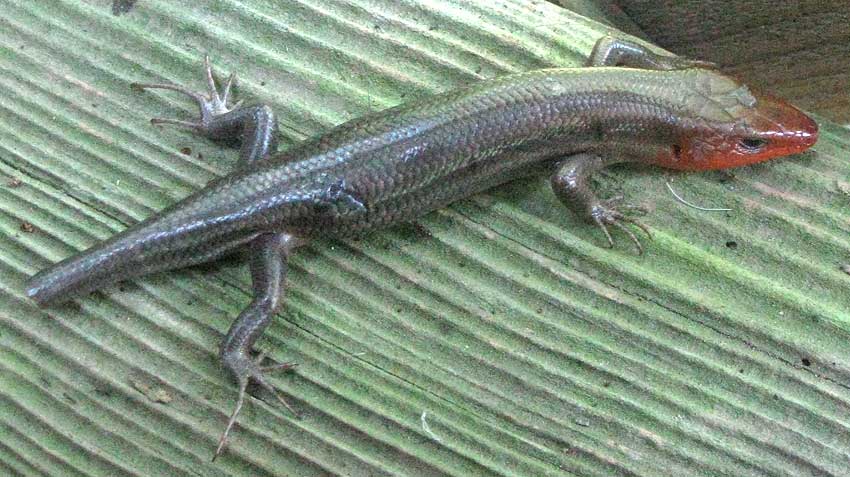
On the trailer's porch my food is stored in a large plastic container that mice can't get into. While digging into the container I noticed that on the shelf beside me a skink was perched watching me. Usually they run away, so thinking that maybe this one was hurt or sick I moved to make a poke with a finger, but then the critter agilely scampered to behind the container. That's when the photograph was taken shown at https://www.backyardnature.net/n/12/120624sk.jpg.
That skink has had a close call, as you can see by the tail's missing end, and an old wound in the side. Fracture planes cut across the tails of many skink species enabling the tail to break off easily when grasped by a predator, so maybe that happened here.
By "skink" is meant a member of the Skink Family, the Scincidae, which is the second-largest family of reptiles known generally as lizards, only the Gecko Family being larger. About 1200 skink species are known and Mississippi is home to five of them. Therefore, which species is this?
Figuring them out can be hard. Their colors can vary with age and sex. If you just have a picture as we do and can't examine such details as the anal plate on the bottom, basically you're left to noticing which scales, counting from the back's center, bear the white lines.
On that basis, ours looks like the Broad-headed Skink, EUMECES LATICEPS. Its most similar relative is the Southeastern Five-lined Skink, which also is found here, but that species' white side lines are narrower than ours. Ours is either a female or immature male, for the mature male at this time of year has a much-enlarged, almost scary looking head, a "broad head." During my hermit years near here, where my trailer was more isolated in the woods, Broad-headeds were my most common species, so seeing them here is to be expected.
Two months ago we looked at a Five-lined Skink from here. You might be interested in comparing our current Broad-headed with that one at https://www.backyardnature.net/n/a/5-line.htm.
The habitats of Broad-headed Skinks are described as moist, wooded areas as well as open areas where low shelter is provided by leafy debris or piles of rubble. My woods-edge trailer with its porch wall-trellises overgrown with Japanese Climbing Fern falls into that description pretty well.
*****
BASSWOOD FLOWERING
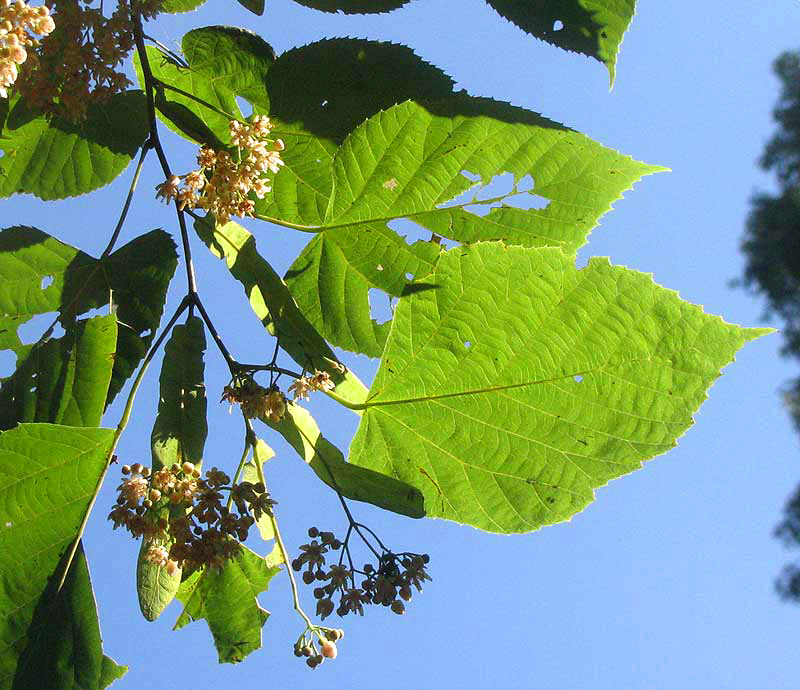
Nowadays the Basswoods, TILIA AMERICANA, are very prettily flowering, as shown at https://www.backyardnature.net/n/12/120624ti.jpg.
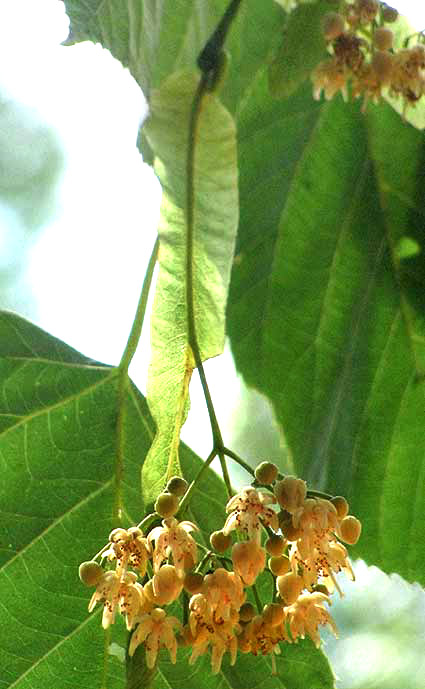
If you're unfamiliar with the Basswood's unusual manner of presenting its flower clusters, be sure to notice in the above picture how each cluster of creamy-white blossoms dangles from a stem, or peduncle, that is not attached to the stem in the normal manner, but rather connects to the center of the midrib of a flat, fingerlike, green blade very unlike the big leaves, and that this strange blade itself arises from the angle between the petioles of the regular leaves and the stem, where flower clusters usually arise. A close-up showing this remarkable construction from a different angle is at https://www.backyardnature.net/n/12/120624tk.jpg.
The fingerlike items the flower clusters arise from are bracts, which are modified leaves. Over the years we've seen many kinds of bracts doing extraordinary service -- such as the spectacularly large, red ones surrounding the Poinsettia's tiny, inconspicuous flowers. The Basswood's bracts are just as amazing.
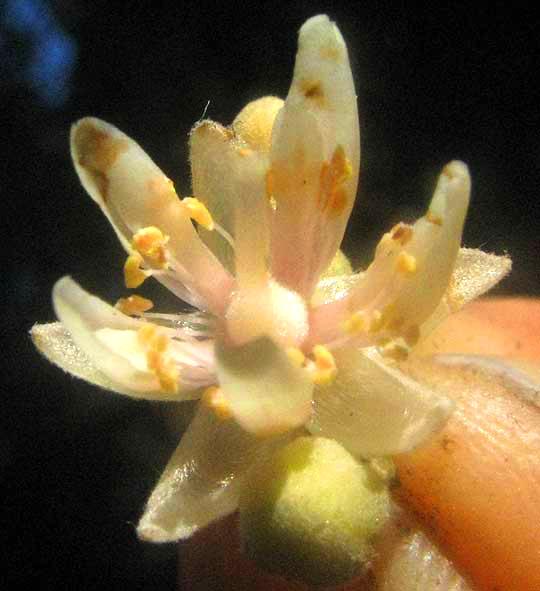
Basswood flowers themselves are a little unusual, as shown at https://www.backyardnature.net/n/12/120624tj.jpg.
There you can see a fairly normal but fuzzy, oval ovary in the flower's center, with its stigma-tipped style rising vertically. Below the ovary numerous male stamens arise with their yellowish anthers shedding pollen. Below the ring of stamens there are five petals, and alternating with them are five white, fuzzy, petal-like sepals. That's all normal, but if you look closely at the petals, particularly the topmost one, you'll see what looks like a second, smaller white petal arising between it and the ovary. This is what's unusual. These "smaller inner petals" are actually modified stamens called staminodia, and they're regular features in flowers of the many basswood species. I can't imagine why the flower thinks it needs them.
Basswoods are big trees up to 80 feet tall (24m), typically well formed and pleasing to look at, and especially handsome with those large, thin, heart-shaped leaves with serrated margins. Nowadays their abundant flowers keep the trees abuzz with pollinators. Basswood honey is among the best tasting. Standing beneath a tree with sunlight filtering through the thin leaves while all that pollination activity goes on is a delicious experience itself.
Basswoods are uncommon in this area and I suspect that the reason is because their wood is especially light, strong, and beautiful. I'll bet that they, like White Oak and other highly valued hardwoods, have been "harvested" to the point of local extinction.
The "bass" in the name basswood derives from the word "bast," one definition of which is "fibrous material obtained from the phloem of jute, hemp, flax, lime, etc., used for making rope, matting, etc." That makes sense when we read that the Basswood's inner bark contains such tough fibers that in the past ropes were made from it. It also makes sense that basswood inner bark would be so fibrous, since basswoods are member of the Hibiscus Family, and in recent times we've focused on the tough fibers of several species in that family traditionally used by the Maya and others as rope.
Basswoods are often called Lindens. You may have enjoyed herbal tea in which "dried Linden flowers" were an important ingredient. Dried basswood flowers contain plenty of aromatic volatile oils that taste good to humans. They also contain flavonoids which act as antioxidants, and mucilaginous agents that soothe and reduce inflammation. The list of ailments Linden flower tea is good for is too long to list. What a wonderful plant.
Basswood taxonomy is in mess. Mainly, the experts can't agree on whether there's one big, variable species occurring throughout nearly all of the forested, eastern US and adjacent Canada, or whether some of the variations are distinct species. Wikipedia presents them as different species but Weakley's online Flora of the Southern and Mid-Atlantic States points out that the variations "are imperfectly distinct in geographic areas of overlap," and treats them all as one species. That's how I'm treating ours -- as Tilia americana var. caroliniana, sometimes separated as the Carolina Basswood, Tilia caroliniana.
*****
LAUREL OAK
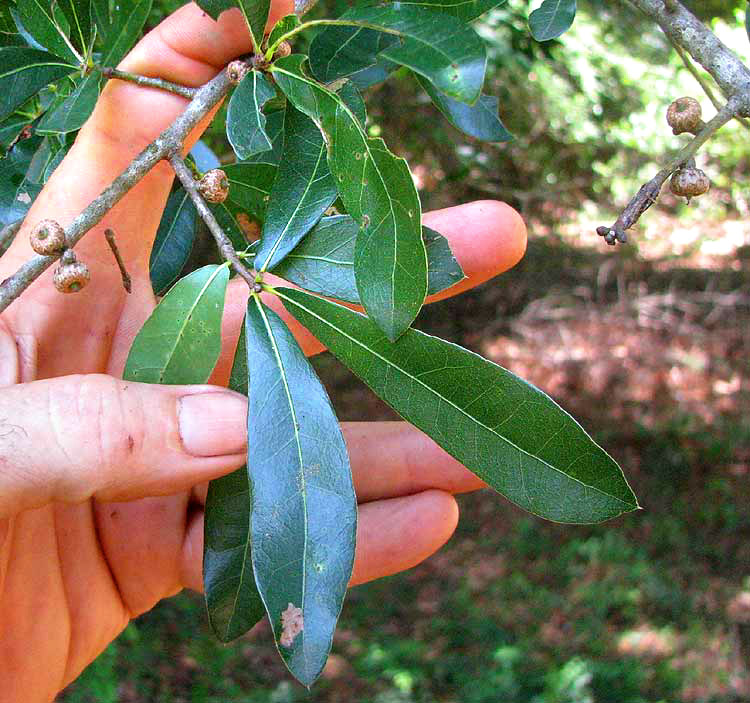
It's always a good day when I can meet a tree species new to me, just stand there and admire it, and let sink in what the species' special features are, the characteristics that make it a distinct species. This week I got to have that experience, and it was an especially gratifying for two reasons: First, I'd passed this very tree many times without realizing who it was, and; second, just last month we looked at a very closely related species, the "oak that comes and goes," a species that has gone unrecognized as a species for so long that it doesn't yet have a commonly accepted English name. It was Quercus hemisphaerica, whose page is at https://www.backyardnature.net/n/w/qu-hemis.htm.
That species had been regarded as merely part of the normal variation of the Laurel Oak. This week I met the Laurel Oak itself, QUERCUS LAURIFOLIA. It was a fair-sized tree in the swampy bottomlands of Homochitto National Forest near here. You can see its twigs bearing immature acorns and narrow, unlobed leaves with conspicuous yellow midribs, and blade tips ending with sharp, short bristles at https://www.backyardnature.net/n/12/120624qu.jpg.
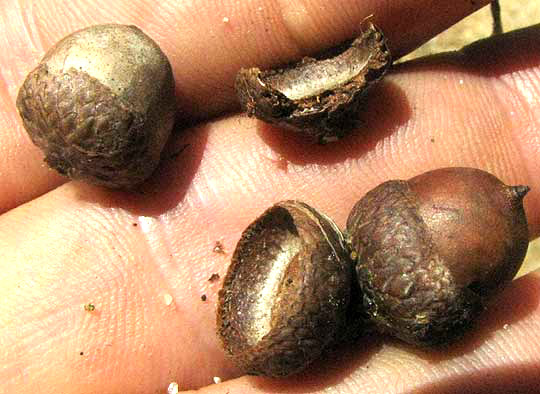
The Laurel Oak's leaves are classified as semideciduous or tardily deciduous because they remain on the tree through most or all of the winter, but not long enough to be regarded as evergreen. Last season's acorns picked up beneath the tree are shown at https://www.backyardnature.net/n/12/120624qv.jpg.
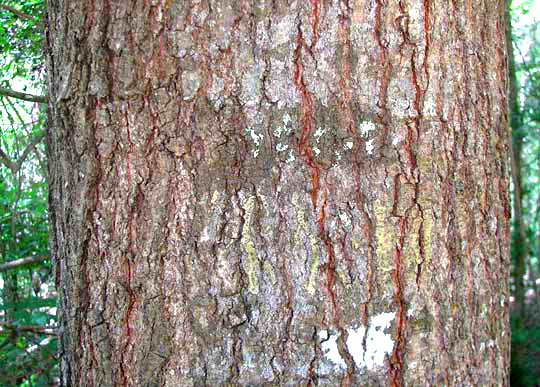
The tree's blackish-brown bark with flat-topped ridges between furrows is shown at https://www.backyardnature.net/n/12/120624qw.jpg.
Laurel Oaks are endemic to the US Southeastern Coastal Plain from Virginia to Texas. In the upland interior they don't reach as far north as Kentucky and Tennessee; they're genuinely a Deep South species.
*****
GIANT WILD LETTUCE
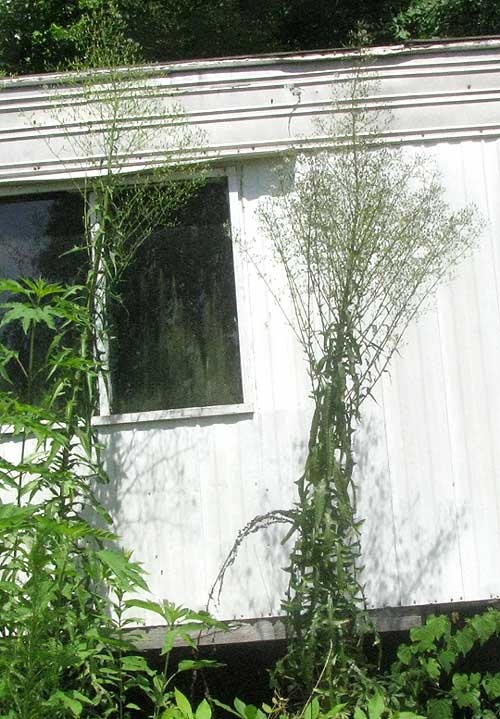
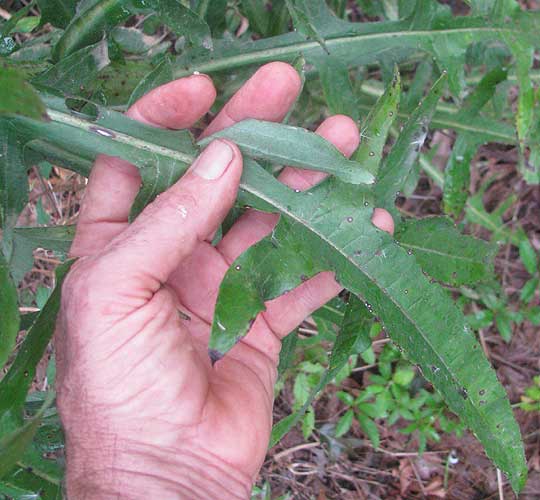
Sometimes you meet organisms you've known all your life but maybe they are in a new place or they're doing something you've never seen them do, and you don't recognize them. That's how it was when next to one of the neighborhood's abandoned trailers I met the 12 feet tall or taller (3.7m) plants shown at https://www.backyardnature.net/n/12/120624la.jpg.
A leaf from one of those plants, looking like it's from an enormous Dandelion, is at https://www.backyardnature.net/n/12/120624lb.jpg.
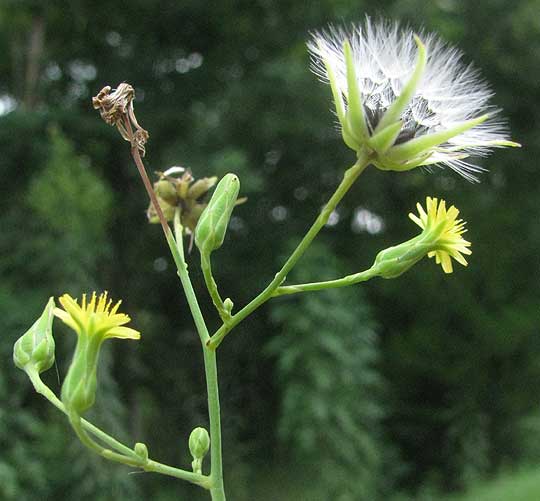
Despite the plant's rambunctious vigor, its heads of flowers and fruits were dainty and small, rather like those of a dwarf Dandelions, as shown at https://www.backyardnature.net/n/12/120624lc.jpg.
Obviously this was some kind of wild lettuce, genus Lactuca, of the Composite or Sunflower Family, but I'd never seen a wild lettuce as big and course-bodied as this. When I "keyed the plants out" in the online Flora of North America treatment for the wild lettuces, I could hardly believe what I came up with: It was LACTUCA CANADENSIS, sometimes called Canada Lettuce, but more generally just Wild Lettuce.
It's a species I'm accustomed to thinking of as seldom over head high, usually smaller. It's a biennial, so in the spring of its second year it produces a rosette of soft, dandelion-like leaves that are sweet and nutritious, making excellent salad ingredients. But as soon as the weather warms the rosette draws upon the energy stockpiled in carbohydrates in its substantial, Dandelion-like taproot to "bolt" and create a much bigger plant. Flora of North America says that this Wild Lettuce species can reach 4.5 meters -- 15 feet -- and higher!
Some wild lettuces are invasives from Eurasia but this one is a native American species occurring throughout North America in all but the driest and coldest parts, as well as Mexico and Central America, plus it's "gone wild" as an invasive in Eurasia.
What a pleasure seeing such healthy, robust and even good-tasting plants doing their best to nurture a spot where people who could do no better than abandon their derelict trailers there.
*****
SENSITIVE-BRIAR FLOWERING
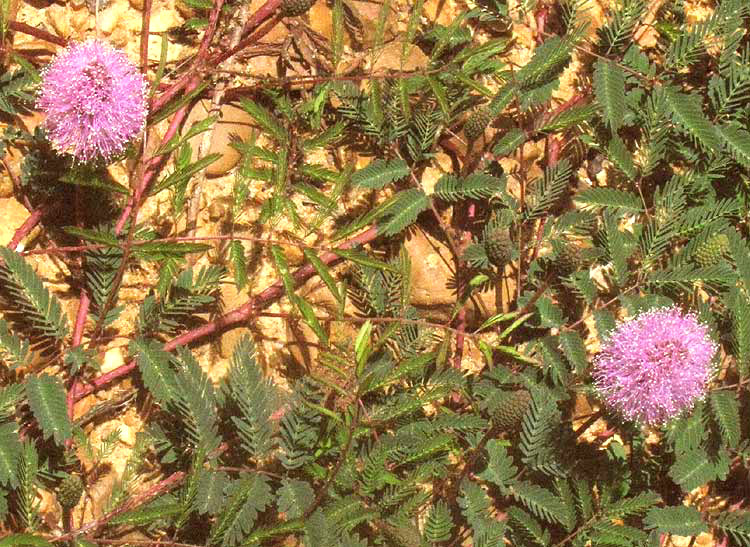
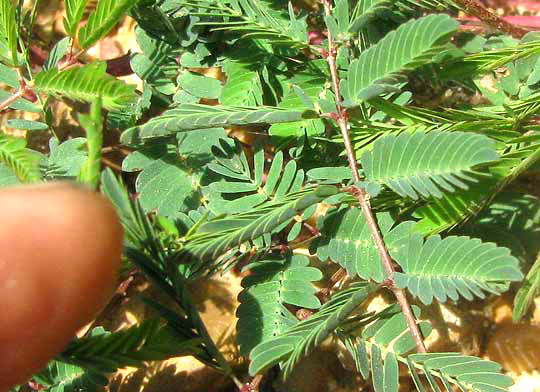
As I biked down the long, very hot, sunlight-bedazzled gravel road through nearby Homochitto National Forest, at the road's sandy edge there was a low mat of ferny herbage sprouting from a crisscrossing network of ground-hugging, reddish, stickery stems. The patch was about the size of a bathtub. Here and there pink, golfball-sized, pompom-like flowering heads rose above the leaves. You can see a small section of the plant at https://www.backyardnature.net/n/12/120624mm.jpg.
The temperature was so high that when I dismounted the bike and no longer had cooling air flowing around me, I almost lost my breath. How could such a tender-looking little plant survive hugging the sand and gravel, with the sun's full force at midday coming down on it?
It was the Eastern Sensitive-briar, MIMOSA MICROPHYLLA, a native wildflower so tough and flexible that when humans began destroying North America's Eastern Forest Biome it was able to expand from its ecological bases in sandhills, hammocks and open woods into abandoned, soil-impoverished fields, roadsides and even derelict city lots.
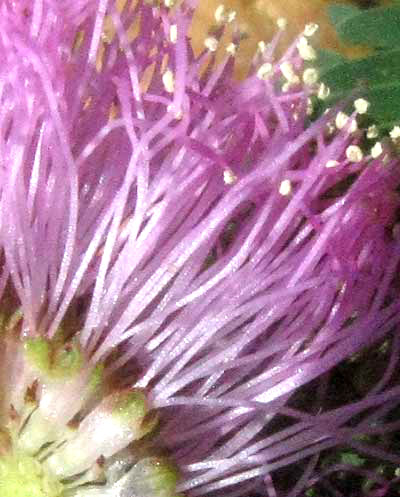
Sensitive-briars are members of the huge Bean Family, and the Mimosa subfamily. The pink pompoms are not flowers, but rather flower heads, or inflorescences. A cross section of a head showing what's going on with the flowers is at https://www.backyardnature.net/n/12/120624mo.jpg.
Bases of three or so actual flowers can be seen packed next to one another. From inside the corolla of each flower arise 8-10 stamens with pink filaments and tiny, whitish, pollen-producing anthers. This is all typical of the genus Mimosa and its subfamily, which also includes the acacias and Silk Trees we've looked at lately. What's extraordinary about sensitive-briars is that they're sensitive. Touch their leaves and immediately they fold. You can see part of one of this plant's twice-compound leaves, with leaflets on the left closed only two or three seconds after I had touched them with my finger, and untouched leaflets of the right still open, at https://www.backyardnature.net/n/12/120624mn.jpg.
Usually it takes 3-5 minutes for the leaves to open back up. In Plant Physiology class we were taught how the movement resulted when touch disrupted a finely balanced system of water pressure in the plant, but I never found that explanation entirely convincing. And now I'm gratified to find that the specialists still disagree as to why sensitive plants are touch sensitive to begin with. Some say it's to make the plant less visible to herbivores; others say the movement better exposes the stems' spines so they can better protect the plant; others say closed leaves cause the plant to look sick to herbivores, who know better than to eat sick-looking plants; others say that merely seeing a plant move unnerves herbivores, who then go eat less demonstrative plants. Who knows?
I know it was wonderful to meet such a remarkable plant so pleasingly sitting along that isolated, inhospitable road, minding its business photosynthesizing oxygen for me to breathe, providing nectar for pollinators, reclaiming a roadside for the forces of Life on Earth, and even putting on a show for anyone willing to poke a leaf.
*****
DUCKWEED
Standing waters in local bottomland drainage ditches nowadays are green-carpeted with tiny, oval, flat plant bodies which most folks recognize as duckweeds. Thing is, in North America four or five genera of plants known as duckweed are found, and many more species. The fun is in figuring out which duckweed you have.
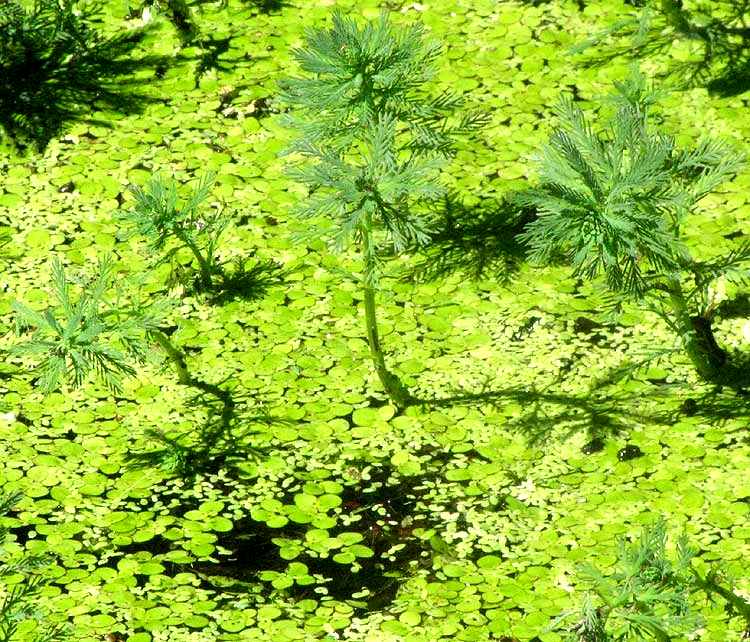
A close-up of a tiny section of a local duckweed-covered drainage ditch is shown at https://www.backyardnature.net/n/12/120624sp.jpg.
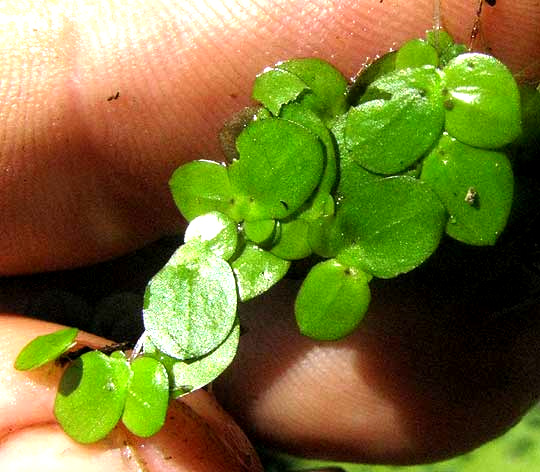
In that picture the parsley-like items emerging from the water are aquatic, invasive Parrotfeathers, which we looked at a while back. On the water's surface you can see that two duckweed species intermingle, a smaller, paler one and a larger, darker-green one. Right now we're focusing on the big one, whose bodies, or fronds, are mostly 6-8mm long (¼ inch). Some of those larger ones adhere to my fingers at https://www.backyardnature.net/n/12/120624sq.jpg.
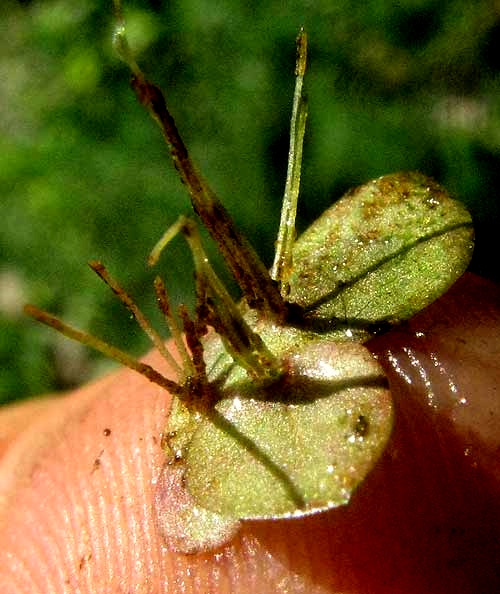
Notice how often one frond appears to be attached to one or more others. That's because -- even though these are flowering plants who can reproduce sexually -- mostly they reproduce vegetatively, with new fronds "budding" from older ones. Also notice that veins originating from little depressions at the fronds' bases are vaguely visible, maybe seven or so in the larger ones. A view of the undersides showing several roots emerging from the point that appears as a depression on top is at https://www.backyardnature.net/n/12/120624sr.jpg.
Most duckweed species in our area are members of the genus Lemna, but plants in that genus bear only one or no root on the lower surface. Spirodela has several roots. The Flora of North America lists two Spirodela species for North America. Our plants' five or fewer roots and five to seven veins key it out to SPIRODELA PUNCTATA, occurring nearly worldwide, and introduced into North America, where mostly it's found in the southern states. Some experts place the species in another genus, calling it Landoltia punctata.
With names like duckweed and duckmeat, this species' importance to ducks and other waterfowl is obvious. It's also important to fish and invertebrates who live in the duckweed community. Even humans are becoming excited about duckweed. The page at http://www.duckweed49.com suggests that "Duckweed may be the most promising plant for the twenty-first century... "
Mainly that's because duckweed produces more protein per square meter than soybeans. As such, it can be used to feed fish, shrimp, poultry and cattle. Also, duckweed can purify and concentrate nutrients from wastewater such as sewage.
*****
FASTIDIOUS LITTLE CANDLESNUFF
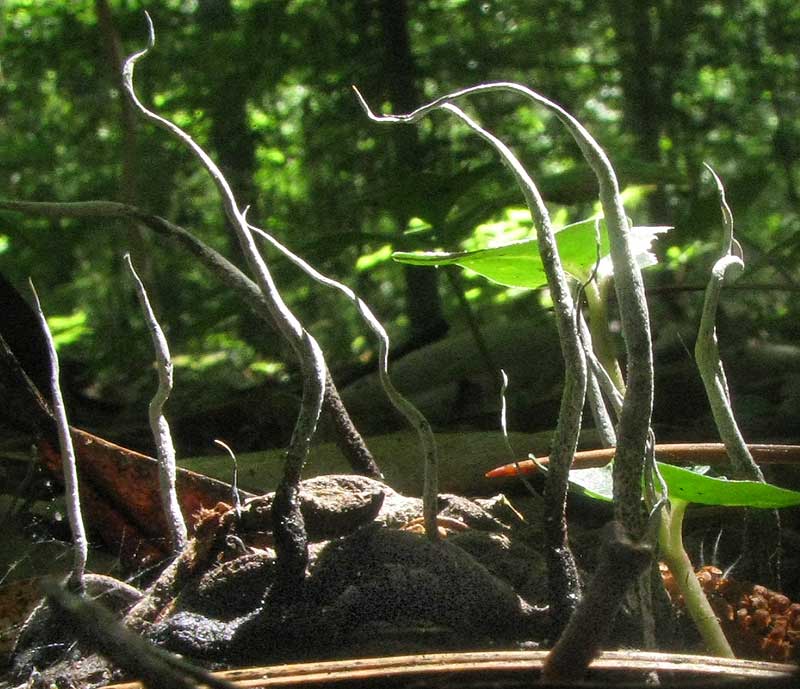
In deep shade on the floor of a bottomland forest in nearby Homochitto National Forest, slender, tapering, 1¼-inch (3cm) little black fingers with white fingertips arose from a decaying Southern Magnolia fruit from last year. Each "finger" issued from a different chamber, or follicle, of the fruit. You can see the strange little community at https://www.backyardnature.net/n/12/120624xy.jpg.
The graceful little fingers are the spore-producing fruiting bodies of an Ascomycota fungus, a fungus phylum incorporating the mildews, molds and famously edible morel mushrooms. The fungus was XYLARIA CARPOPHILA, its "fingers" sometimes known as Candlesnuffs. In much of the literature they are called Beechmast Candlesnuffs, because in Europe they nearly always occur on decaying beechnuts. However, in North America they have been documented on decaying fruits of hornbeam, dogwood, haw berries, fruiting heads of tulip trees -- and now we see that they also like Southern Magnolias -- so we'll just call them Candlesnuffs.
Members of the genus Xylaria decompose wood and other plant debris. Candlesnuff's species name, carpophila, translates to "fruit-loving," so this species' predilection for fruits was early noted.
This January in the Yucatan we met a much larger, thicker, more common member of the genus Xylaria -- "Dead-Man's Fingers," growing on a woodpile near my hut. You may want to compare our present Candlesnuff with that at https://www.backyardnature.net/yucatan/earth-tg.htm.
*****
FEATURED ESSAYS FROM THE PAST:
"Seeing Like a Caveman" from the February 13, 2005 Newsletter, at https://www.backyardnature.net/n/p/050213.htm.
"Bitter Pozol" from the April 21, 2008 Newsletter, at https://www.backyardnature.net/n/p/080421.htm.
*****
Best wishes to all Newsletter readers,
Jim