March 25, 2012
BAUDIN'S TREEFROG
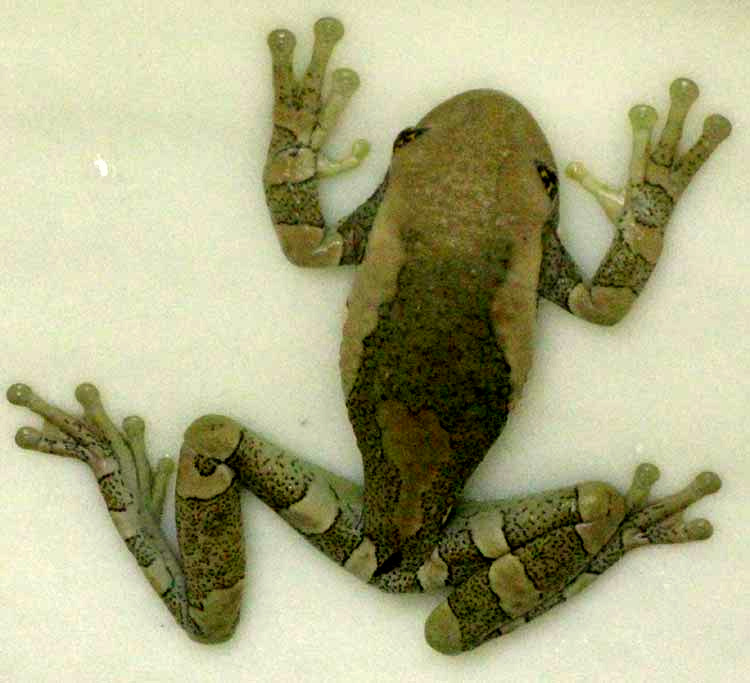
Beside an orchard about a 15-minute walk into the scrub there's a water tank where for the last couple of years usually one or more Yucatán Casqueheaded Treefrogs could be found. Last Monday when I peeped into the tank to check on the Casqueheads they were gone but someone unexpected was there, as shown at https://www.backyardnature.net/n/12/120325tf.jpg.
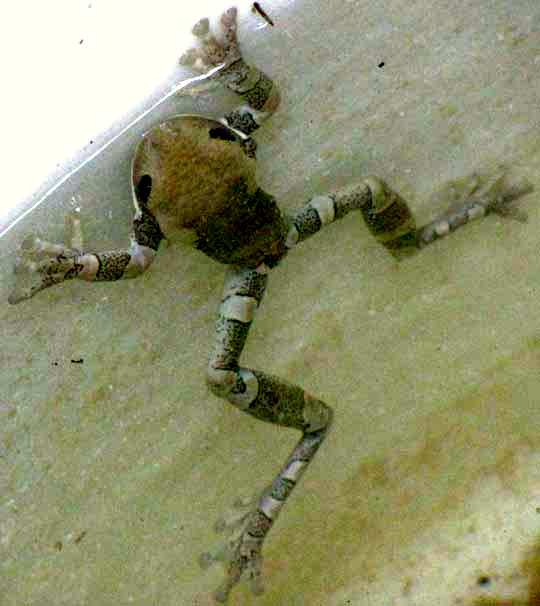
A different shot of the critter, in the water, is at https://www.backyardnature.net/n/12/120325tg.jpg.
That's a Baudin's Treefrog, SMILISCA BAUDINII, distributed from southern Texas to Costa Rica, and inhabiting a wide variety of habitats, from our scrubby forests to high-elevation cloudforests, to low-elevation rainforests.
Since it's so adaptable, over much of its distribution it's one of the most common frog species. Though this is the first time I've seen Baudin's Treefrog at the Hacienda, in 2006 at Hacienda San Juan near Telchac Pueblo it was common. However, I'll bet that this is the species that often after our rains here I hear lustily calling WONK-WONK-WONK, as the species' call is described. During the day Baudin's Treefrogs are known to take refuge in the axils of epiphytic bromeliads or beneath logs and vegetation on the ground.
*****
MOTMOT IN A WELL
Motmots are birds of a kind that doesn't occur in North America. Generally they nest in burrows excavated in banks, root masses of fallen trees, etc. At Hacienda Chichen at least one Turquoise-browed Motmot is at home about 15 feet down (4.5m) in a deep well chiseled through the limestone back during colonial times. Our Turquoise-browed Motmot page is at https://www.backyardnature.net/yucatan/motmottq.htm.
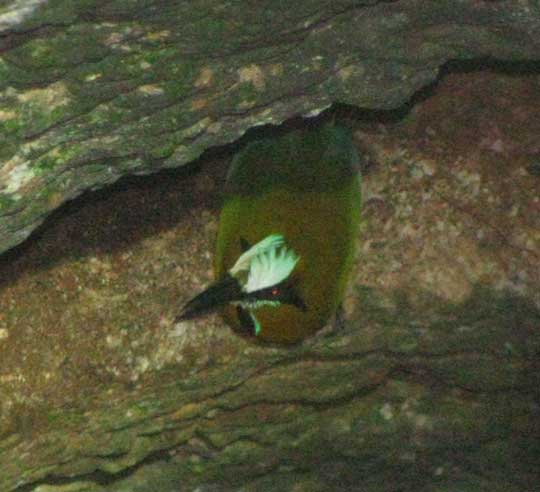
When you peep into the well, at first you don't see anything because it's so dark inside. After your eyes adjust, however, sometimes pale, blue-tinged spots show up moving back and forth. They're the reflective "turquoise brows" atop the bird's head as he looks around while perched on a natural ledge. You can get see what that looks like in the flash-assisted shot at https://www.backyardnature.net/n/12/120325mm.jpg.
The "brows" on that bird are more fluffed out and held erect than on birds seen outside the well. Are the brows standing up to impress a potential mate, or are they warning other motmots that this well already is taken? Or do they just stand up when the bird is nervous about someone looking down at him from above?
Whatever is going on, it's good just knowing that a motmot is so securely at home in the dank well, his flaring eyebrows aglow.
*****
GUMBO-LIMBOS HEAVY WITH FRUIT
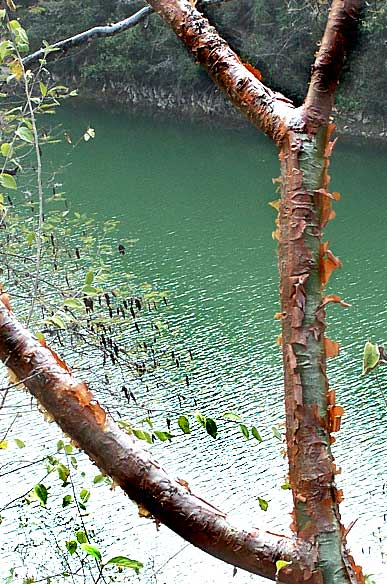
Gumbo-Limbos, BURSERA SIMARUBA, are among our most common trees here, as they are in much of humid, tropical Mexico. Often they're the first native tree visitors learn to identify because their bark is so distinctive, as shown in our picture from Querétaro at https://www.backyardnature.net/q/bursera.jpg.
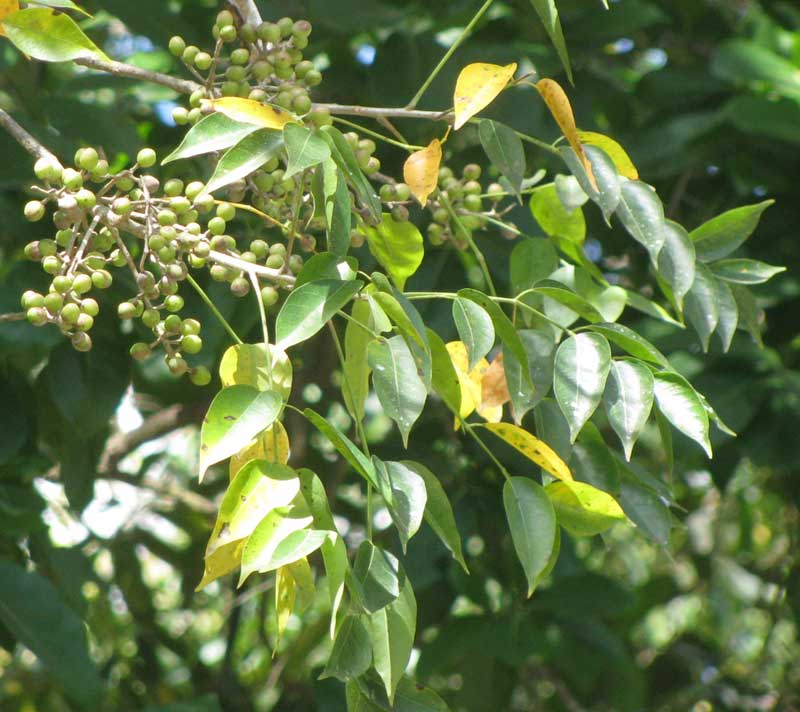
The trees produce abundant, pea-sized fruits, as seen at https://www.backyardnature.net/n/12/120325gu.jpg.
That picture shows that Gumbo-Limbo's pinnately compound leaves (5-13 leaflets) are very similar to those of the North's ash trees, except that they're alternate (one compound leaf per stem node) instead of opposite (two leaves per node), as found among the ashes.
For years I've been waiting for a picture of a Gumbo-Limbo tree bearing mature fruits. I never got one, however, despite heavy yearly fruit crops. Now I understand: Birds, squirrels and other critters so relish the fruits that they eat them before they look ripe, at least to my eyes. As the above picture was being taken several Social Flycatchers as well as a Masked Tityra were gorging themselves, one fruit after another, though on the whole tree I couldn't spot a single fruit whose flesh I considered ripe. Biting into the ripest fruit available, I found the flesh green, hard and bitter, with a pungent taste somewhat between menthol and pine resin. Gumbo-Limbo wood has a resiny smell, too.
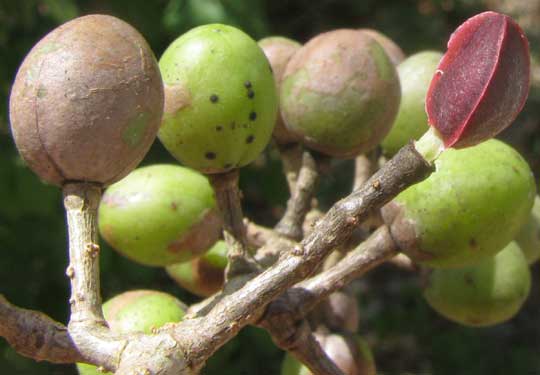
On the whole tree I found only one dark-red, three-angled seed on its pedicle, its flesh stripped from around it. You can see it at the top, right corner at https://www.backyardnature.net/n/12/120325gv.jpg.
*****
TRAVELER'S TREE
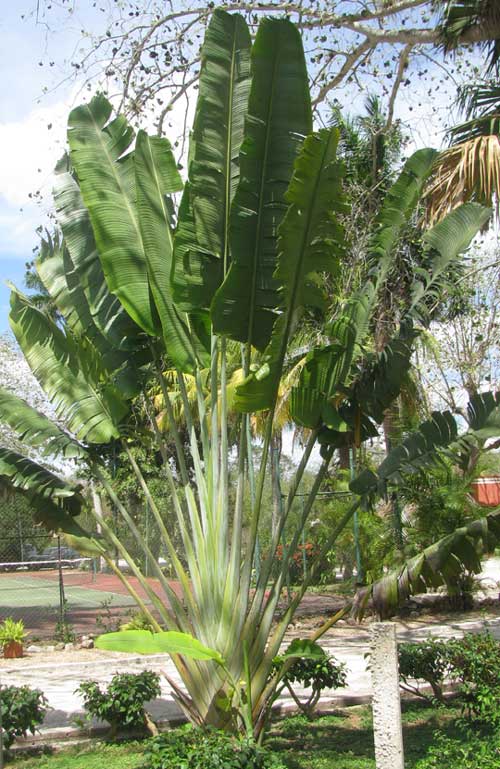
At a hotel across the road from the Hacienda you can see the, 20-ft-tall (6m), eye-catching plant shown at https://www.backyardnature.net/n/12/120325rv.jpg.
That plant is reminiscent of a banana tree, but notice how the leaves are arrayed in one plane, like feathers in a peacock's tail -- they're "distichous," botanists say. Leaves on Banana plants arise every which way -- they're "spirally arranged."
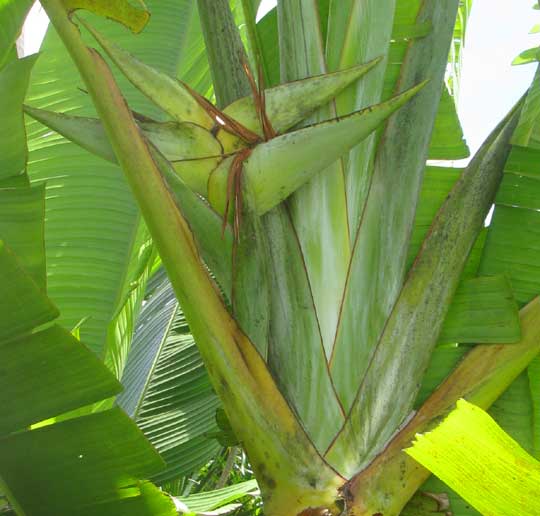
Our plant's flowers also are distichously arranged, as seen in the top, left quarter of the picture at https://www.backyardnature.net/n/12/120325rw.jpg.
Those of you familiar with gorgeous, southern-African Bird-of-Paradise plants will recognize that our mystery plant's flat inflorescence with stacked bracts from which flowers arise is very similar. In fact, Bird-of-Paradises and our present plant are both members of the Bird-of-Paradise Family, the Strelitziaceae.
Our pictures show a Traveler's Tree -- also called Traveler's Palm, though it's not palm -- RAVENALA MADAGASCARIENSIS, a native of Madagascar. The "traveler's" part of the name derives from the fact that thirsty travelers find rainwater pooling at the bases of the plant's petioles, which are U-shaped in cross-section, as well as in the horizontal, boat-shaped flower bracts. Also, there's a general tendency for the tree's fan of leaves to orient themselves east and west, thus providing a crude compass.
The plant in our picture is a young one. On mature plants the lower leaves and petioles die back and fall away exposing a sturdy, gray trunk.
Besides being one of the world's most exotic looking tree-sized plants, Traveler's Trees are so unique that they're the only species in their genus -- they're "monotypic." To a naturalist, meeting a monotypic species is always special, a time to pause and savor a "unique variation on the theme of living on Earth."
*****
FIJI FAN PALM
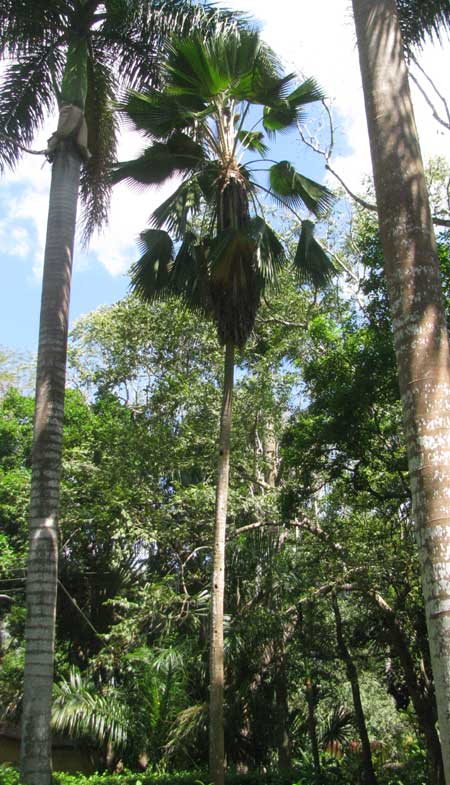
For 2-½ years the identity of a certain palm at Hacienda Chichen has eluded me, pricking me with twangs of frustration each day I walk by it. You can see it framed by the trunks of two big Royal Palms at https://www.backyardnature.net/n/12/120325pp.jpg.
You can see that it's a fan palm -- one with fan-shaped fronds -- as opposed to the world's majority of palm types with feather-like blades, or "pinnately divided" ones. At first I thought the palm was just a shade-stunted Huano, or Thatch Palm, very common here. However, the trunk is much slenderer and the fronds are much flatter, less deeply incised, and arise from much slenderer petioles.
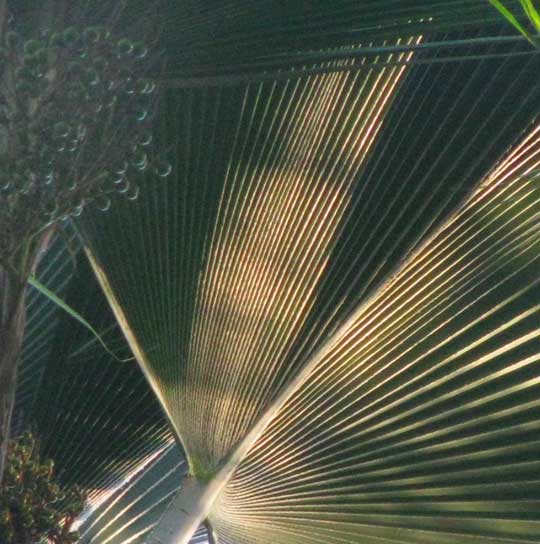
A feature separating blades of the Huano Palm from the similar Chit Palm, abundant along the Caribbean coast, is that the Huano frond's petiole extends as a diminishing midrib up into the frond, curling a bit at its end, and warping the frond downward. The minority of Fan-palms whose fronds have such curling midribs are said to be "costapalmate." Are our "shade-stunted" palm's fronds costapalmate? You can see that they are, with the petiole entering the picture at lower left, at https://www.backyardnature.net/n/12/120325pq.jpg.
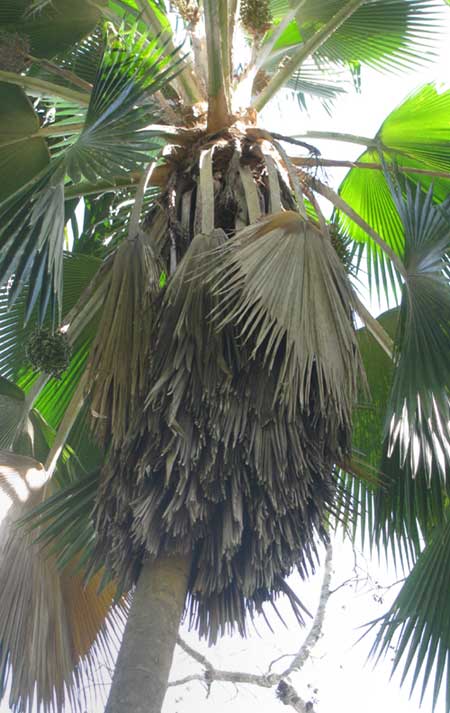
The costapalmateness was more evidence that the mystery palm was just a sun-starved Huano. However, other features just didn't match. For example, the mystery palm's old fronds tended to dry out, droop, and form a "shag skirt" below the fronds, as shown at https://www.backyardnature.net/n/12/120325ps.jpg.
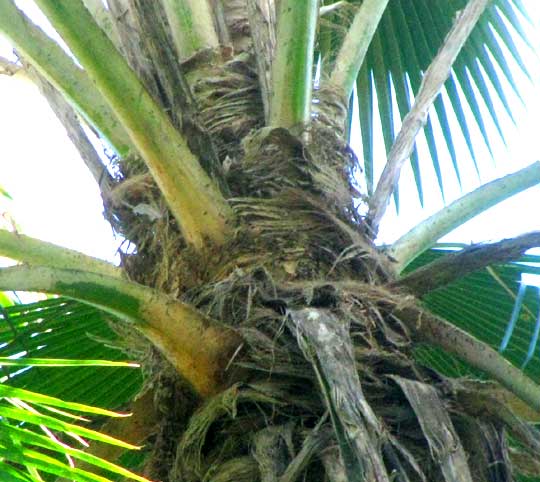
Huanos don't do that. Also, the bases of Huano frond petioles are broad and massive, and split down the middle. The shaded tree's petioles didn't split, seen at https://www.backyardnature.net/n/12/120325pm.jpg.
Moreover, you can see in that photo that petiole bases arise from a tangle of splitting, fibrous sheaths, which isn't the case with Huanos.
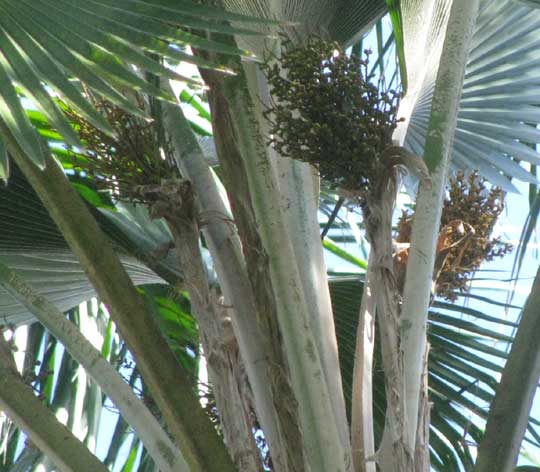
This week I noticed that the tree was fruiting, and that prompted me to try again at identification. This time I figured it out. You can see the fruit clusters at https://www.backyardnature.net/n/12/120325pr.jpg.
It's the Fiji Fan Palm, PRITCHARDIA PACIFICA, native to the Pacific islands of Tonga and Fiji, but planted in the tropics worldwide for its prettiness. I've seen it planted at another hacienda in the Yucatán, but I'd forgotten about it.
The genus Pritchardia contains 27 species, all native to Pacific islands. Hawaii is home to 22 species, of which eight are on the US Federal Endangered Species List. Pritchardias are closely related to our Huano Palms but distinguished from them by the field marks mentioned above. Pritchardia pacifica is the most frequently planted species of the genus.
Now that I know that our mystery palm is something different and special, and that it's the only one at the Hacienda, I'm struck by its handsomeness, and by how the wind causes its broad, stiff, kite-like blades to gyrate on their slender petioles.
Woodpeckers, by the way, prefer this palm's trunk over all others for drilling their nest holes.
*****
VARIATIONS ON THE CUSTARD-APPLE THEME
Already we've met three cultivated, small-tree species of the genus Annona, all producing deliciously sweet, creamy fruits about the size of apples or larger. Annonas, along with eastern North America's Pawpaws, are members of the Custard-Apple Family, the Annonaceae. In a general sense, members of the genus Annona are often referred to as custard-apples.
In Pisté, some time back we found one species of the genus Annona, the Soursop, or Guanábana, shown at https://www.backyardnature.net/yucatan/soursop.htm.
Also in the Yucatán, in the Maya village of Sabacché, we had the lumpy looking Sweetsop or Sugar-Apple shown at https://www.backyardnature.net/yucatan/sweetsop.htm.
In upland Chiapas we ran into the Cherimoya shown at https://www.backyardnature.net/chiapas/anona.htm.
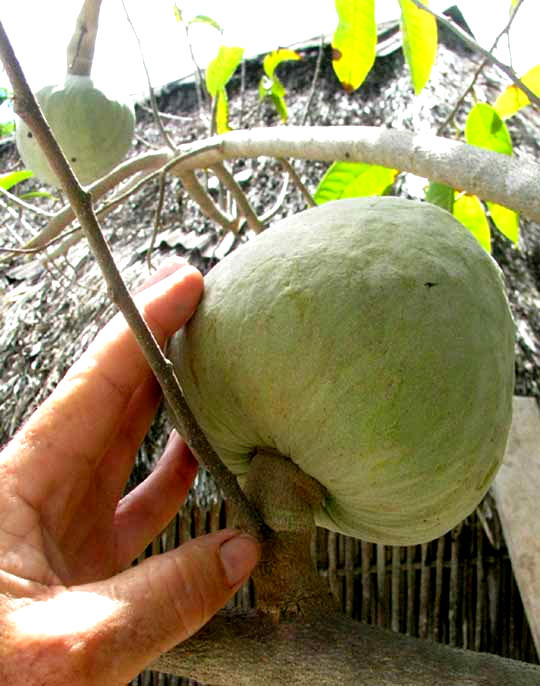
Now in Pisté a fourth custard-apple has turned up, one which folks here call Anona, and which books usually refer to as the Common Custard-Apple, or Bullocks-Heart. It's ANNONA RETICULATA, shown at https://www.backyardnature.net/n/12/120325an.jpg.
The Common Custard-Apple differs from the previous three Annona species by the fruit's smoother surface and spherical or heart-shaped form. It's so smooth that if you weren't looking for the more or less diamond-shaped bumps more obvious in the other species you might not notice them. Annona fruits are bumpy because they are "syncarp" fruits -- produced by flowers with more than one pistils, which merge together as the pistils mature. In Annona reticulata the pistils have merged so seamlessly that they're hardly recognizable in the mature fruit. The pattern on the fruit created by the merged pistils is referred to as "reticulation."
The Common Custard-Apple is thought to be native to most of tropical America, though now it's planted in the tropics worldwide, and in many countries its gone wild, or become "naturalized." Several cultivars are recognized, with fruit flesh varying from juicy and very aromatic to hard with a repulsive taste.
*****
ACHIOTE FRUITS
Hacienda Chichen's Chef Josué regularly offers guests cooking lessons. When the guests don't speak Spanish, I translate. Therefore, frequently during my time here I've described to visitors how to cook various traditional Maya dishes.
A surprising number of traditional Maya dishes require an orangish-red paste called recado rojo, or "red broth." Even in the little frutaría where I buy my bananas and oranges in Pisté they sell plastic-wrapped blocks of the moist, reddish paste. The paste's ingredients usually include Mexican Oregano, cumin, clove, cinnamon, black pepper, allspice, garlic, salt, and ground-up Achiote seeds. It's the orangish-red Achiote seeds that impart to "red broth" its redness, and contribute much to the broth's special taste.
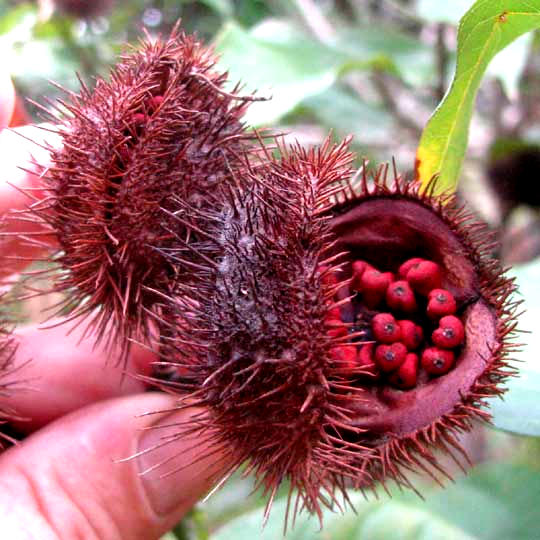
Achiote seeds are produced in spiny pods of the Achiote shrub or small tree, BIXA ORELLANA, in English often known as Annatto. In every Maya town Achiotes commonly grow around people's homes and along streets. Our Achiote page showing flowers and fruits is at https://www.backyardnature.net/yucatan/achiote.htm.
The other day a fruit was opening, about to drop its seeds, so necessary for "red broth." This is shown at https://www.backyardnature.net/n/12/120325ae.jpg.
*****
ORGANIC MATTER & THE MAYA
One feature of contemporary Maya life that continues to mystify me is that none of the Maya farmers I've known over the years -- here, in Chiapas, in upland Guatemala -- has used organic matter to maintain the richness of their soil. Traditionally the Maya use slash-and-burn agriculture. That's sustainable under low population densities, but at high levels it continually destroys soil structure, causing it to erode until little soil is left, and what is left is poor.
Comparable cultures in the Old World often use organic matter in sophisticated ways. They may compost, use mulch, plow under cover crops or fertilize with animal excreta. I read that in 50 BC Cleopatra made earthworms sacred after observing the effects of their presence on nearby plants.
So, why don't the Maya use organic matter? Did the Maya people's ancestors lose basic farming information as they crossed the Bering Strait or otherwise came into the Americas, or did they arrive before the value of organic was noticed in the Old World and the information just never filtered over here?
Agriculture involving domestication of plants and animals was developed at least 10,000 years ago. That's about the time the Mayas' ancestors may have crossed into the Americas, so... the issue remains unresolved.
*****
SILHOUETTE IN A FLAKE OF BARK
On our first day of spring it was 100° (38°C) in the shade. I sat in a quiet place thinking how, except for the heat, it was very like early autumn up North: Breezy, very dry and dusty, and leaves falling because of the advancing dry season.
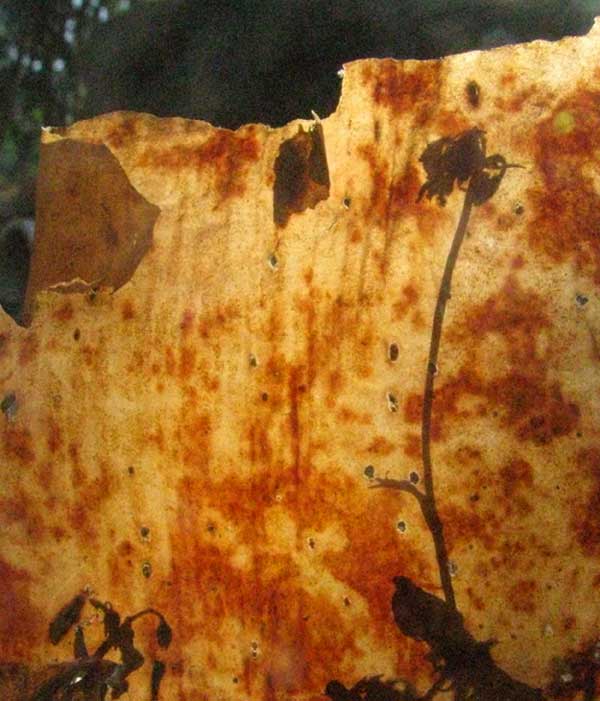
A hand-size flake of papery, peeling-off bark of Gumbo-Limbo tree had fallen onto the ground; a blade of grass propped it vertically so that sunlight shined through it, causing it to glow in an abstraction of warm yellows and russets. On the other side of the bark-flake stood the spent, dried-up remains of a little Callisia wildflower. The Callisia cast a shadow on the bark that on my side created a graceful silhouette.
You can see this, and maybe feel some of what I felt, at https://www.backyardnature.net/n/12/120325zz.jpg.
*****
LEAVING THE YUCATÁN
When I arrived at Hacienda Chichen in November of 2009, after a summer in the Siskiyou Mountains of southern Oregon, I figured I'd be lucky if I could stay here the whole winter, maybe six months. I didn't know then that I'd be so warmly and generously received, and that I'd like it so much -- that the owners even would build a traditional Maya hut and say that it was mine for as long as I wanted. During the last two and a half years I've had a good thing here, and I thank the Hacienda owners and staff for it.
The decision to leave such a beautiful place causes me to reexamine my wandering ways. It's true that I want to experience different plants and animals. However, you can always find interesting things to think and write about, even staying in one place, especially if you have a garden.
Nevertheless, periodically I ignite a "bomb" in my life by just up and leaving. In the new environment that settles around me I'm obliged to readapt myself and to examine details of my new everyday realities with utmost attention. I must call from myself resources I'd forgotten I had, or didn't even know existed. Somehow I feel that this is necessary for me; it resensitizes me to the world around me, helps me develop more penetrating spiritual insights, and basically helps me grow as an individual.
Is periodically setting off such life-bombs a good living strategy? One proof that it might be is that it mimics the strategy Nature Herself employs for evolving life on Earth toward ever more sophisticated life forms. At the core of Nature's strategy lies a surprising number of "bombs" -- global upheavals causing new evolutionary blossomings. For example, 65,000,000 years ago a comet, presumably, hit northwestern Yucatán, ending the Earth's Age of Dinosaurs. Immediately thereafter many new species exploded into existence, especially among mammals, setting the stage for the planet's current mammalian cerebral domination -- to thoughts and feelings made possible by humans' big brains. Similar explosive periods of speciation occurred after each of the six or so mass extinctions the Earth has experienced. My current leaving, then, is like that comet so full of destruction and promise plummeting toward the Yucatán...
That's the theory, anyway, or at least my rationalization. Monday when I get on the bus, hanging about will be many murmuring, questioning memory ghosts, and sweet but bruised fragrances of unfinished relationships.
However it goes, after all the bus traveling I'm about endure, I doubt that next weekend I'll be in any shape to issue a Newsletter.
Also, if anyone out there can suggest someone or someplace -- anyplace with plants and animals, and which can be bused to -- receptive to having a visitor like me who does the kind of things I do, let me know. I'm setting the bomb off tomorrow, Monday. Sometimes I can use help putting the pieces together again.
*****
Best wishes to all Newsletter readers,
Jim