March 11, 2012
HAIRSTREAKS
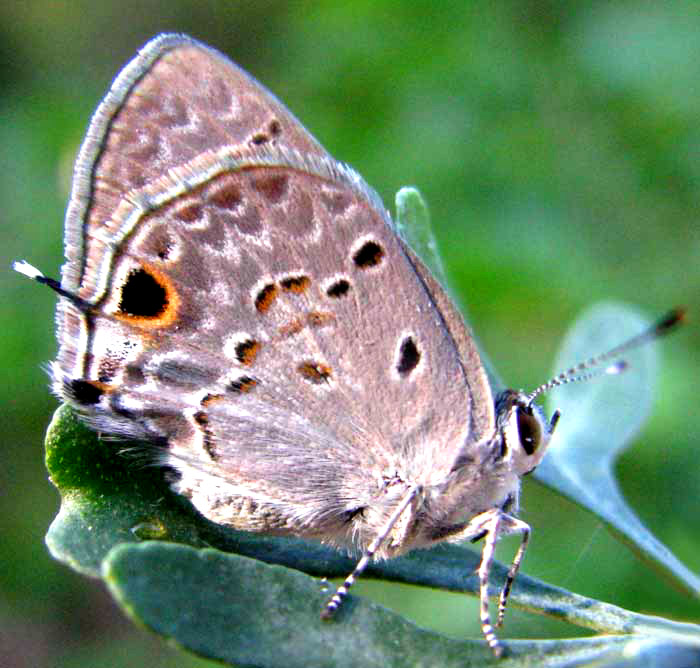
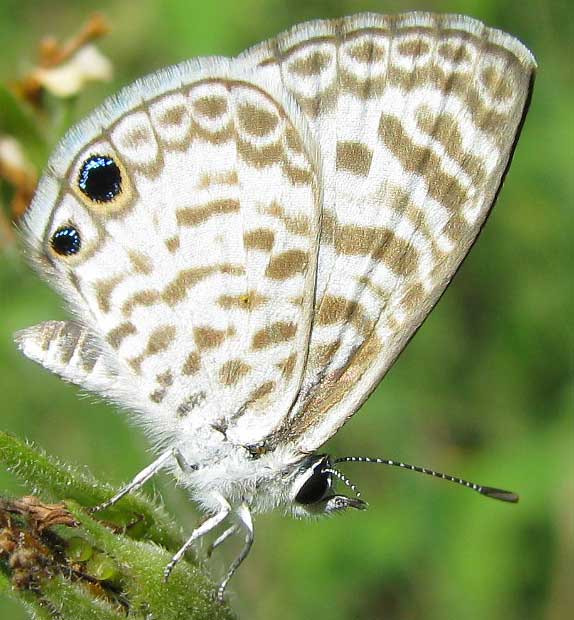
A norte passed through here early this week, a "cold front" that up North stirred up lots of storms and dumped plenty of rain and snow. On Tuesday morning here it was chillier than it had been for a long time, about 55° F (13° C), and maybe that's why on the Common Rue plant outside my door a small, grayish butterfly sat unmoving, as if stunned by the cold. A quick glance discovered him to be a hairstreak. There are many hairstreak species, however, so I looked more closely, and by golly he did look a little different from others I've seen. He's sitting on his Rue leaf at https://www.backyardnature.net/yucatan/mariposa/butt113.jpg.
You recognize this as a hairstreak because of his small size, his basic gray color, the "eyespot" at the back, and the "hair" projecting backward, arising near the eyespot. To a predator this combination of eyespot and "hair" may look like an eye with its adjacent antenna, thus causing the predator to attack the rear end instead of the more critical front. Often hairstreaks wiggle their "hairs" as if they were probing antennae.
Volunteer identifier Bea in Ontario pegs our Rue-perching butterfly as the Mallow Scrub-Hairstreak, STRYMON ISTAPA, apparently a relatively common species from Brazil north to the southern US border states. He lives in open, disturbed areas and second growth and his caterpillars eat members of the Hibiscus Family, which are abundant here.
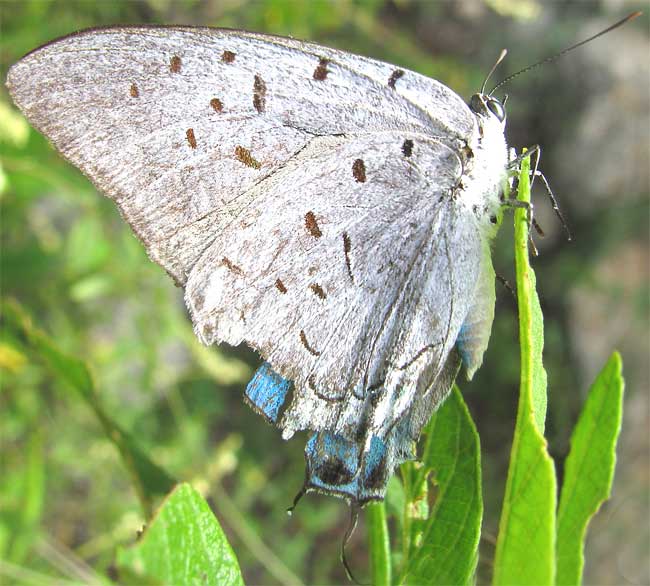
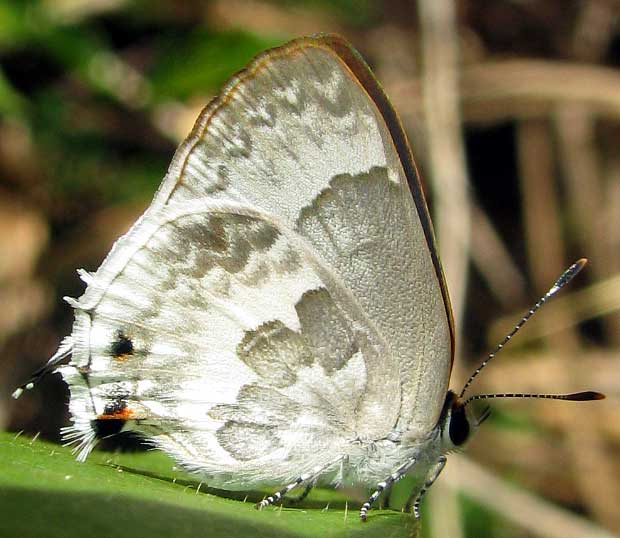
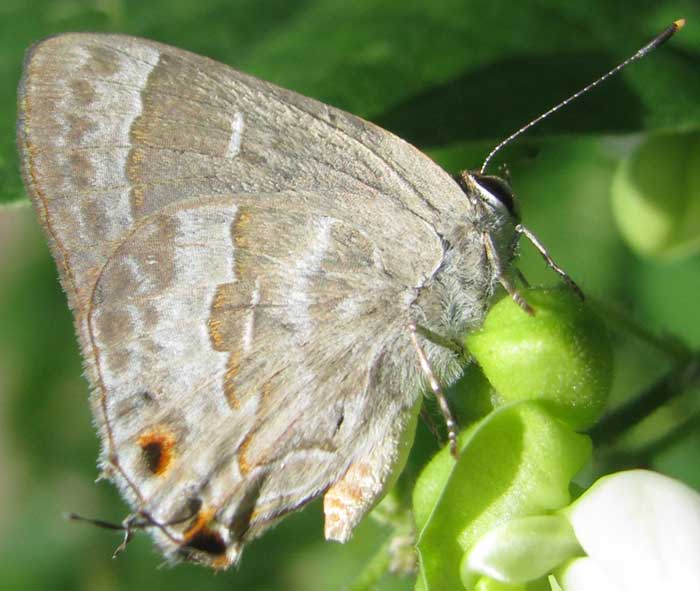
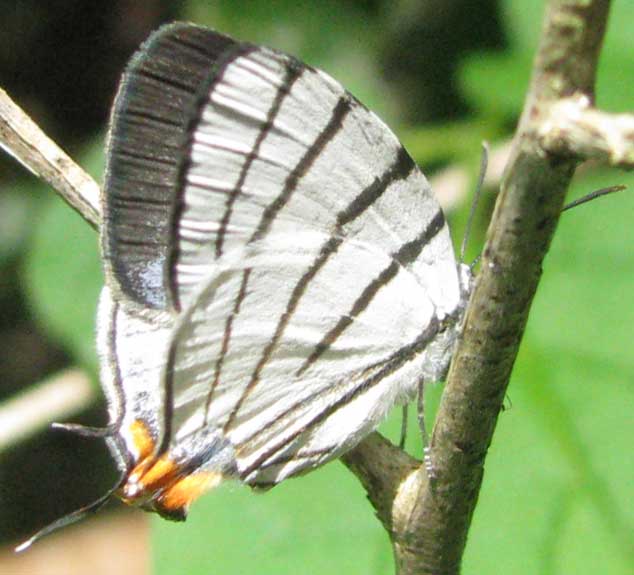
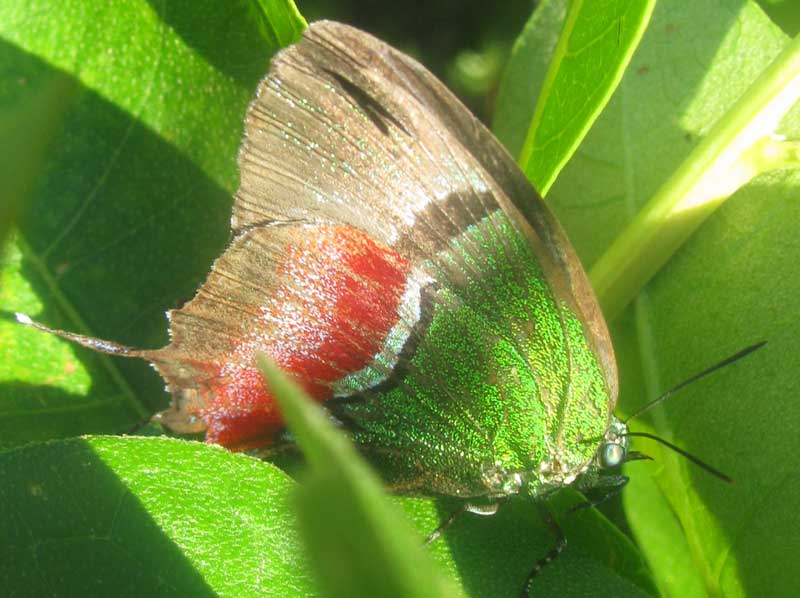
We've already documented five hairstreak species in the Yucatan, all with "hairs" pointing backwards and only one lacking eyespots. You might enjoy comparing our earlier finds with this one, just for the pleasure of seeing how Nature can fugue "variations on a hairstreak theme."
The Sky-blue Hairstreak can be seen at https://www.backyardnature.net/yucatan/mariposa/butt013.jpg.
The White Scrub-Hairstreak is pictured at https://www.backyardnature.net/yucatan/mariposa/butt026.jpg.
The Yojoa Scrub-Hairstreak is shown at https://www.backyardnature.net/yucatan/mariposa/butt107.jpg.
The Fine-lined Hairstreak appears at https://www.backyardnature.net/yucatan/mariposa/butt108.jpg.
And the Regal Hairstreak, without an eyespot, is at https://www.backyardnature.net/yucatan/mariposa/butt089.jpg.
Tropical hairstreaks often are iridescent blue above, the iridescence caused by wing scale structure, not by pigment in the wing.
Hairstreaks belong to the Gossamerwing Family of butterflies, the Lycaenidae, and the Hairstreak Subfamily, the Theclinae. About 237 members of the Hairstreak Family are listed for Mexico, so our six species are just a tiny sampling. Members of the Blues Subfamily, the Polyommatinae, also in the Gossamerwing Family (about 26 species in Mexico), are very similar, but typically lack the "hair." For example, you can see our eyespotted but tailless Cassius Blue at https://www.backyardnature.net/yucatan/mariposa/butt008.jpg.
*****
VARIEGATED SCREW PINE
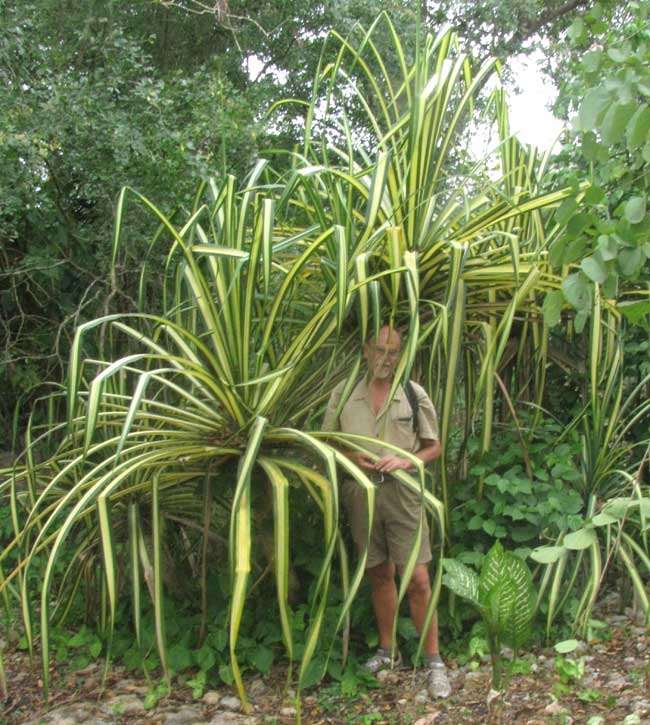
Roaming in a forgotten corner of the Hacienda I came upon the 12-ft-tall (3.7m), variegated plant shown at https://www.backyardnature.net/n/12/120311pa.jpg.
I'd seen this particular plant before but it had never been flowering or fruiting. I'd figured it was some kind of stemmed lily or amaryllis that more easily could be identified later when it flowered, but it never flowered, and I'd forgotten about it. However, this week when I saw it I recalled the big Pandanus "screw pine" we looked at last month, profiled at https://www.backyardnature.net/yucatan/pandanus.htm.
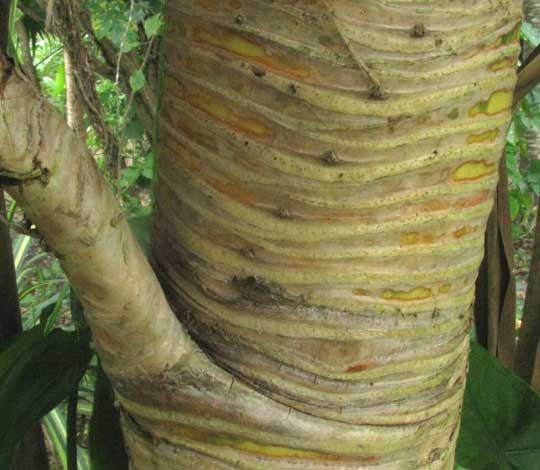
Now in this variegated plant I recognized certain screw pine features. For example, neither of the two species seems to flower here. Both species bore long, thin, stiff leaves, and both sprout their leaves from atop thick stems. Also, the stems of both species are heavily scored with narrow, close-together, horizontal leaf scars left by shed leaves. Our variegated plant's stem, with a branch arising on the left, is shown at https://www.backyardnature.net/n/12/120311pc.jpg.
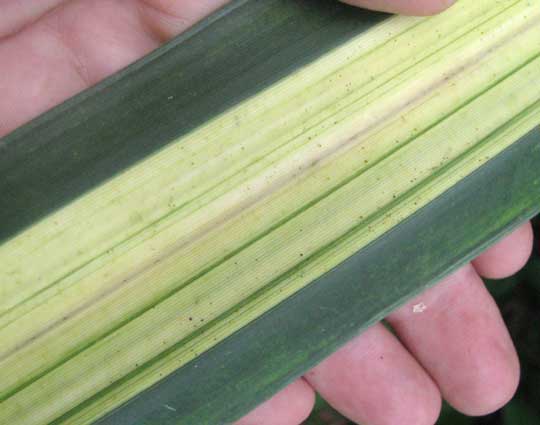
However, the leaf margins of our February screw pine were armed with very tough, sharp spines, while blade margins on our current species bore none, as shown at https://www.backyardnature.net/n/12/120311pb.jpg.
Still, I suspected that we had yet another species of screw pine here, and a little Internet time confirmed it: Here we have what's often called the Variegated Screw Pine, PANDANUS SANDERI, originally from tropical Asia but now planted worldwide in the tropics.
As was the case with February's screw pine (Pandanus veitchii), our second discovery, P. sanderi, has nothing to do with pines and very little to do with screwing. Sometimes leaves arise from stems in a noticeably spiraling fashion, so that's the screwing they do. The pine part may arise from the roundish, bumpy fruits produced by Pandanus species, which are vaguely similar to pinecones.
Screw Pines belong to the Screw-Pine Family, the Pandanaceae, native to the Old World tropics.
*****
DIPHYSA SHRUB
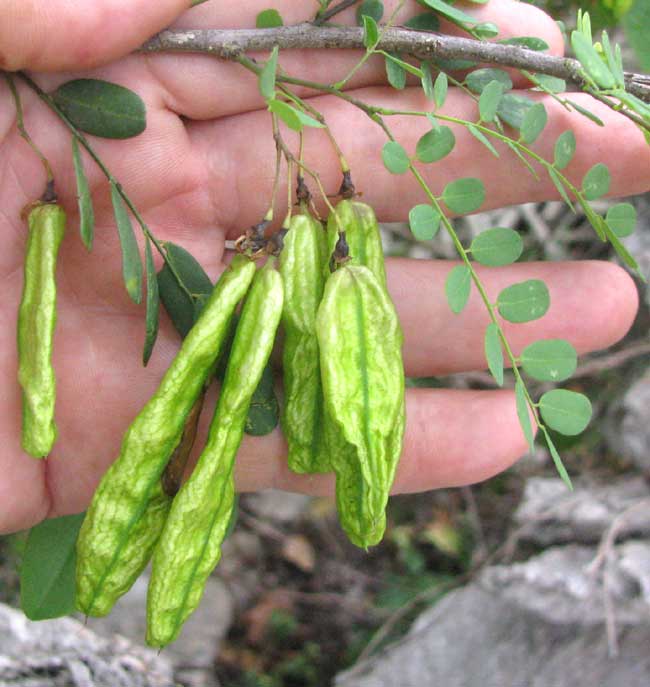
Typically if you see the fruit, or bean-bearing legume, of a member of the ubiquitous Bean Family, you recognize right off what you're seeing. However, there's a Bean Family member fruiting here nowadays whose fruits don't look like legumes. They're shown at https://www.backyardnature.net/n/12/120311dp.jpg.
Those legumes are "inflated," or bladder-like, with the beans suspended inside them. At least the leaves look right for the Bean Family, a bit like North America's Black Locust leaves.
This is DIPHYSA CARTHAGENENSIS, found from southern Mexico to northern South America. There is no good English name for it, though the Maya, with their eye for the unusual, have several.
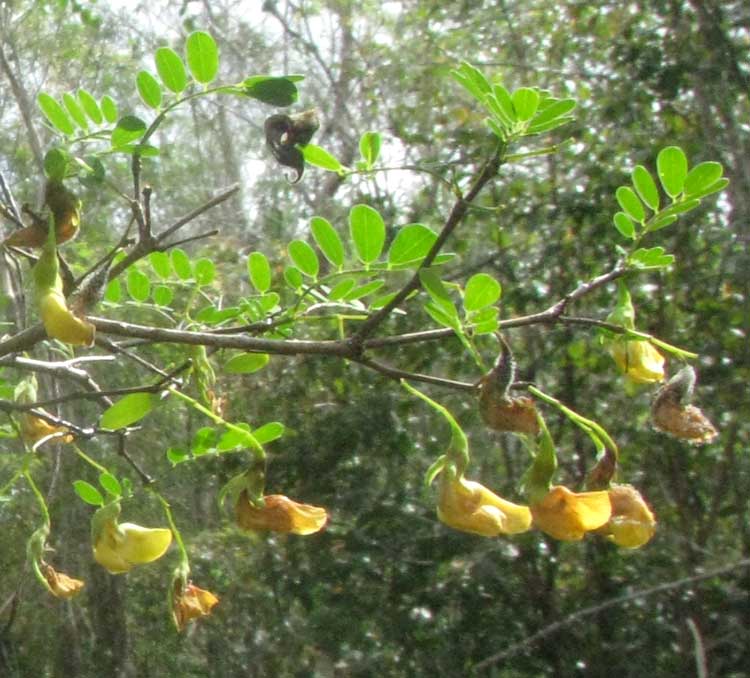
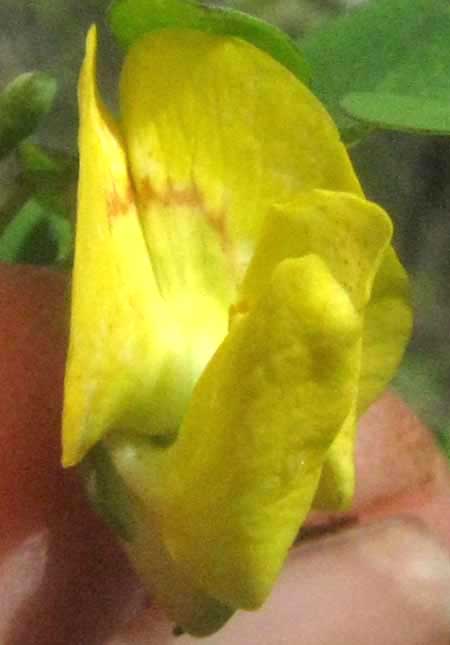
It happens that last February I photographed the shrub's flowers but was unable to identify them. You can see the interesting way the yellow blossoms hang at https://www.backyardnature.net/n/12/120311dq.jpg.
And a front view of an individual blossom is shown at https://www.backyardnature.net/n/12/120311dr.jpg.
The online, free Atlas de las Plantas de la Medicina Tradicional Mexicana reports that the main medicinal use for the species is against respiratory ailments, but also it says that in some places a cataplasm is made of the leaves to heal wounds and inflammations. Sometimes infusions of its leaves are used against fevers. Inhaling the air off freshly macerated leaves prevents motion sickness. In some places drinking water in which ground bark has been steeped is used against snakebite, but here in the Yucatán the same concoction is used for dysentery.
As so often is the case with these medicinal herbs, the reported uses are so varied and inconsistent with one another that you suspect the efficacy of them all. The Atlas comments on the lack of experimental data to back up the claims.
*****
PURSLANE'S TINY BOWLS
Last summer down at Marcia's on the coast we ate quite a lot of Purslane, PORTULACA OLEARACEAE, whose pictures and culinary notes are still available at https://www.backyardnature.net/yucatan/purslane.htm.
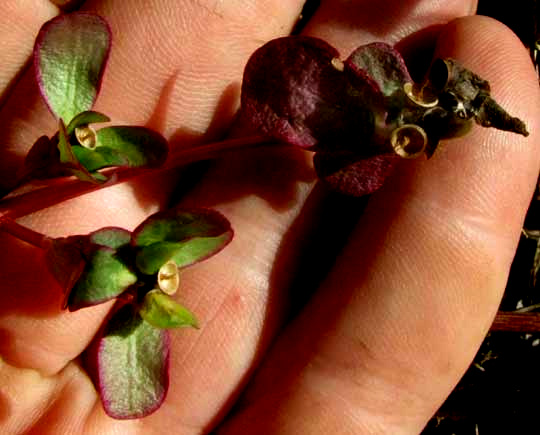
Now that the dry season is starting to bite, even semisucculent Purslane is dying back. You can see a sprout losing its greenness and withering at https://www.backyardnature.net/n/12/120311po.jpg.
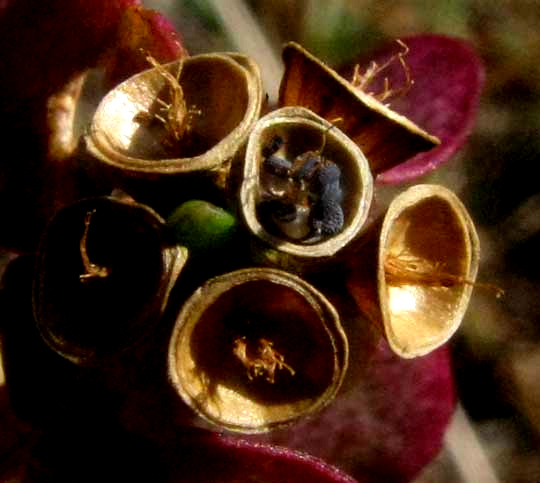
Normally one wouldn't bother to look at such a weather-beaten sprout, but I did, and what caught my eye were those pale little bowl-shaped things nestled among the withering leaves' bases. A close-up is at https://www.backyardnature.net/n/12/120311pn.jpg.
There you see the bottoms of some fruit pods, with the central pod holding several black, warty seeds. The tufts of slender items arising from the bottom of each fruit base are placenta-like funiculi which earlier connected the seeds with their ovary walls.
What's interesting about Purslane's fruit pod is that it splits around its equator, not between the fruit's base and tip as with most other fruits. Fruits opening this way are said to be "circumscissile." Once the fruit is mature, the top comes off like a pointed hat, leaving a "bowl" of seeds exactly as the picture shows.
What's the advantage of having a circumscissile fruit that creates a tiny bowl filled with seeds? I'm guessing that it's to facilitate seed dispersal by raindrops. A raindrop hitting inside the bowl would splash seeds in all directions.
*****
GRAPEFRUIT FLOWERS
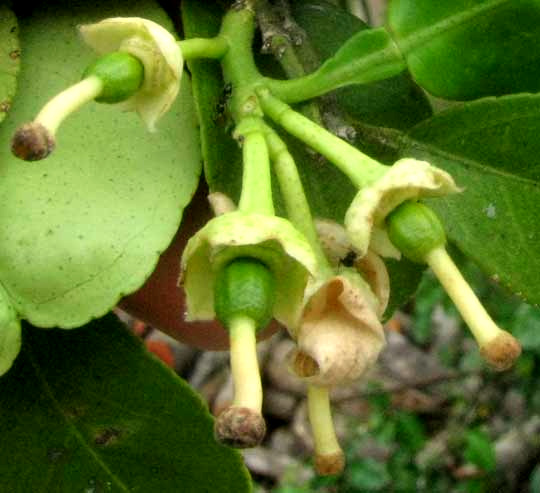
Wandering through the nearby little Maya town of Libre Union last Sunday we came upon the blossoms shown at https://www.backyardnature.net/n/12/120311gf.jpg.
As indicated by the "winged petiole" of the leaf in the picture's upper right corner, this is obviously the flower of some kind of citrus species; neighbors sitting nearby on their rock fence told me the tree was a Grapefruit.
The flowers are past their prime, for their waxy-white corollas and stamens have fallen off, leaving in each blossom only a large, cuplike calyx, in the center of which arises a green, fast enlarging ovary, atop which arises a surprisingly thick style tipped with a large, blunt, brown stigma.
*****
LEAF-STAMENS
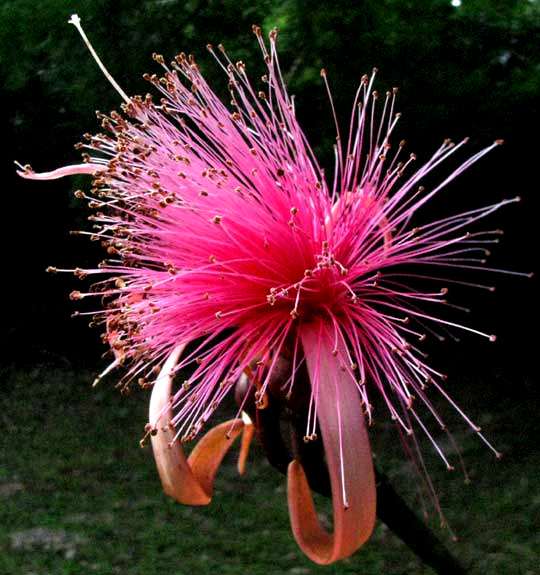
On my afternoon plant-walks around the Hacienda one tree most visitors want to know about is one that's entirely leafless now, but at the tip of many of its unusually thick twigs there arise large, pink blossoms composed of many four-inch-long (10cm) stamens. It's the Amapola, profiled on our page at https://www.backyardnature.net/mexnat/amapola.htm.
The other day an open flower was low enough for us to take a good look at its anatomy. It's shown at https://www.backyardnature.net/n/12/120311hc.jpg.
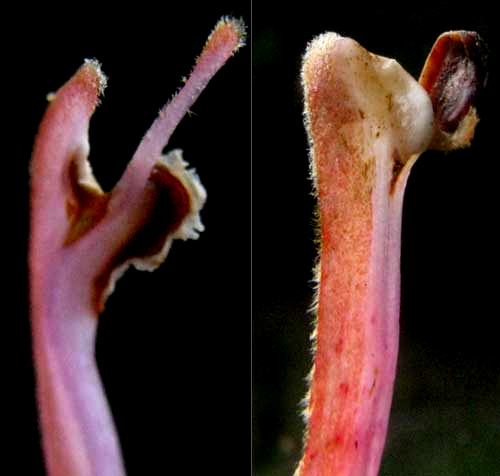
In that picture, notice the white style -- the slender part connecting the stigma with the top of the female ovary -- projecting beyond the stamens toward the picture's top, left corner. Below that style something a little thicker, somewhat curvy and nearly as long as the style also emerges from among the stamens, so what's that? In fact, that particular flower bore two such items. The tips of both of them are shown at https://www.backyardnature.net/n/12/120311hd.jpg.
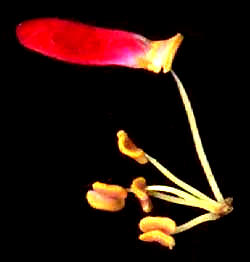
In a sense, these two items are mistakes made by the flower, at the genetic level. For, during the course of evolution, flower parts arose from pre-existing leaves. It's easy to imagine how leaves where modified to create the green calyx subtending most flowers, and from green calyxes it's easy to visualize colorful petals being formed. A flower's male and female parts similarly have leaf ancestors. As one expert expresses it, "... petals are essentially colored leaves, and the stamens ... are essentially petals/leaves with pollen-making chambers on the ends."
Consequently, much of the genetic coding a flowering plant needs to produce a stamen consists of recycled petal-producing coding, and much of that petal-producing coding is recycled leaf-producing coding.
The things in our picture are half-formed stamens -- half flower petal, half stamen. The left sides of both things are mostly petal, but on the right sides at the tops there are anther sacs in which pollen might be produced. Amapola anthers consist of two anther sacs with fleshy connective tissue between them. In the picture, on the malformed stamen at the left, the fingerlike extension arising to the left of the anther sac is connective tissue.
Apparently as certain embryonic cells in the Amapola's flower bud were "reading the coding" to make their stamens, about three-quarters of the way through the process something happened causing the last part of the stamen-making coding to become unavailable or lost. They got through the first part -- "how to make a petal" -- but got only halfway through the part on "how to make a stamen out of a petal."
Horticulturalists find this situation useful for creating "double-blossomed flowers." They selectively breed for plants whose flowers, when decoding genetic information for forming stamens, suffer decoding breakdowns partway through the process, so that petals form where stamens are expected. This happens a lot in rose blossoms. You can see a picture from my website showing a rose's half-petal/half-stamen at https://www.backyardnature.net/pix/rose2.jpg.
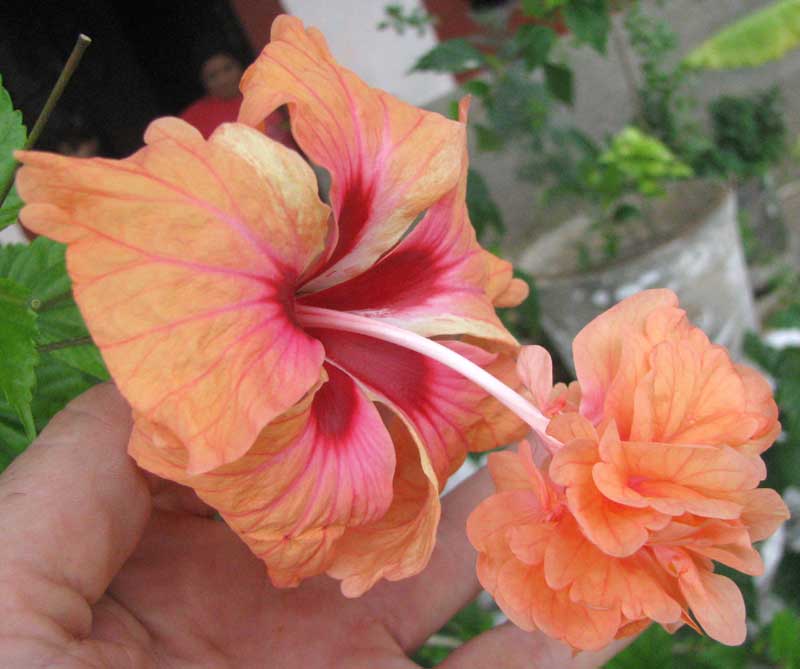
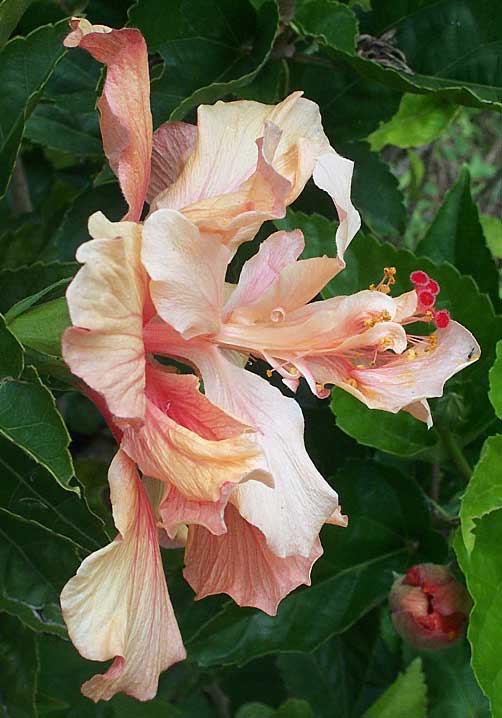
Last Sunday while exploring the nearby little Maya town of Libre Union we found the hibiscus flower shown at https://www.backyardnature.net/n/12/120311hb.jpg.
In hibiscus blossoms normally many stamens cluster at the end of the long, white tube that in our picture extends toward the lower, right corner. In this blossom, petals formed where stamens should have been. You may remember such a flower encountered in Chiapas in which only a few of the stamens manifested themselves as petals. A picture of that flower is at https://www.backyardnature.net/chiapas/rosechin.jpg.
*****
TOMATO DISASTER
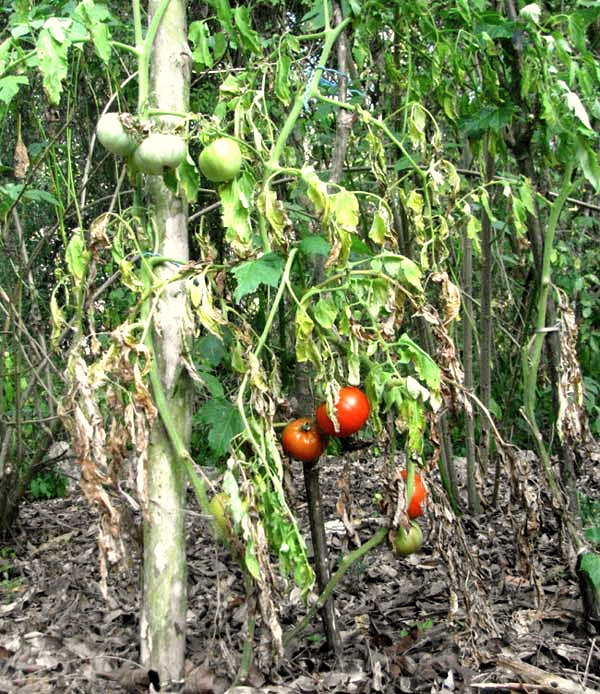
My glorious tomato vines, now over seven feet high, (2m) are dying. You can see what one vine looks like at https://www.backyardnature.net/n/12/120311tt.jpg.
I knew I had trouble two weeks ago when suddenly the vines' upper leaves wilted as if the plants needed watering, though I watered them well each day. Last week the vines' lowest leaves began turning yellow, then quickly became dry and brown, and began falling off. Now all the leaves on the vines' lower half are dead and it's clear that the whole vines soon will die.
Tomato plants are subject to various wilting diseases, so on the Internet I studied their symptoms closely. The fungal diseases of Verticillium Wilt and Fusarium Wilt both cause symptoms just like I've described. However, Verticillium Wilt appears to favor cooler climes, and a symptom of both Verticillium and Fusarium Wilts is that the piths of stems of sick plants at ground level discolor brown. The piths of my dying plants looked healthily white.
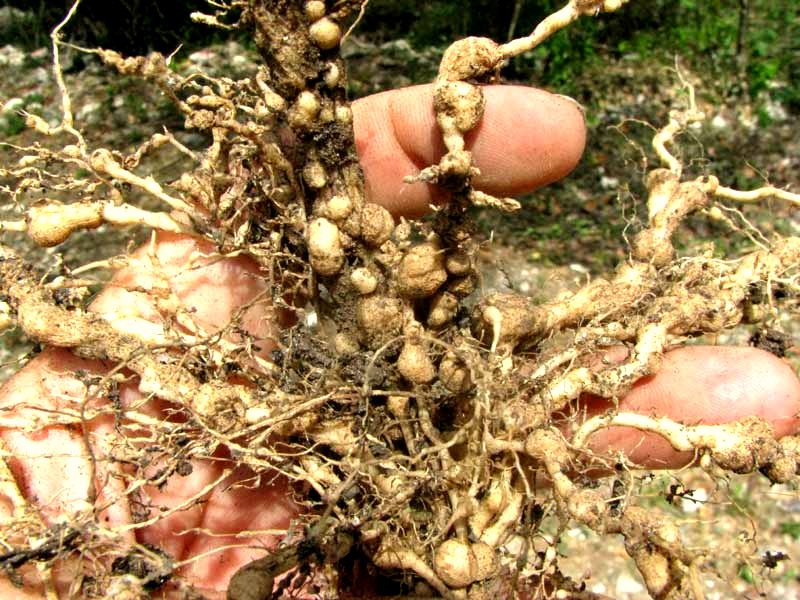
But uprooting a plant to cut into its stem to see what color its pith was enabled me to see what's shown at https://www.backyardnature.net/n/12/120311tu.jpg.
Nematodes! A tomato's roots are supposed to be slender and much branched into fine rootlets, but just look at how these roots are thick and gnarly with swellings. I recognized the growths as the work of nematodes because in 2010 soon after arriving at the Hacienda I tried to grow tomatoes, but nematodes killed them all. This year, remembering that debacle, I germinated and potted the plants in soil from where the gardeners had burned a pile of brush, thus surely sterilizing the soil, and similarly the seedlings were planted where previously an even bigger brush pile had been burned. These nematodes are tougher than I thought! And the Hacienda must be nematode paradise.
The afternoon of the morning after the picture of my ripe tomatoes was taken, birds hollowed out my prizes. So there's something to think about even if your plants don't succumb to nematodes.
*****
MY GARDENING EXPERIENCES IN THE YUCATÁN
This may be a good time to give a brief review of my gardening experiences in the Yucatán.
During the rainy season (late May to November) few plants Northerners think of as traditional garden occupants will survive here long enough to produce except chili peppers, basil, cilantro and a few others. If you want to garden during the rainy season, use traditional Maya milpa seeds of corn, beans, squash, peppers and what the Maya call "pepino," which actually is a very large, cucumber-like squash. Northern squash and cucumber varieties won't survive. Also the Maya grow chives, which they call cebollín, and radishes. Traditional milpa plants are resistant to diseases caused by fungal spores that fairly saturate the rainy season's hot, humid air.
During the dry season (December to early May) many Northern garden plants can be grown if you have soil that isn't full of disease organisms, if you can defend the plants against a large selection of animals, and if you can water the plants regularly. I've had great luck with leaf lettuce of various kinds. Soil in the Yucatán, however, usually is thin and low in organic matter. There's red soil and black soil. Black soil has more organic matter in it and thus holds moisture and nutrients better, and has better tilth, so it can be worked.
If you have a greenhouse and assiduously guard against introducing disease organisms and insects into it, you can have lots of fun. Hydroponic gardening has potential in the Yucatán because of the availability of abundant, naturally filtered underground water and the year-round heat and sunlight.
*****
WIND SINGING
I suppose that on the coast, down at Marcia's where we spent the last rainy season, wind blows off the Caribbean all the time now, day and night. Here it's been breezy lately, too, though not like there. Most of the year the only wind here is what's associated with rainy-season afternoon storms or the dry-season weather fronts we call nortes.
This is a different kind of wind, though. It's part of that big change that happens early each year when the Sun on its daily path across the sky starts rising high enough to banish the North's winter, and to set the stage for our rainy season. The breezes we're having nowadays, then, aren't local or even regional, but rather the work of a majestic planetary adjustment. Maybe that's why this wind, of all winds, to me is the most transcendent, the wind most likely to set me to watching it, thinking about it, and feeling it.
How delicious to lie inside the mosquito net in the hut, deep in the night or maybe during a sweaty mid-day siesta, when suddenly an unusually assertive, vagrant breeze rustles the roof's thatched fringe all around, causes the mosquito net's walls to billow or lean against my side, and cool air to ripple across my body.
Sometimes the billowing netting reminds me of the kites kids are flying nowadays in every village, homemade kites not bearing gaudy pictures of rockets or spiky stars on them, but maybe the kid's own drawings, and maybe with cut-paper fringes that flutter in the wind, and maybe the kite has a knotty cloth tail that circles when the kite loops. Some people are like kites, I think, thinking about kites, in that they're always resisting life's wind and in doing so are thus destined to endless gyrations, soaring and diving and, inevitably, the come-downs, or crashes. Better to be the wind itself, I think, thinking about kites.
The other day for a few seconds a breeze rustled the thatch, blew the netting to one side and even stirred dust from my dirt floor. The commotion roused me from an early afternoon siesta. Rising onto my elbows, through spaces between the hut's wall-polls I saw the little birdbath beneath the Tree Cotton outside my door. A Melodious Blackbird perched on a rock in the water, his feathers ruffled and wet after bathing, and he was looking around at the wind. Looking at the wind, feeling it on his wet skin beneath sodden feathers, on his moist eyes, seeing the Tree Cotton's leaves shake, the pink Cosmoses beside him heave, and I thought how beautiful it must be being a blackbird in the wind.
The Clay-colored Robins were singing then, too, their chiming, echoic, monotonously repetitive phrases some kind of sweet, hypnotic lullaby, their singing mingled with the rustling wind, and I thought about the robins silhouetted deep in shadows among leaves alive with the wind, the robins singing into the wind.
I would like to sing into the wind, but I haven't the voice for it. I try to do it metaphorically, I guess. In fact, I like to think that these words issued into cyberspace are my windsong. The thoughts formless, like the wind, not rooting anyplace, mental images swirling around insinuating themselves into random reality-crevices, not really having any meaning at all, just being, just flowing, finally calming down to nothingness.
*****
Best wishes to all Newsletter readers,
Jim