January 29, 2012
COTTON STAINERS
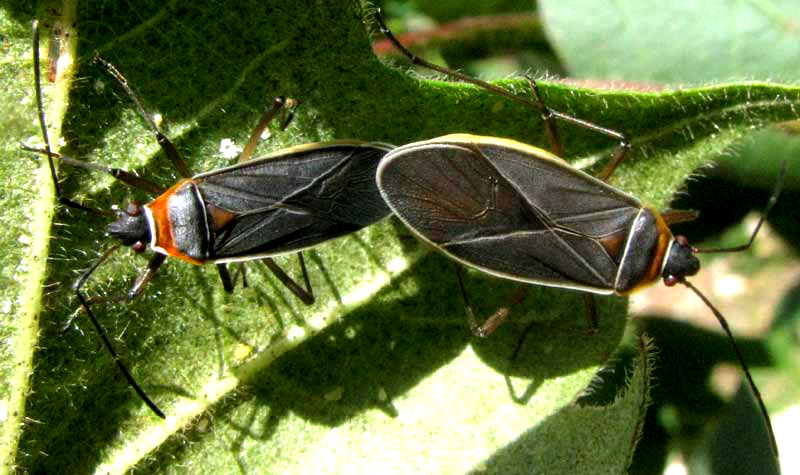
One morning this week while ducking beneath the Tree Cotton limb arching over the hut's path, I noticed a bug on a cotton leaf. Then another. And another and another, and then many, and most were joined together mating end-to-end. There were dozens of these bugs where just the day before I hadn't noticed a single one. Two copulating on a Tree Cotton leaf are shown at https://www.backyardnature.net/n/12/120129bg.jpg.
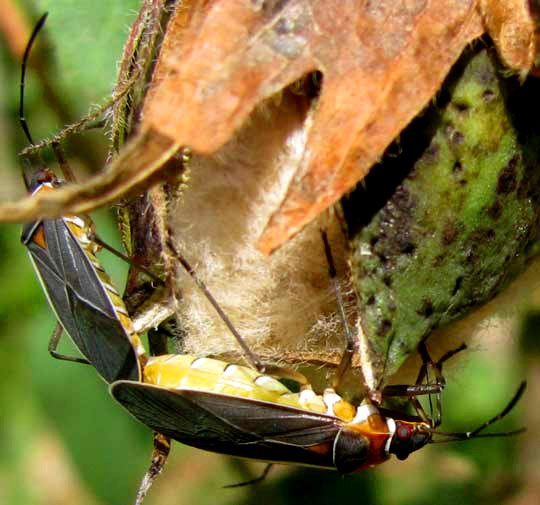
You can see that these are "true bugs," members of the Order Hemiptera, because the bases of their front pair of wings are thickened and leathery, while behind the thick parts the exposed wing surfaces are thin like black, veiny cellophane. Other "true bugs" include cicadas, hoppers and aphids. True bugs have "piercing" not "chewing" mouthparts. A female with her swollen abdomen, presumably displaying the afterworkings of extended sex, is shown poking her slender, straw-like proboscis into a dehiscing cotton bole at https://www.backyardnature.net/n/12/120129bh.jpg.
Snowbound volunteer identifier Bea in Ontario was glad to pounce on this summery challenge, but immediately recognizing the bug's order and knowing that it was part of an outbreak on my cotton, it didn't take much artful search-engine usage to come up with a verdict: Here we have DYSDERCUS MIMULUS, a member of the Family Pyrrhocoridae. Sometimes that family is referred to as the Red Bug Family, its red bugs being different from the US South's itch-causing Redbugs, also known as Chiggers.
Members of the genus Dysdercus are further sometimes called Cotton Stainers. In some parts of the world a member of that genus other than our D. mimulus, one much redder than ours, is famous for plaguing cotton, citrus and other plants. When that species punctures the developing bolls of cotton it introduces a fungus that "stains" the cotton fiber.
Thus, our Dysdercus mimulus can be called Cotton Stainer in a general sense, because it's a member of the Cotton Stainer genus Dysdercus, but, really, it just doesn't have an English name only for itself.
A day or two after our pictures were taken I was showing around some English visitors when we noticed Cotton Stainers on the flowering hibiscuses. Then it occurred to me: Of course Cotton Stainers would be attracted to hibiscuses, for cotton and hibiscus plants belong to the same Hibiscus Family, the Malvaceae.
There must be a chemical common to many or all Hibiscus Family members that wildly attracts and sexually arouses our little Cotton Stainers, which continue roaming over my Tree Cotton bushes, still mating, even on this Sunday morning.
*****
A BIG, TERRESTRIAL ORCHID
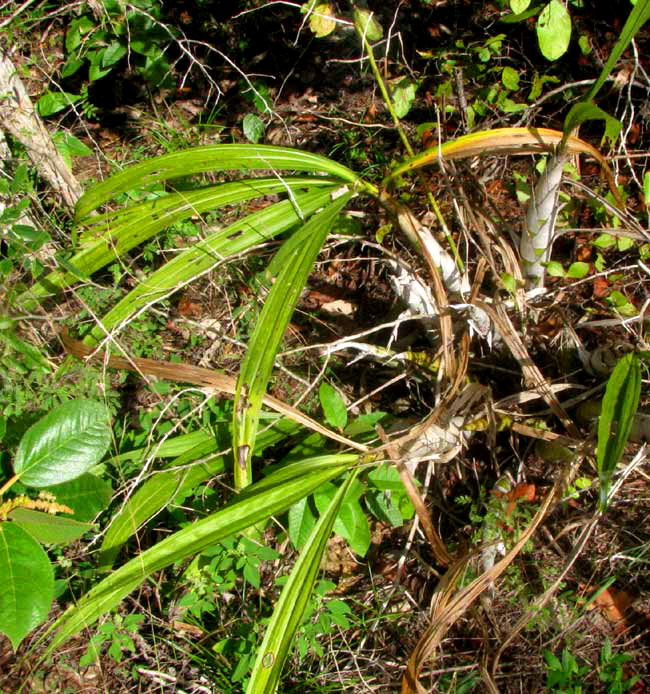
Along a dirt trail through the scrub just north of Pisté I came upon the knee-high orchid shown at https://www.backyardnature.net/n/12/120129cy.jpg.
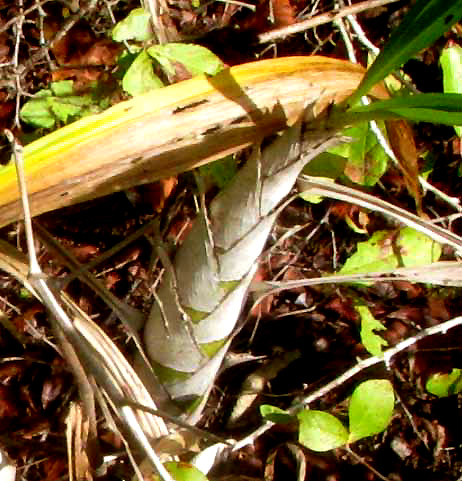
At first I thought it was a fallen Catasetum integerrimum, our most common orchid species, even though that orchid is much smaller, seldom falls from its host tree, and both its leaves and pseudopods (succulent stem swellings below the leaves, scaly-white in the picture) are shorter and broader. But the triangular, white scales on this orchid's pseudopods are really striking, unlike anything I've ever seen on a Catasetum. A closer look at them, revealing them to be the petiole bases of faded, discarded leaves, is at https://www.backyardnature.net/n/12/120129cz.jpg.
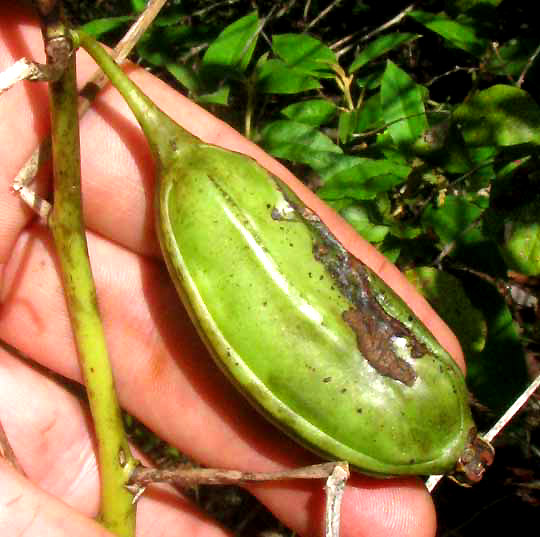
A 2-1/3-inch long (6cm), capsular fruit hung from a panicle branch rising above the plant. It's shown at https://www.backyardnature.net/n/12/120129c_.jpg.
On the Internet it was easy to identify such a singular orchid. It's CYRTOPODIUM MACROBULBON, known to occur here, but still there's little information about it, other than that it's terrestrial and seems to occur spottily from Mexico through Central America into northern South America.
Internet pictures show pseudobulbs from which the white scales have fallen leaving horizontal rings around the green pseudobulbs. Sometimes numerous flowerless, fruitless and leafless pseudobulbs poke from bare ground like clusters of thick cigars standing on their ends.
I've not seen this species before, and it was the only plant in the area. Its inflorescence was large and diffuse with thumbnail-size flowers. You can see someone else's page showing flowers at http://www.abundaflora.com/Cyrt_macrobulbon.htm.
How would it be to be such a lonely, flamboyant being deep in the Yucatán scrub? How would it be to be a Maya farmer hiking down the trail with a sack of corn on his shoulders, pausing to see this plant in flower right there beside his way?
*****
THE GARCIA TREE
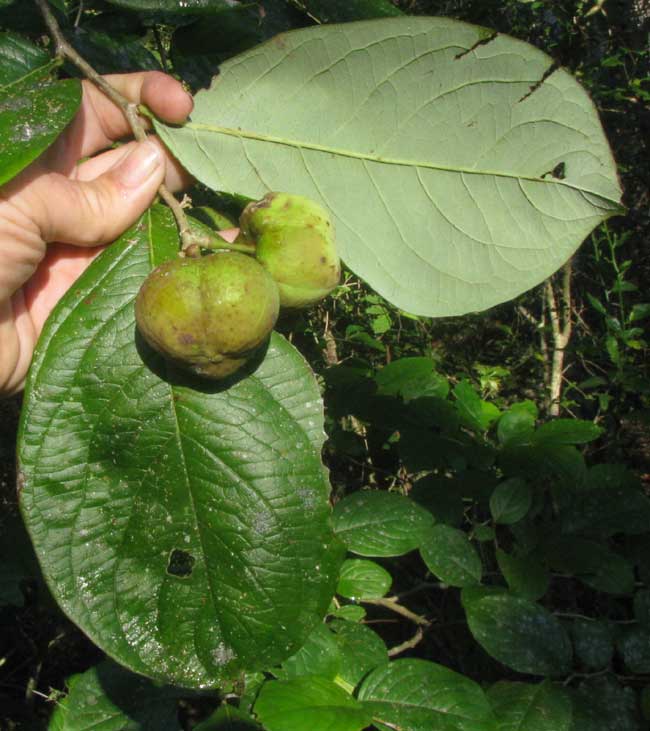
After over two years of being here, not over a hundred yards (meters) from the hut, a tree species has turned up that's new to me. Not only have I never seen the species before, but I've never seen anything in its family. For me it's an exciting discovery. It's about 12 feet tall (3.7m) and is fruiting. You can see the tree's three-parted, drupe-type fruits and broad leaves that are much lighter below than above at https://www.backyardnature.net/n/12/120129di.jpg.
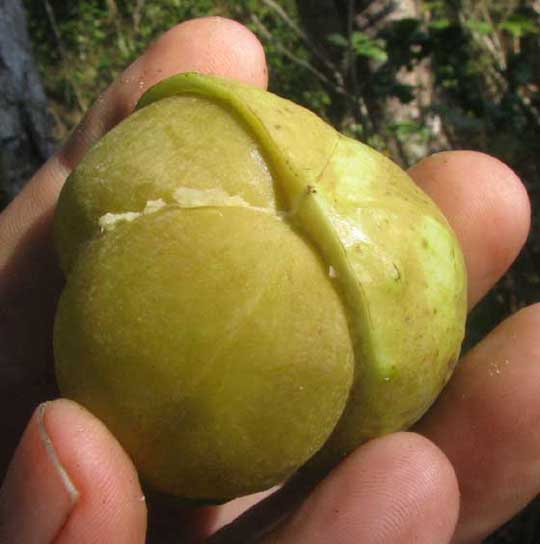
A fruit displaying its thin, dry and fairly hard husk is at https://www.backyardnature.net/n/12/120129dh.jpg.
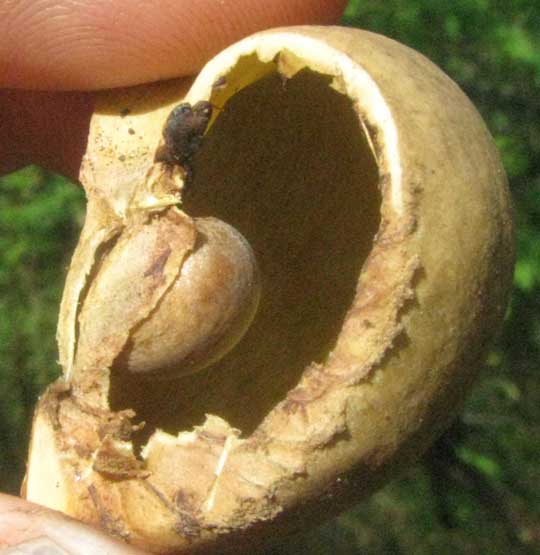
The brittle, dry drupe is divided into three hollow compartments, or carpels. In each carpel two dry seeds hang suspended in otherwise empty chambers as shown at https://www.backyardnature.net/n/12/120129dj.jpg.
Seeing the three lobed fruit I was fairly sure the tree belonged to the Spurge or Poinsettia Family, the Euphorbiaceae. On the Internet, the unusual fruits match those of GARCIA NUTANS, a little known tree seldom noted, by found from the central and southern lowlands of Mexico and the Caribbean islands south to Columbia in northern South America.
I can find no English name for the plant except False Tungoiltree, and I just don't like that name, and will call it Garcia here.
What a buzz to find something so rare and interesting -- and so close to my own front door!
*****
A SKULLCAP, BY GAUMER
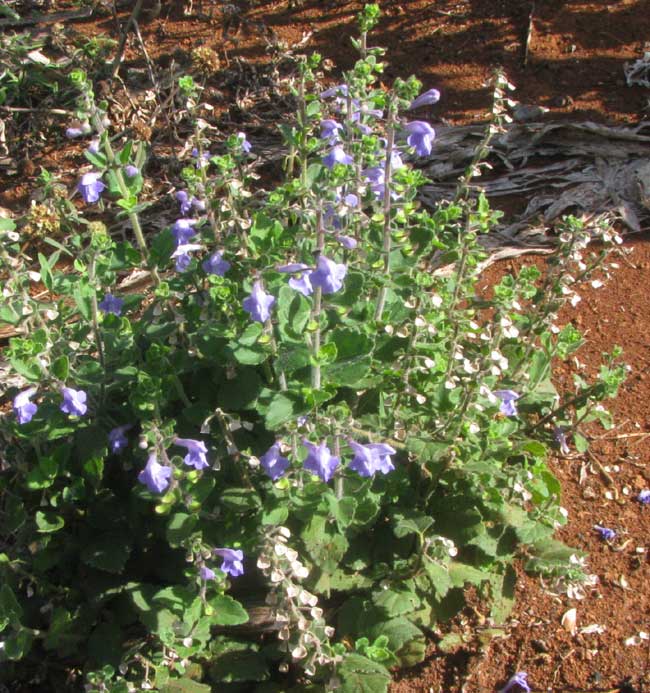
The Mayas' cornfields, or milpas, are standing fallow now, their widely spaced corn plants bleached pale by rains, the corn ears long since harvested by hand and carried away in bags. Most corn plants now have dried-up morning-glory vines twining up their stalks, their dark, dry seedpods about to open and release seeds. The ground is thick with knee-high weeds, basically the same few species occurring again and again, but in one spot there's something different, shown at https://www.backyardnature.net/n/12/120129sc.jpg.
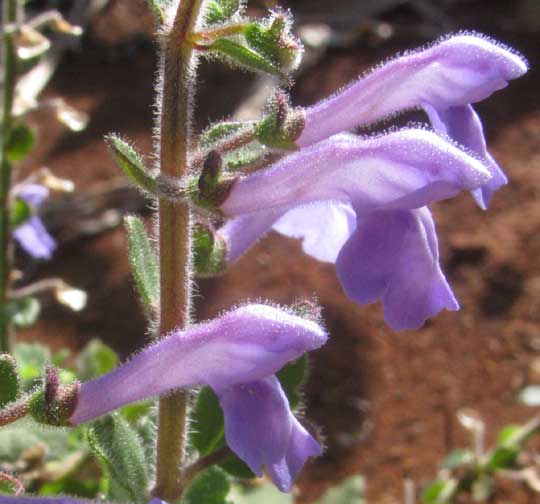
Those blue, bilaterally symmetrical blossoms are typical of the Mint Family. The plant's two-to-a-node (opposite), oval leaves, like those of a Spearmint, confirm the plant as a mint. You can see the flowers, unusually densely coated with gland-tipped hairs, at https://www.backyardnature.net/n/12/120129sb.jpg.
In the last picture, locate the greenish, two-lipped, bowl-like calyx at the bottom of each blossom. Notice that on the back side of each calyx there arise upward projecting, duckbill-like protuberances unlike anything seen in the vast majority of other flower types. These "crests" are distinctive for the Mint Family genus Scutellaria. The Mint Family contains so many look-alike genera that often it's hard to distinguish them, but if you see calyxes with such projections, you have a Scutellaria. In English Scutellarias are known as skullcaps.
Finding only two Scutellarias listed for the Yucatán, it wasn't hard to figure out that this was SCUTELLARIA GAUMERI. The species isn't graced with any generally accepted English name, but I think of it as Gaumeri's Skullcap.
It's always a treat to find any organism bearing Gaumer's name, and in the Yucatán there are many. Here's what I wrote back in 2006 when we found the cactus Mammillaria gaumeri near Río Lagartos on the Yucatán's northern coast:
"George Franklin Gaumer (1850-1929) was a US citizen residing in the Yucatan from 1884 to his death, and he collected a remarkable number of rare and endemic species, which he sent to specialists for identification or, if they were unknown to science, for naming. Many of those specialists named the undescribed plants after their discoverer, Gaumer. There's Acacia gaumeri, Caesalpinia gaumeri, Thevetia gaumeri, Vitex gaumeri, and many more. What a heck of a lot of fun that guy must have had as he explored a land basically unknown to biologists!"
*****
PITHECELLOBIUMS FRUITING
Back in Querétaro Don Gonzalo showed us how to eat the sweetish, white, pithy material accompanying the black seeds of PITHECELLOBIUM DULCE, which goes by many names, none of which are much used in the English-speaking world. Our page for this fair-sized tree is at
https://www.backyardnature.net/mexnat/pithecel.htm.
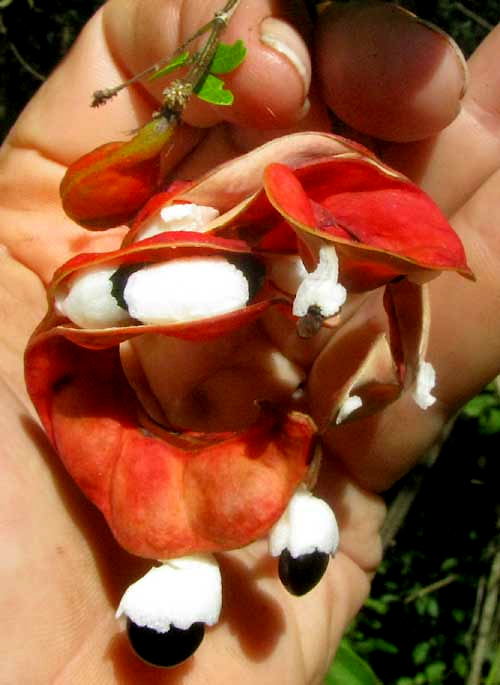
Two intertwining pods of the species are ripening beside the hut, prettily displaying bright colors at https://www.backyardnature.net/n/12/120129pi.jpg.
Pithecellobium dulce is a member of the Bean Family, so the two fruits in the picture are legumes. The black, oval items at the picture's bottom are seeds, and the white material capping each seed is known as the aril. Only certain seeds have arils.
To understand the aril, remember that maturing beans inside a legume fruit are attached to the legume's husk by a placenta-like "fenicle." In Pithecellobium dulce the top of the fenicle is expanded to form a fleshy, white aril. You can imagine why when you pick off a bit of aril and chew it. It's fairly palatable and sweet. It's easy to imagine birds grabbing for the aril and incidentally carrying the bean along for the ride, thus disseminating the bean, which is what the tree "wants."
On the morning after the above picture was taken the red, empty pods were found on the ground emptied of their seeds and arils.
*****
FEMALE BANANA FLOWERS
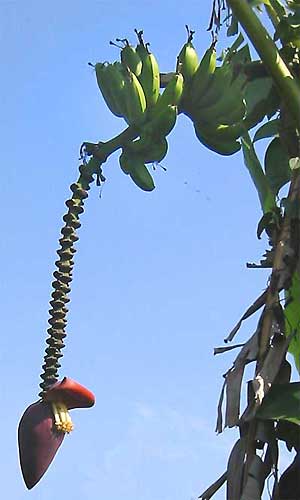
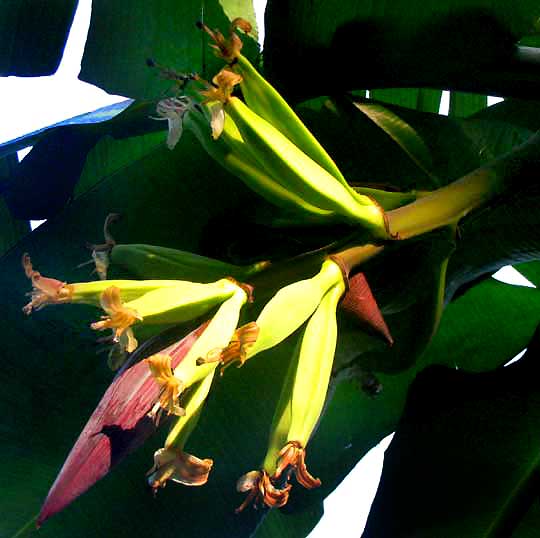
We've seen that a Banana plant's flower cluster bears female flowers at the base of its central axis, or rachis, and male flowers among fleshy, purple bracts, or modified leaves, at the rachis's tip. This arrangement is shown on an immature banana cluster at https://www.backyardnature.net/chiapas/banana8.jpg.
Earlier we looked at individual male flowers; now let's look closer at female flowers. Some are shown at https://www.backyardnature.net/n/12/120129bn.jpg.
In that picture the flower cluster is just beginning to open up, revealing female flowers at the base of the cluster. Until well after this stalk's female flowers have ceased being receptive for pollination, male flowers will remain immature and hidden beneath the numerous overlapping purple bracts forming the spearhead at the picture's lower left. By having male and female flowers maturing at different times, plants can avoid pollinating themselves.
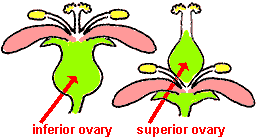
In most flowers, the calyx, corolla and male stamens arise at the base of the female pistil, as shown for the "superior ovary" in the diagram provided at https://www.backyardnature.net/inf_sup.gif.
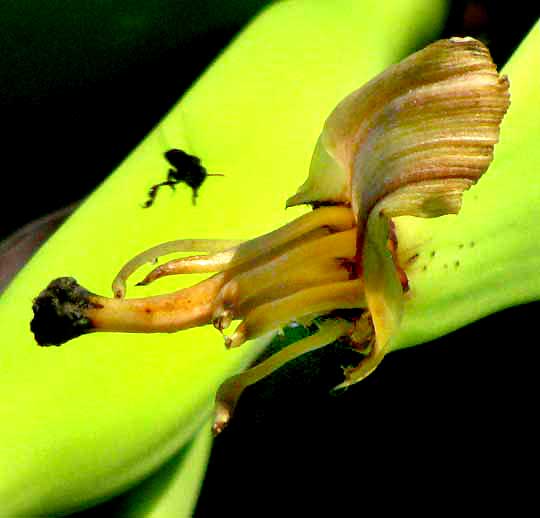
In that diagram, the "inferior ovary" at the left shows the case with Banana flowers, which have the calyx, corolla and male stamens arising atop the female ovary. Another way of saying that is that the immature bananas in our pictures are inferior ovaries. You can see what's atop a typical banana ovary at https://www.backyardnature.net/n/12/120129bo.jpg.
The ribbonlike, striated item curving toward the picture's top, right is the calyx, which started out as a cylinder, then split down one side and curled back, and soon will fall off. Earlier on the other side there was a similar ribbonlike thing; that was the corolla, and it's already fallen off. The pale, slender, fingerlike objects arising at the base of the single, thicker, dark-headed item are sterile stamens. In the distant past when the Banana's ancestors were evolving, these stamens would have been fertile, producing pollen, but now, in these female flowers, they're vestigial, like the appendix on the human large intestine. The thick-based, black-headed item pointing at the left side of the picture is the blackish stigma, where pollen germinates, atop the ovary's "neck," the style.
Actually, these sexual parts are all rather useless to the cultivated Banana, since Banana genes have been so scrambled during centuries of domestication by humans that Banana flowers no longer produce fruits with viable seeds. Those tiny, brown, soft, sandgrain-like items inside a sliced-open banana fruit are aborted ovules -- aborted because the female sex germ inside each ovule never was fertilized by a male sex germ from a pollen grain.
If humans were to disappear, and thus no longer transplant vegetative sprouts arising at the bases of Banana "trees," there'd be no more Banana trees producing banana fruits as we know them. Some wild ancestral Banana species still able to reproduce sexually and make viable seeds would continue to survive, however.
*****
THE YUCATÁN'S RED & BLACK SOILS
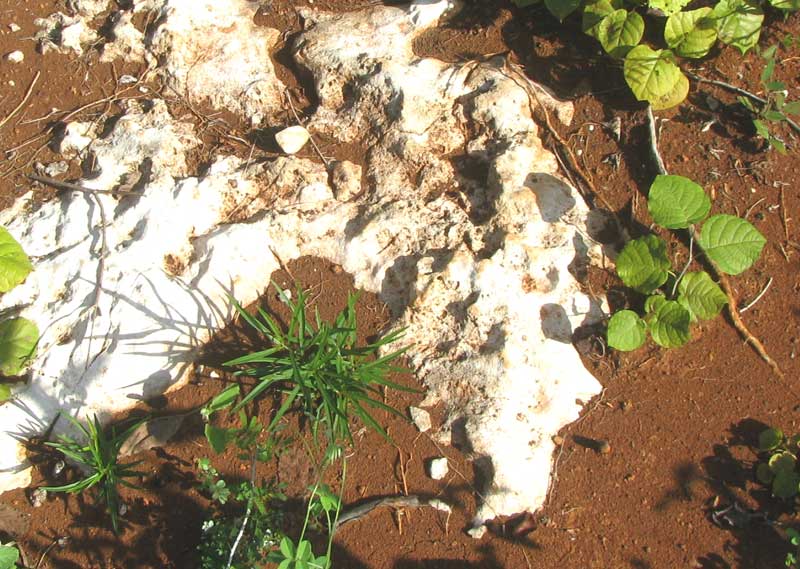
Just north of Pisté in a cornfield lying fallow for the dry season the soil is thin and red, with much limestone bedrock emerging from it, as shown at https://www.backyardnature.net/n/12/120129sl.jpg.
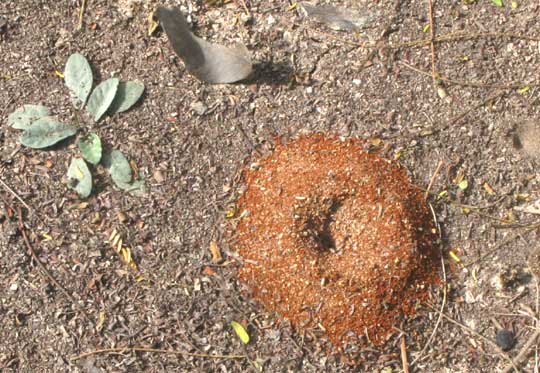
Maybe a hundred feet away the soil is black, but anthills built of deeper-mined soil are red, as shown at https://www.backyardnature.net/n/12/120129sm.jpg.
The Maya know that the black soil is richer and easier to cultivate. Black soil holds water longer and doesn't dry into hard, brittle clods as red soil does. Sometimes the Maya carry black soil to areas of red soil where they want to grow something special.
All this makes sense because black soil contains higher concentrations of organic matter -- decomposing remains of living organisms -- while red soil holds much less. And soil organic matter behaves like a sponge in soil, not only holding water there but also nutrients. Black soil dries into a crumbly state instead of bricklike like red soil. Water-saturated black soil also tends to be crumbly instead of soupy as with red soil.
The Yucatán's limestone-derived soil is red because the limestone from which it derives contains small amounts of iron. When iron is exposed to oxygen, iron oxide is formed, and iron oxide is reddish. In the mineral form iron oxide is known as the reddish hematite; on gate hinges it's known as rust.
Therefore, for as long as soil keeps developing from limestone there'll be red soil. However, black soil is fragile and easy to destroy. Expose it to air and heat and it converts to nutrients that leach away, or its molecules are oxidized and mineralized, losing their beneficial organic properties. In the Yucatán, red soil is replacing black soil.
A technical article in the journal Agronomy (vol. 22, #3, April 2002) reports on soil studies in the Yucatán where forests are cleared and burned, cornfields are planted, then, when the soil deteriorates and weeds and insects invade, the fields are abandoned and allowed to revert to forest. The whole cycle is referred to as slash-and-burn. Because of ever-increasing population pressure, the time allowed for fields to remain abandoned, or fallow, as vegetation re-enriches the soils, is ever briefer.
The study found that as the fallow time "is shortened from the traditional 25-30 years to 6-12 years, soil productivity declines... Black soils contained twice as much organic matter, more total P {phosphorus} and three times more available P than red soils. At the end of the cultivation cycle both soils had lost one quarter of their organic matter relative to the longest fallow."
Online you can search for this paper under the title "Soil fertility during shifting cultivation in the tropical Karst soils of Yucatan" at http://www.agronomy-journal.org/.
*****
DEWY MARIGOLD BLOSSOM
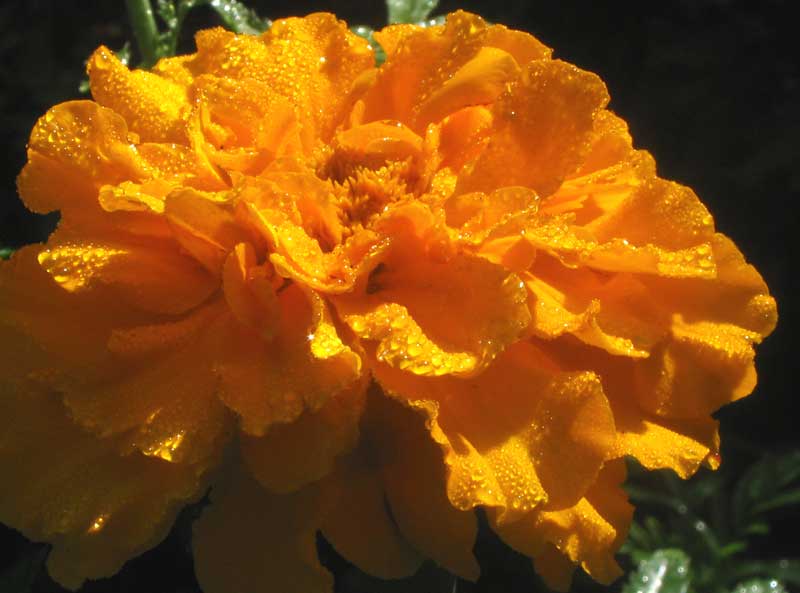
Early one morning this week just as the sun broke over treetops flooding the plantings in front of the hut with dazzling light, this season's first marigold blossom reached its peak of expression. The flower was drenched with dewdrops, each droplet focusing sunlight someplace special within itself, sometimes as a pinpoint sparkle, sometimes as diffuse glare, sometimes like a burning diamond in a drop of honey.
The air that morning was unusually warm for this time of year and as Altamira Orioles idly called with widely spaced, sharp but lazy notes, the air smelled like spring up North on those special mornings when lawns are getting shaggy but nobody is mowing yet, so there's just that green, herby smell without the later-to-come lawnmower fumes and odors of cut wild onions. It's a naive smell, moist and fresh as you breathe it in, almost caressing the soft flesh of eyes, of cheeks.
Nowadays this kind of moment with a flower, I suppose, is hard to come by up North, so I took a picture to share, an image that, passing through so many microchips and relays, through so much copper and silicon between here and there, merely hints in lame and ghostly hues at what I saw and felt. It's at https://www.backyardnature.net/n/12/120129mg.jpg.
*****
iPHONES & THE TREE OF LIFE
In an online New York Times article I read an executive's account of what happened when Apple redesigned the iPhone's screen at the last minute:
In China, "A foreman immediately roused 8,000 workers inside the company's dormitories. Each employee was given a biscuit and a cup of tea, guided to a workstation and within half an hour started a 12-hour shift fitting glass screens into beveled frames. Within 96 hours, the plant was producing over 10,000 iPhones a day. There's no American plant that can match that.”
Reading this, I visualize the Evolutionary Tree of Life with its millions of branch-tip species. Some of the Tree's branches grow and rebranch exuberantly, constantly generating new, fast-speciating, fast evolving organisms. Brush-footed butterflies, grasses and asters explode among these rampaging limbs with gorgeous vitality, though at this point in their evolutionary history all the tips look pretty much alike. Other of the Tree of Life's branches bear idiosyncratic-looking but stagnant "living fossil" species like chitons, Ginkgos and cycads. But most limbs are of an in-between nature, calmly but efficiently and routinely generating Nature's hard-working, beautiful-in-their-own-right-but-never-dominating yeomen, life's cuckoos, maples and columbines.
This visualization -- this natural paradigm so basic to Life on Earth that it echoes in the doings of all living things, including humans -- teaches that the feverish pace of Chinese super-factories is natural and inevitable, for at this moment in history the Chinese are humankind's brush-footed butterflies, asters and grasses. Moreover, knowing that inside the Tree of Life there arise untold numbers of dead branches terminating with extinct species, one knows the consequences of losing one's insatiable hunger, one's irrepressible creative edginess, one's terrible, unquenchable aggression.
And yet, the Sixth Miracle of Nature -- the one enabling us humans on Earth to think and behave in ways other than those programmed in our African-savanna-formulated genes -- lets us imagine a world in which no one works endless 12-hour shifts while living in dormitories, and where the pace of life gives everyone time enough to mature intellectually, emotionally and spiritually.
But, there's the hunger, the edginess, the aggression so natural and requisite for all dominant species, and so human that without these traits we'd hardly be human at all...
Thinking like this, The Middle Path never beckoned so brightly, and never seemed so hard to attain.
*****
Best wishes to all Newsletter readers,
Jim