April 19, 2009
ROBINS HERE, TOO
Travelers like to see new things but maybe just as important is to gain new perspectives on what makes up everyday life back home. That's the way it is when I travel and see American Robins, TURDUS MIGRATORIUS. Few songbirds are more familiar, yet there's always more to know about them, more to appreciate about them.
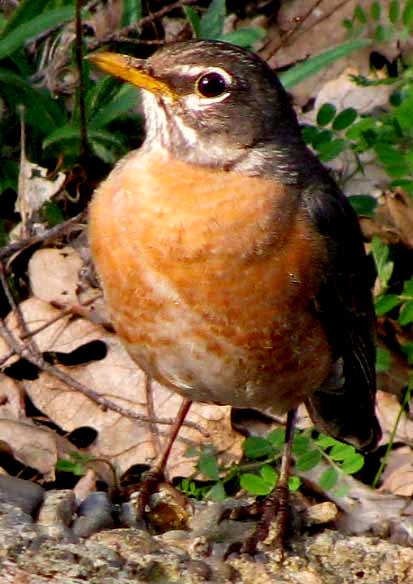
When I was a kid in Kentucky robins were the birds hopping around looking for earthworms in our lawn. During my hermiting days in Mississippi in the fall they flocked in big Pecan trees above my trailer alternately basking in sunlight and gorging themselves on Poison Ivy fruits. The first bird I saw here was a robin. If you're in a robinless part of the world you can see what the one outside my door looks like at https://www.backyardnature.net/n/09/090419ro.jpg.
Mature adult males in summer wear darker gray upperparts than the one in the picture, and their breasts are more intensely orange. Here's what we read on A.C. Bent's Robin Page in Life Histories of Familiar North American Birds online for free at http://birdsbybent.com/ch31-40/robin.html.
The most frequent notes we hear the robin utter, perhaps, are fretful expressions of uneasiness, complaint, or resentment at our presence or at some other distraction, yet it is characteristic of him to break out with a phrase or two of song even in the midst of complaint. He seems always apprehensive, often standing alert and restless, wing tips lowered or twitching, head high, and tail pumping, on the watch for danger, and the least alarm upsets his equilibrium and startles him into vociferous, unrestrained remonstrance.
Those words were published in a Smithsonian museum bulletin in 1949. I relish the old naturalists' way of putting their hearts into such descriptions, offering a richness of detail no modern technical journal would permit for fear of being accused of unscientific anthropomorphism.
But, what a picture of the robin those words paint! If you want to see your common backyard robin from several new perspectives, go read that Robin page linked to above.
*****
WAXWINGS
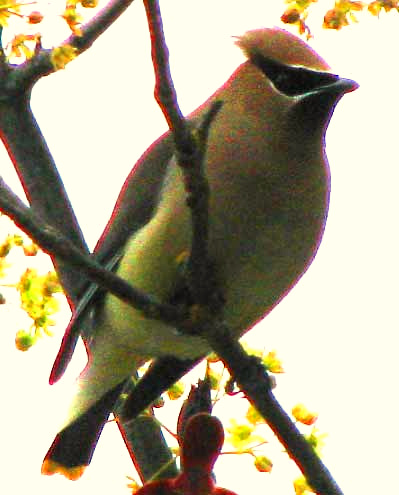
Friday I visited an ophthalmologist in town to check the progress of my eyes' cataracts and was surprised to encounter about a dozen Cedar Waxwings, BOMBYCILLA CEDRORUM, awaiting us, perching about ten feet high in flowering Norway Maples at the parking lot's edge. I'm used to seeing waxwings high in trees in the woods, not just ten feet up in a town parking lot. You can see one of these neat-looking birds, its colors bleached because of a very bright background, at https://www.backyardnature.net/n/09/090419cw.jpg.
All across the southern US Cedar Waxwings are only winter visitors. In much of the US Northeast and this part of the Pacific Northwest they're permanent residents, but most of their summer breeding ground lies in Canada.
During courtship the male and female may perch close to one another passing small objects back and forth, maybe a small fruit or a bug. Mating pairs sometimes rub their beaks together in a way that to human eyes looks a lot like an expression of affection. I've never seen a solitary Cedar Waxwing; they're always in small to large flocks. In my December 9th, 2001 Newsletter written during my hermit days I wrote:
Tuesday morning about 120 waxwings adorned my big Pecan's topmost branches. At first they perched silently and unmoving about a foot apart, each bird positioned so that dawn's low-slanting sunlight struck its broad chest. Waxwings, while small, possess rounded chests, and now in the morning sunlight 120 little chests made soft, oval glowings within the big Pecan's black reticulation of naked branches.
I still remember that wonderful visit. Waxwings have always evoked a friendly, homey feeling for me.
According to an online etymology site the name "waxwing" derives from "... the tips of its feathers which look like red sealing-wax." The whole bird seems made of wax to me, crafted by a master artist creating a bird prettier than it really needs to be, and I guess that that's exactly the case after all.
*****
PAINTED LADIES AMONG THE MANZANITAS
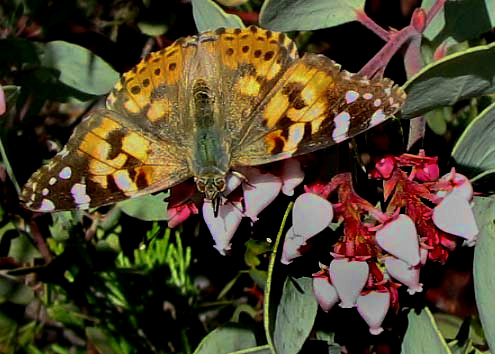
Shrubby manzanitas, profiled below, are flowering profusely now and on warm, sunny afternoons if you go stand beside them probably among the blossoms you'll see several butterflies flitting like the one shown at https://www.backyardnature.net/n/09/090419vn.jpg.
That's a Painted Lady, VANESSA CARDUI, possibly the world's most widespread butterfly, being distributed almost worldwide, except for South America and the polar regions. Notice that the individual in the picture is a bit faded. All the Painted Ladies I've seen here are old, faded ones, and there's a story in that.
Painted Ladies disappear between the first heavy frost and the onset of spring -- they can't survive very cold weather. Nor do they leave eggs or cocoons to emerge in the spring. In the colder parts of its distribution the species is simply wiped out when winter comes.
In spring, then, Painted Ladies who have survived in warm areas make one-way trips into colder territory where they've disappeared over the winter. Therefore, the faded individuals I'm seeing now on the manzanitas have just arrived after long flights from frost-free areas far to the south.
There's a lot of discussion on how altruism could have evolved. I think a much more engaging question is how the Painted Lady could have evolved to send vast numbers of individuals on one-way trips into regions where eventually they and their genes will all be wiped out. Once answer may be Nature's irrepressible urge to fill voids with life, and Her focus on the welfare of the species or community, not the individual organism. And maybe that answer lies more in the spiritual realm than the scientific.
*****
LITOCALA SEXSIGNATA
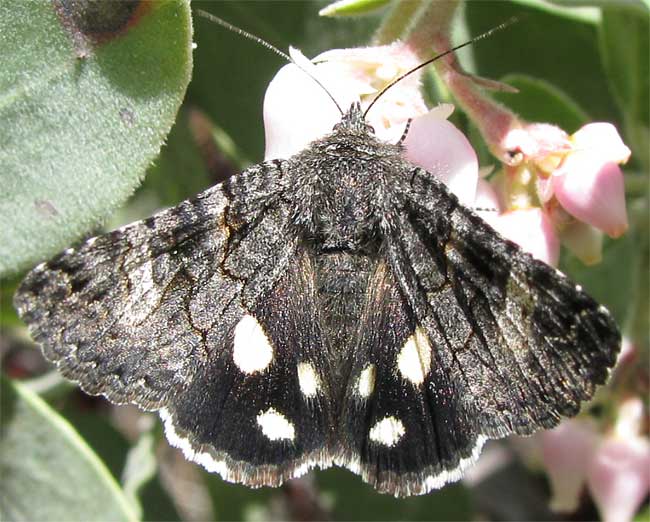
Not all lepidopterous species flitting about our flowering manzanitas are Painted Ladies, though maybe 90% are. You can see another visitor at https://www.backyardnature.net/n/09/090419ls.jpg.
After searching all through my Audubon butterfly field guide I just couldn't identify this insect. Here in Oregon my modem connection with the Internet is so slow that I can't enter online forums, so Bea in Ontario volunteered to upload the above picture to the ID-help forum at Bugguide.net and in just two or three hours someone gave her a name:
It wasn't a butterfly at all, but rather a moth, LITOCALA SEXSIGNATA. I can't find a common name for it, nor life history information, plus the few records of the species all appear to be in or near Arizona. Do we have a new species here? Is this the first time it's been recognized as taking nectar from a manzanita?
This isn't the first time I've confused a moth with a butterfly. Bea, who at first also was tricked, wrote that " ...when I was looking at its feelers I was looking to see if it had a round ball at the end, or hooked antennae like a skipper, and I just couldn't tell. I thought it was because the picture was unclear, but it was because they just weren't there! Usually moths have feathery antennae. Plus, usually moths only come out at night, but your little moth was a daytime moth and I read it even flies like a skipper!"
*****
DOUGLAS-FIRS
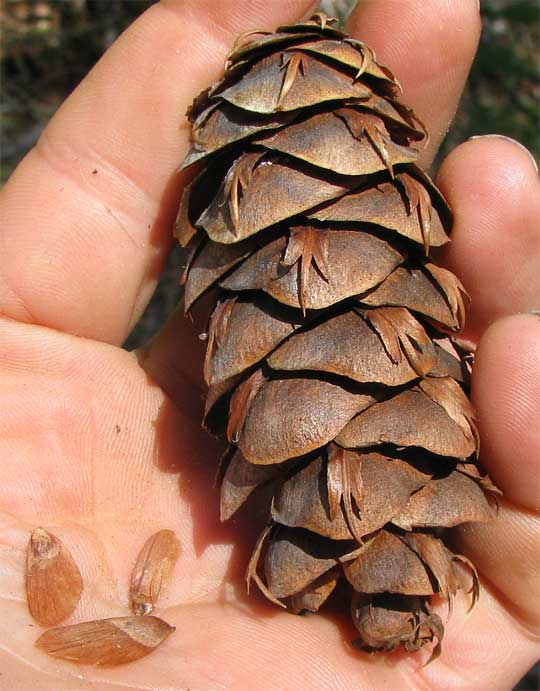
No place on Earth has a greater diversity of conifers than here. This week the conifer I've focused on is the Douglas-Fir, PSEUDOTSUGA MENZIESII, which is so common here, growing up to 200 ft (60 m) tall, and such an important timber tree, that it's Oregon's state tree. From a distance Douglas-firs look like so many other tall evergreens with straight, dominant central trucks bearing short branches attached more or less at right angles. Up close, however, you can see how it differs from similar trees. Look at the cone at https://www.backyardnature.net/n/09/090419df.jpg.
The most conspicuous difference between that three-inch long cone and a pine cone is the three-pointed bracts emerging from beneath each of the cone's woody scales, looking like the rear ends of flattened mice. Other conifers don't have such bracts. Even after the cones fall you can tug on the bracts and they don't come loose. Sometimes you can lift up a bract and a winged seed plops out, like the three seeds at the picture's lower left corner.
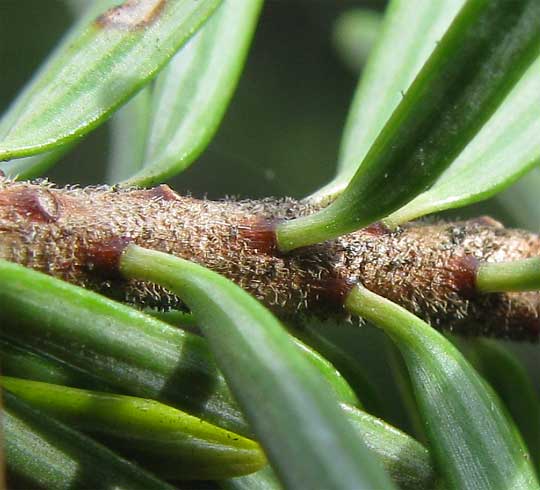
The Douglas-Fir's twigs also are distinctive. At https://www.backyardnature.net/n/09/090419dg.jpg you see a close-up of its short-hairy twig. Notice how the spirally arranged, small-based, flattened leaves arise from slightly raised and tilted little stumps. When you pull leaves off other conifers in this area either what remains is a petiole-scar flush with the surface (firs) or else the stump stands much higher, causing the de-leafed stem to be rough enough to comb your hair with, which I've often done. Spruce and hemlock twigs are like that. Pines and larch also occur here, but they produce clusters of needles instead of individual leaves or needles along their stems.
Notice that the name Douglas-Fir has a hyphen between Douglas and Fir. That's because Douglas-Firs are not firs; they're Douglas-Firs, something completely different. Regular firs belong to the same family, but they're in a different genus, Abies, no Pseudotsuga. Fir cones, instead of dangling like this and other conifer cones are held upright.
*****
A DRIFT OF TRILLIUMS
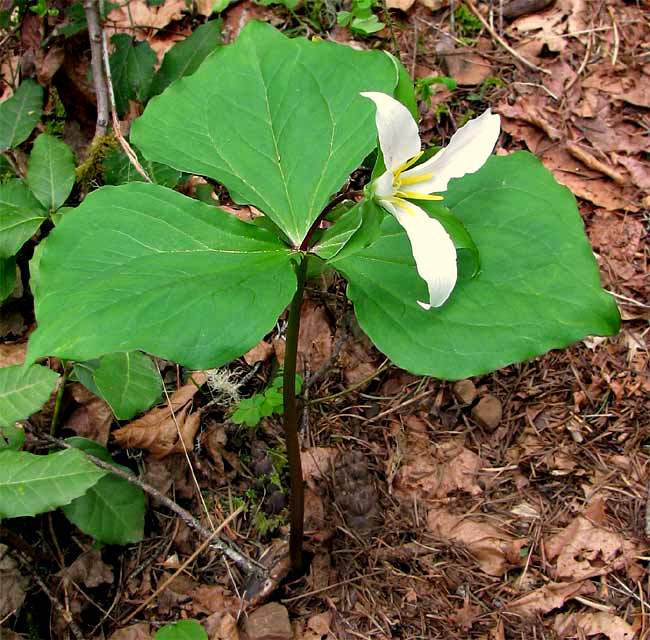
I'd never heard anyone refer to a "drift" of anything until on the Internet I was checking out the gorgeous, white-blossomed wildflower shown at https://www.backyardnature.net/n/09/090419tr.jpg.
That's the Western Trillium, TRILLIUM OVATUM, which at least one wildflower fancier calls the "most beautiful of all native flowers." I've run into several authors referring to "drifts" of them. That's an evocative term and when you see large numbers of them nodding gracefully in an afternoon wind among frilly ferns in a moist, forest grove, "drift" seems a good word to apply to them -- though I'd be just as happy referring to a "diffusion" of them, or maybe a "chiming," a "fragrance" or even a "murmuring."
A few weeks ago in Mississippi I introduced you to our common trillium species there, which was very different. Its blossom was dark maroon, the flower wasn't "stalked" with a stem between it and the three leaves below it (as with our Western Trillium), and it was endemic to a tiny part of the country. Our white- flowered Western Trillium here occurs widely from British Columbia to California east to Montana and Idaho. I read that its petals turn purple as the flower ages. At this early stage of blooming I find only white flowers and few pink ones.
All my older manuals and field guides place trilliums in the Lily Family, but nowadays they're separated into their own Trillium Family, the Trilliaceae. I can understand why, if only because it's such a novelty for a plant to consist of a whorl of three leaves at the summit of a stem, where a single flower arises. I can't think of anything else like it.
The Trilliaceae comprises six genera of which only the genus Trillium occurs in North America -- except for the monotypic (only one species in the genus), endemic genus Pseudotrillium, which occurs, of all places, "in the Siskiyou Mountains of California and Oregon." I'll sure be looking for that one!
*****
WHITELEAF MANZANITA
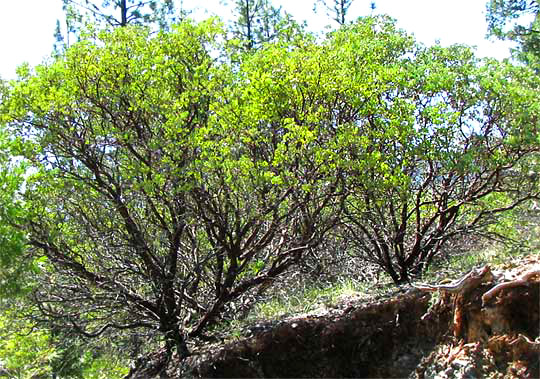
On our mountain slopes where tall, lush conifer forest gives way to serpentine barrens, roadsides, or wherever it's a bit dry and the light gets in, you get the much-branching, rusty-red-stemmed bush or small tree growing to ten feet or so high known as Whiteleaf Manzanita, ARCTOSTAPHYLOS VISCIDA. You can see two manzanitas and how profusely they branch at https://www.backyardnature.net/n/09/090419mz.jpg.
Sometimes you run into manzanita thickets so dense you can't even crawl through them. People around here usually have a clear-away-the-underbrush frame of mind because of the summer dry-season fire hazard and they don't care much for manzanita -- except as firewood. "You put pine in your stove and it'll burn up before you know it, but manzanita lasts and lasts and doesn't make a mess," a friend tells me.
The name "manzanita" is Spanish meaning "little apple" because the shrub's fruit is like a 1/3-inch-across, shiny-red to greenish brown crabapple, mealy and full of seeds, so wildlife like it. I read that the Miwok indigenous people of northern California once made cider from the fruits.
When you see how quickly the species invades along logging roads you can imagine legions of birds, bears and others dropping their manzanita-seed-filled poop there. Also, Whiteleaf Manzanita is one of the first woody plants to colonize ground after fire. I read that its seeds require fire for germination, though I see it invading areas where I doubt there's been recent fire.
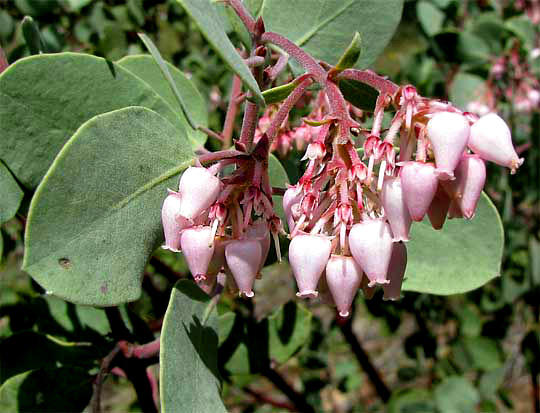
The reason I'm thinking about Whiteleaf Manzanita now is that it's flowering, as you can see at https://www.backyardnature.net/n/09/090419my.jpg.
If you notice a similarity between manzanita's flowers and those of blueberries or heath it's because those bushes along with manzanita are members of the Heath or Rhododendron Family, the Ericaceae. Cylindrical corollas with bulging bases tapering to narrow openings rimmed by four or five tiny lobes is typical for that family. There's a neat term applying to corollas of that shape, which are regarded as "urn shaped," and that's "urceolate."
Whiteleaf Manzanita is native only to Oregon and California.
*****
CATTAILS IN THE SNOW
In my mind certain plants and animals are so associated with poignant moods, feelings, and incidents of the past that sometimes I think there must be a reason beyond the normal rules of mental association. Maybe it arises from our hunter-gatherer past when it could have been highly adaptive to associate roots, fruits, mushrooms and the like with good or bad impressions from previous encounters. See a poisonous Amanita mushroom and if your spine tingles and your stomach twists itself into a knot, just don't eat the thing.
I have a strong psychic association with cattails. When I see them in late fall or winter with their once-gracefully arching, vibrantly green blades now collapsed pitifully into bleached, dry tangles, the spikes pointing skyward or maybe bent or broken over, their heads' velvety brownness suspended amidst dead grayness and the heads' rounded-frankfurter ends somehow so optimistic and youthful amidst all that wintry wreck -- I can relate! There's a certain calmness, a certain hominess, a certain profound sense of perfection in a wintry cattail colony beside a sleeping pond or marsh that stabs into me, invites me to hunker amidst them, and often I do.
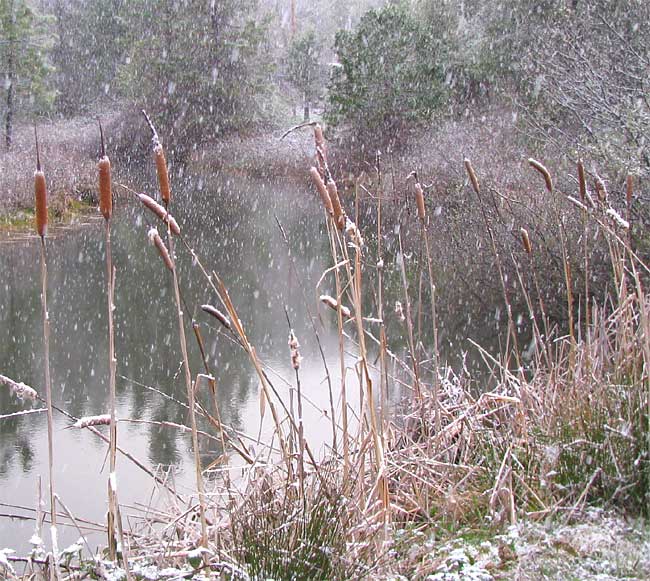
About a minute upslope from my trailer there's a wonderful little pond I'll be writing a lot about, and cattails grow along its banks. Last Tuesday morning it began snowing and the thing I wanted most to do was to go see how those cattails looked in the snow. You can see them, maybe atavistically evoking for me images of my very distant Germanic ancestors trudging across the blustery north-German plains at https://www.backyardnature.net/n/09/090419ct.jpg.
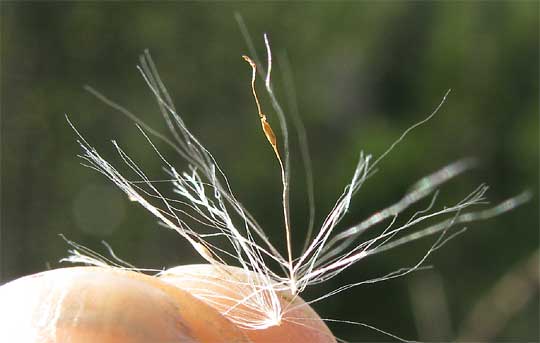
You can see that above every brown cattail head there's a slender, pointed stem several inches long projecting upward. Last summer that slender finger bore hundreds of tiny, closely packed male flowers, while just below that male part closely packed female flowers covered the stem. Now wasted male flowers constitute a black, matted shag covering the spike top, while down below the thicker, brown zone earlier populated with female flowers now consists of an enormous number of cattail fruits, each fruit attached to its own "parachute" of fuzz, like a Dandelion "seed." You can see a single fruit with its fuzz at https://www.backyardnature.net/n/09/090419cu.jpg.
The cattail fruit is that tiny, brown swelling on the upright stalk in the picture's center. You can see that a white bristle continues upward from atop the fruit. Back in flowering days when the fruit was an ovary, that white bristle atop the fruit was the style and at its very tip was the stigma, the female part on which pollen grains germinate.
On dry, breezy days, what a pleasure to sit amidst the cattails. Maybe a finch comes pecking and tugging at the brown spike, and at this season every fruit with its fuzz inside the spike is more than eager to be released from its confinement among thousands of other fruits. With the merest scrape of your thumb across the spike's brown, velvety surface, grand, tickling fluff-clouds explode into the wind and if it's sunny you see them blowing across the pond like burning embers, maybe wafting into the big pines, prepared to find a new home beside a pond far, far away.
In the picture, that's the Common Cattail, TYPHA LATIFOLIA. Three cattail species are listed for California. The Common is found throughout North America and Eurasia, except for the most northern extremities.
*****
NOT ECONOMICALLY FEASIBLE
The other day my friend and I were snipping dried twigs from a cut-down madrone tree. Such snippets are good for starting fires in the stove. Ignite a bit of paper, the paper sets a little teepee of madrone twigs ablaze and once the madrone is afire the regular-size kindling catches. Madrone and manzanita both are heavy, long-burning woods that produce lots of heat and little ash.
"What we're doing isn't so economically feasible," my friend said, shrugging his shoulders. I knew why he said that. First, our work was Mickey Mouse stuff in this land where he-men use chainsaws instead of hand snippers, and move truckloads of timber, not little boxes of twigs. Also, in this culture we're always making mental calculations like this:
"It takes me three hours to produce this box of twigs. Even charging as little for my labor as $5/hour, that means that this box of twigs should be worth at least $15."
But, no one would have paid $15 for our little box of madrone twigs, not even us. "Not economically feasible... "
As we continued working and I thought more on the matter, it grew ever clearer that if you accept "economic prosperity" as the main measure for your success as a human being -- and that's our society's bedrock assumption -- you're in a mess if you care for things that merely enrich life, or make life worth living. Camaraderie and the feeling of working in spitting snow as a Raven calls from up high in a wintry mountain valley aren't "economically feasible."
But, "economics" is no more than an artificial system based on money, and money's value is only what people say it is at the time, and people are likely to say anything.
Moreover, "economics" is a subset (human-imagined system) within a subset (humanity) within a subset (Life on Earth) within a set (the Universe).
In profound contrast, two friends standing shoulder by shoulder snipping twigs for their own warmth on a snow-spitting morning with a Raven overhead... are part of an organic whole, a local manifestation of the blossoming Universe. What my friend and I had that day was something with exactly as much value as a wildflower meadow on a mountain slope, the beauty and meaning of the night sky, as music and geometry... all things to which "economics" attributes no value at all.
That day in the spitting snow, what enormous value our work was in terms of contributing to the blossoming of the Universe, and how beautiful we were just being ourselves, exactly then, exactly there.
*****
Best wishes to all Newsletter subscribers,
Jim