January 5, 2007
SWEET ACACIAS BLOSSOMING
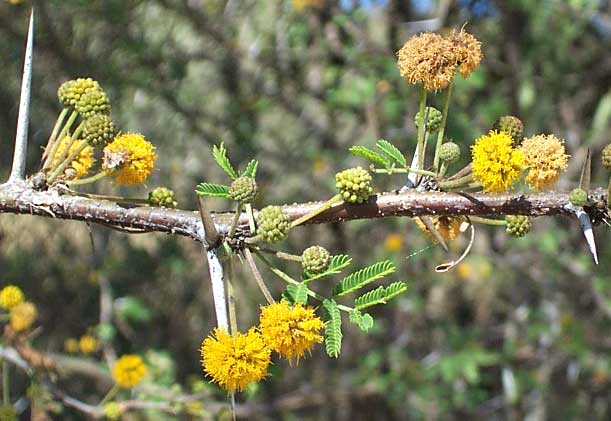
Sweet Acacia is flowering. A member of the Bean Family and sometimes called by its Spanish name Huisache (we-SACH-eh), it's ACACIA FARNESIANA and it's been flowering ever since I got here. However, nowadays surely it's at its flowering peak, for I can't imagine it getting more loaded with tiny, yellow flowers clustered into globular, mothball-size heads. You can see a zigzagging, flowering branch with 1.5-inch long, white spines and feathery leaves at https://www.backyardnature.net/n/07/070105sa.jpg.
On dry, scrubby, thorny slopes around Jalpan, Sweet Acacia often is the most abundant tree. This is of importance to the local ecosystem, for now we're well into the dry season and most scrub-forest plant species are well into "suspended animation" until rains return. Annual herbs are dead or dying, depending on future rains to sprout their seeds. Many perennials are dying back to their tubers and rhizomes, and many trees are losing their leaves, just as if a northern winter had arrived, though we've not come close to having freezing temperatures here. Even Sweet Acacia is dropping some of its leaflets. Thus very few plants in the scrub zone are flowering -- except Sweet Acacia. Pollinators in the scrub zone have little to work with other than Sweet Acacia, but Sweet Acacia gives them what they need.
Moreover, Sweet Acacia's super-abundant blossoms are sublimely fragrant. Every walk I take Sweet Acacia's perfume wraps itself around me just as generously and disconcertingly as Japanese Honeysuckle's aroma did when I used to write about its effects on me, in April, in Mississippi. Why do the most sublime effluvia usually emit from such bristly or otherwise wild and disreputable sources?
Last Saturday I camped beneath a prodigously flowering Sweet Acacia next to the reservoir. In the afternoon I watched untold numbers of honeybees, beetles and birds working the flower-laden branches. Among the birds mostly there were Blue-gray Gnatcatchers with their long, jerky tails and buzzy calls, but also present were Black- crested Titmice and a sprinkling of warblers, including Wilson's, Townsend's and Black-and-white Warblers. What a city of life that tree was, and I was honored that I could sleep beneath such an important ecosystem citizen.
Others cherish Sweet Acacia's fragrance for different reasons. Some of the finest, most expensive perfumes are based on an essence called "cassie" extracted from Sweet Acacia's flowers. To get cassie, macerate the flowers and mix with melted, purified fats until the fats are saturated with fragrance. Then re-melt the fats, strain and cool. This results in a kind of salve that in some cultures is used as pomade for dressing hair. If alcohol is mixed with the salve and let stand for about a month at below-freezing temperatures the fragrance transfers to the alcohol. When you distill this, the alcohol evaporates leaving a viscous, yellow to brown liquid called "cassie absolute," which is one of the most prized of all perfume ingredients.
Despite Sweet Acacia's abundance, specialists aren't sure where the species' homeland is. Today Sweet Acacia grows throughout the world's tropics, in certain places in Africa and Asia seeming as much at home as it does here. In Hawaii it's considered a threat to local ecosystems. I think the general consensus is, however, that it's a native American.
*****
BLACK-CRESTED TITMICE
Back to those Black-crested Titmice seen foraging in the Sweet Acacias. They look, sound and behave pretty much like the Tufted Titmice so common at birdfeeders in eastern North America. In fact, sometimes Black-crested Titmice have been regarded as a subspecies of Tufted Titmice, but now usually they're considered to be a distinct species, one favoring more arid woodlands than the Tufteds.
The most obvious difference between the two species is that the front part of the Black-crested Titmouse's crest is perfectly black, while the Tufted's tuft is all gray. You can see the black-fronted tuft at http://www.birdphotography.com/species/bcti.html.
Black-crested Titmice are distributed from Texas and southern Oklahoma into east-central Mexico -- to HERE.
*****
PRICKLY-POPPIES
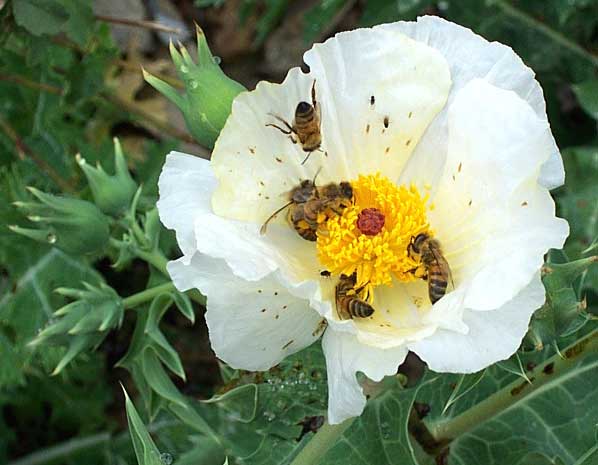
Though the scrubforest -- except for the Sweet Acacia -- looks subdued in its crispy, scratchy, dry-season way, people's gardens and certain weedy areas continue to flourish. One common weed putting on a show now with its four-inch-wide, white flowers is a Prickly-poppy, genus ARGEMONE. I'm not sure which species it is. In every respect it seems to be A. MEXICANA, but books say that the flowers of that species should be yellow. All of ours are white-flowered and you can see one, with honeybees harvesting pollen from its yellow stamens, at https://www.backyardnature.net/n/07/070105ar.jpg.
In that picture you can see why it's called prickly. Each leaf-lobe ends in a sharp spine, plus the flower's calyx is spiny. The four roundish, spiny objects to the blossom's left are not fruits, but rather unopened flower buds with each scale -- the future sepal -- bearing a stiff, broad-based spine.
Prickly-poppies are members of the Poppy Family, which is easy enough to believe not only because the flowers look like poppy flowers but also because if you wound the plant it exudes orange latex. Remember that opium is made from dried latex exuded by scratched poppy fruits.
It's not surprising, then, that traditionally Prickly- poppies have been regarded as having special medicinal properties. My Las Plantas Medicinales de México provides a recipe for making an alcohol-based extract from fresh fruits meant to induce sleep and calm a cough. The Aztecs used the latex as an eye medicine, to clear their vision of spots and clouds.
*****
POINCIANA PODS ON SIDEWALKS
On a torrid January morning in 1974 or 75 I was a young botanist on my first important botanical expedition. I had waded into a piranha-infested lake in Paraguay's Chaco region
-- heroically, I thought, but anything for the sake of science -- to retrieve the most amazing seedpod I'd ever seen. Obviously it was a legume of a Bean Family member, but this pod possessed woody walls and was over two feet long! Surely I'd discovered a new species, something that'd floated in from some unexplored recess of the vast, mostly botanically unexplored wetlands around us.
On my first day back at work at the botanical garden in St. Louis I asked a specialist about my splendid find. It turned out to be one of the most commonplace things in the world, really not even worth keeping, the fruit pod of the Poinciana tree, DELONIX REGIA, a native of Madagascar now abundantly planted throughout the world's tropics. Well, that's how I learned a lot of my botany, by making myself look silly before my colleagues, again and again.
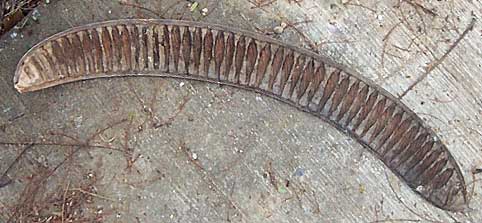
I'm thinking about that little incident nowadays because if you walk more than just a few feet on any sidewalk in Jalpan you're likely to see exactly what I fished from that Paraguayan lake. You can see what it looks like at https://www.backyardnature.net/n/07/070105dr.jpg.
Most pods still hang on the trees, giving the trees a gangly, homely appearance. However, people keep planting Poincianas for one and only one reason: During the rainy season when they flower they are absolutely gorgeous, flamingly-red-blossomed trees. They are much more beautiful in flower than they are ugly in fruit. If I'm here during their flowering season you can bet that I'll photograph one.
*****
DISORGANIZED LEAFCUTTER ANTS
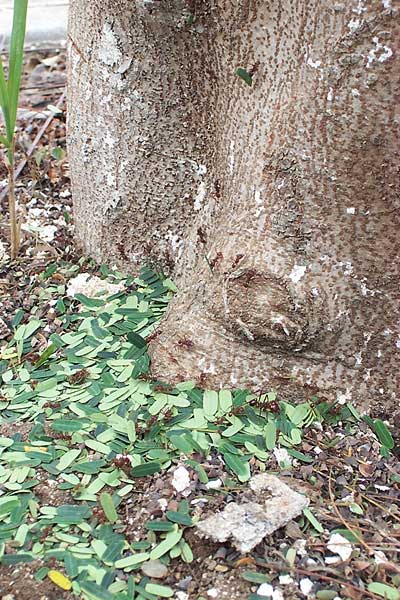
While photographing the above Poinciana fruit I noticed a pile of the tree's green leaflets heaped at the trunk's base. I knew what had left the mess, for I've seen such a thing many times before. You can see this particular mess at https://www.backyardnature.net/n/07/070105la.jpg.
If you look closely at that picture you can see ants on the Poinciana's trunk and hiking across the leaf litter. Those are leafcutter ants. You can see one ant on the trunk carrying a leaflet as if it were a parasol. The ants are slowly defoliating the Poinciana, carrying leaflets one at a time to their underground chambers where fungus will grow on the compost, and the ants will eat the fungus.
But, just why have so many leaflets been dropped and not picked up? If you watch the ants for long you'll see that their behavior has such a disorganized appearance that it's easy to guess what's happened: The ants carrying the leaflets just got confused, decided to do something else, decided to turn around and go the other way, who knows? All up and down the ant line you can see individual ants behaving every way but systematically. Sometimes you even see an ant carrying a leaflet back up the tree. You decide that genius may reside in the ant colony's social structure, but individual ants are pretty scatterbrained.
That doesn't detract from the genius inherent in the colony's organization, however. For example, leafcutter ants rotate their activities among the trees they harvest -- don't ravish the same tree again and again so that it dies. Also, leaves from any one tree are only taken to one part of the nest, rather than distributed throughout it. This prevents the whole nest from being infected if a particular crop of leaves turns out to harbor a disease or be toxic to the fungus.
There are nice pictures and more info on leafcutters at http://www.richard-seaman.com/Insects/CostaRica/LeafcutterAnts/.
*****
ZEBRA LONGWING BUTTERFLIES ON A COLD MORNING
Over the long New Year weekend I camped in the mountains just outside Jalpan. Yet another norther was moving through so the first hours of 2007 found me in a cold, wet tent. I'd prepared for it, however, and at dawn on New Year's Day it was cozy lying in my sleeping bag gazing into the misty valley below. Green Jays orbited around the tent giving me the eye, squawking and flashing their yellow undertails.
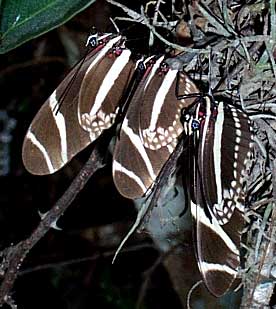
The drizzle ended and I went snooping. Often on such chilly days you can find critters who on a warmer day would be moving too fast to get a good look at. That was exactly the case with the three Zebra Longwing Butterflies, HELICONIUS CHARITONIUS, I found clinging upside-down beneath a gray, epiphytic bromeliad, as shown at https://www.backyardnature.net/n/07/070105he.jpg.
I've been hoping to get a good picture of this species because they're common here, and very dissimilar to most butterflies up north because their wings are so long and slender. When these butterflies fly, their movement seems more buoyant, more fluttery, than that of our broader- winged species. When I see a Heliconius with its tiptoeing-like flight sailing along before a wall of lush, dark-green vegetation I really get that tropical feeling. In fact, the whole genus Heliconius is mainly a tropical one, with about 40 species.
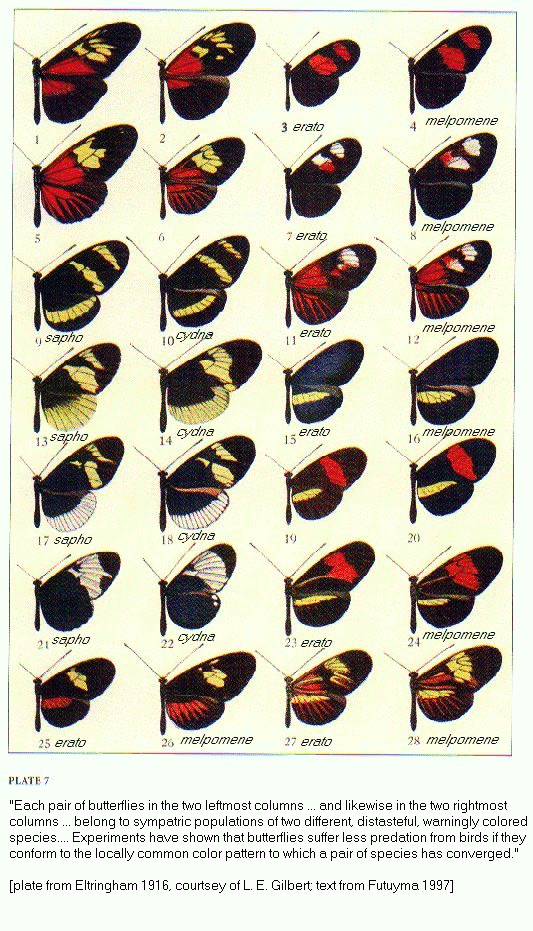
Evolutionists have paid the genus special attention because an uncommon number of its species have "converged," in evolutionary terms. In other words, two different species, both distasteful to predators, over time came to look very similar to one another. This helped predators learn to avoid their particular color and pattern combinations. From the predator's perspective it was "one appearance to avoid" instead of "two appearances to avoid," so each member of the converged pair of species benefited from the predator's greater ease in avoiding them. This special form of convergent evolution is referred to as Mullerian mimicry. There's a chart showing several such converged species pairs at http://www.mun.ca/biology/scarr/Mimicry_in_Heliconius.gif.
Other kinds of mimicry-resulting evolutionary processes -- Batesian, Wasmannian and Peckhamian -- are described at http://www.geocities.com/brisbane_insects/Mimicry.htm.
The Zebra Longwing isn't a member of any such converged- species pair. One ecological curiosity about it, however, is that although its caterpillar form seems able to survive in the forest, the adult form can't compete with other forest species, and is thus fairly restricted to disturbed sites. It's a weedy-area specialist. Though sometimes thought of in the US as a Passionvine Butterfly, here its main host plants are Lantana, Hamelia and Stachytarpheta. The species' distribution extends from deep in South America through Central America, Mexico and the West Indies into the southernmost US.
*****
DWARF PALMETTOS MOVING NORTHWARD
Jarvis in North Carolina sends a note on Dwarf Palmetto, SABAL MINOR, a trunkless palm native to the US Deep South. Apparently the species is extending its distribution northward -- one would guess as a consequence of global warming. Jarvis writes:
"A paper in Castanea, June 2006, discusses an apparent range extension of Sabal minor. The paper also discusses the length of time between the first freeze in fall/winter and the last freeze in winter/spring. Using a regression equation the authors showed that the expected number of days between first freeze and last freeze at Plymouth in northeastern NC decreased from 181 days in the 1940's to 145 days in 2003."
*****
LONG-TERM CHRISTMAS BIRD-COUNT RESULTS
Today, January 5th, the 107th Christmas Bird Count comes to an end. It's fascinating to see what changes in bird-species density and distribution have taken place over the last century. A good place to see some of the results is at the Audubon webpage describing the project at http://www.audubon.org/bird/cbc/.
Down at the bottom of that page click on the checkmark in the box below "What We're Learning" and choose the species you're interested in.
There you can see, with the help of animated maps, how Evening Grosbeaks are losing ground in the US while Mourning Doves are spectacularly increasing in number and moving into new areas. Also, the White-winged Doves so common here (I hear one cooing as I type this) are expanding rapidly into the US. Tufted Titmice are moving northward, too, but a graph shows very well the precipitous drop in numbers of the Eastern Bewick's Wren, possibly caused by competition from the equally adapted buat more aggressive House Wren.
A while back my uncle in Owensboro, Kentucky told me that Eurasian Collared-Doves had moved into his neighborhood. At first I found that hard to believe but now I see that this species has a strong foothold in the US Southeast and is expanding northward fast. When I was in the mountains at La Trinidad last week, while we were served tortillas and beans I heard gentle cooing filtering through the house's widely spaced wallboards. I went to see what kind of doves the lady was keeping and found a cage of Eurasian Collared-doves nailed to the house's outside wall. People like the doves' cheerful calling, which continued during my entire visit. The lady said she'd bought them at a market in the lowlands. I'll bet that among the many sold there some will be released, and before long we'll start seeing flocks of them here, too. You can read about this bird's amazing expansion at http://www.birdsource.org/features/eucdov/index.html.
There are other interesting stories on that Audubon page as well -- some very nice reading and graphics.
*****
JALPAN ON GOOGLE EARTH
You who have Google Earth installed on your computer (free download at http://earth.google.com) may enjoy seeing exactly where I am relative to surrounding mountains, rivers, etc. Just type "Jalpan" into the search window. We're at 21°12'52.45"N and 99°28'11.95"W.
On the south side of town you'll see a reservoir. Most days I'm at the Reserve Headquarters not far from the reservoir's northernmost point.
*****
MEDITATION
Though progress slowly is being made, I've still not moved into one of my typical campfire-centered camps. Except when I'm backpacking, I sleep in an apartment near downtown Jalpan, next to a very noisy restaurant where young men leave their boom boxes at full volume deep into the night. After years of isolation, meditative living and intimacy with nature, this is quite a change.
For a while, however, I welcome such a challenge to my sense of wellbeing and sanity. It obliges me to reflect on the value of the quietness and simplicity I've enjoyed the last few years -- and it's important that one never takes such gifts for granted -- plus it disciplines and hardens me in preparation for future challenges. I never want to grow complacent and soft.
So far my disquietude hardly amounts to an existential crisis. Still, my unease with the situation has got me thinking about my first very painful life crises, which occurred when I was a 340-pound, pimply-faced, profoundly self-conscious, socially inept, hormone-saturated teenager so dissatisfied with my life that often suicide seemed an agreeable option. I emerged from that quagmire with the help of a survival technique that during life's later emergencies also proved helpful.
The technique that saved me was meditation, and the insights and inner peace that meditation enabled.
Lying in the darkness, deep-base boom-boom-boom -- somebody else trying to impose their pulse over my own -- scrambling the sacred molecular structure of my sense-of- being, I breathe deeply, methodically, nurturing resonances with natural patterns set into my soul by recent years of deep immersion in nature, visualizing a blossom suspended before me, identifying not with the mere here and now but with the flow of the Cosmic Whole through time and space, ever evolving, ever actualizing itself in endlessly new ways, me being part of that...
You might enjoy checking out The Meditation Society at http://www.meditationsociety.com/, which lists 108 meditation techniques.
I find rather more appealing "The Meditation Handbook" at http://home.att.net/~meditation/MeditationHandbook.html, which outlines seven popular techniques, and makes the point that Western meditation tends to advocate "focusing on one thing" while Eastern meditation urges not thinking at all, rather relating to the Cosmic Whole "without thought, judgment, or distraction."
Why is the topic of meditation appropriate for a naturalist newsletter?
It is because if we humans are to change ourselves so that we no longer are destroying the planetary life- support system -- the global biosphere -- we must now exercise exquisite insight and self-discipline. Today we are putting much more carbon dioxide into the atmosphere than ten years ago, and nuclear proliferation is more of a danger than ever.
Therefore, we must focus our minds on the lotus blossom of Survival of Life on Earth, and we must root our souls in the concept of the Cosmic Whole evolving, blossoming, beautifully realizing itself by creating life and more life, which itself evolves.
And I do believe that if we can clear our minds enough and cleanse ourselves sufficiently we can reach that state where we genuinely love the Creative Force and the gorgeous Creation She has wrought. Then that love will transform us into beings who simply can't do other than honor the Creator by venerating, protecting and nurturing Her Creation.
*****
Best wishes to all Newsletter subscribers,
Jim