December 29, 2006
BARK BEETLES IN THE PINES
On Wednesday, December 20th, Beto invited me on a trip into the mountains to visit a site where bark beetles were killing large numbers of pines in an important holding of the Reserve. The Reserve is having men cut trees in a broad swath in an effort to stop the beetles' advance. It's like cutting a firebreak in the hope of bringing to a halt an approaching forest fire. When Beto was a student he'd heard that loggers were about to cut this pristine forest so he and 40 friends pooled their resources and saved the forest by buying it. Now bark beetles are doing what the loggers didn't.
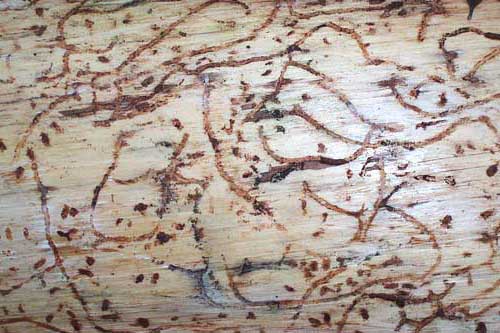
There in the northeastern corner of Querétaro state between 6000 and 6900 feet (1800-2100 m) the forest is predominantly Oak, QUERCUS AFFINIS, and pine, PINUS GREGGII. Arriving at the cutting zone three local fellows already had cleared a good bit, and debarked pine trunks lay in piles stacked three and four logs high -- a major feat since the men worked without machinery or mules. The white, debarked pine trunks were very heavily ornamented with brown arabesques -- the beetles' deadly tracings. You can see what that looked like at https://www.backyardnature.net/n/06/061229bb.jpg.
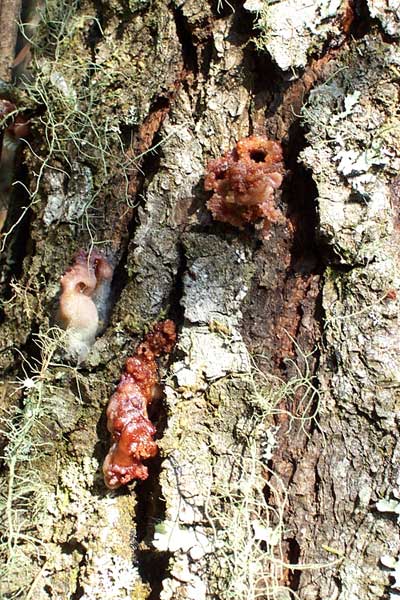
Nearby trunks of standing pines were perforated with holes that oozed resin. You can see some oozy holes with their typical resin chimneys at https://www.backyardnature.net/n/06/061229b2.jpg.
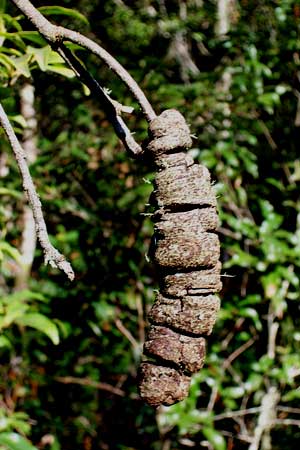
What's even worse is that the oaks are succumbing as well as the pines. A fungus causes finger-sized growths on the twigs. I'm guessing that these growths prevent food photosynthesized in the leaves from reaching the trunks, so the trees die of starvation. You can see a growth at https://www.backyardnature.net/n/06/061229of.jpg.
Beto thinks that recent droughts of historic magnitude, probably associated with global warming, are behind the calamity. Droughts weakened the trees' immune systems, so diseases that usually wouldn't do much harm now overwhelm defenses.
Pinus greggii appears to be especially vulnerable to bark beetles. Still, it's being planted elsewhere in the reserve because it grows fast, people need the trees, and the eroding land needs trees, fast.
*****
MEXICAN MAGNOLIAS
To recover our spirits Beto took me into the valley below the dying slopes. One of the star attractions there was the endemic, endangered Cloudforest Magnolia, MAGNOLIA DEALBATA. We weren't in cloudforest there but cloudforest did mantle the ridge above. Cloudforest Magnolia possesses very large leaves with eared, or cordate, bases much like the US Southeast's Bigleaf Magnolia, of which sometimes it's considered a subspecies.
So, as with our Sweetgums I've told you about, here we see another instance of North America's eastern forests having been driven south during the Ice Age, then when the glacier retreated part of the exiled forest migrated back north while part stayed here, just moving up in elevation. Among the species who stayed in Mexico and went up in elevation, evolution proceeded at different rates. Some species, like the Sweetgums, are still considered the same species as up north, while others are now recognized as local Mexican subspecies, while others are thought of as newly evolved full species. Consensus seems to be that Cloudforest Magnolia is a whole new species -- but just barely -- mothered by the US Southeast's Bigleaf Magnolia.
Also in the highland forests of this part of the state are the following plants an eastern North American woods- lover would know: Redbud; Hornbeam; Hophornbeam; Black Cherry; Deciduous Holly; Virginia Creeper, and more.
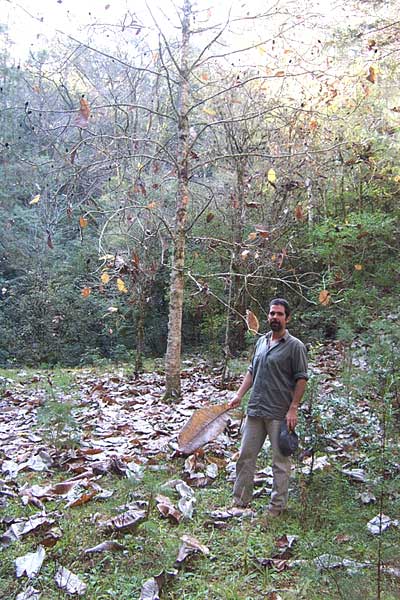
The Cloudforest Magnolia we saw must have dropped its leaves during the previous two or three days, for the dry litter of big leaves beneath it created a crunchy, crackly riot of wastepaper-like silveriness. Light poured through the newly opened canopy creating an ecological sensation like that you feel with your tongue when exploring the hole left by a newly pulled tooth. You can see Beto holding a leaf beneath near-naked limbs, and try to sense that feeling of unaccustomed-to light intruding into a previously dark, sheltered grotto, at https://www.backyardnature.net/n/06/061229mg.jpg.
Mexico is a good place to see magnolias. Another species also in our Sierra Gorda area, an IUCN Red-Listed threatened species, is M. schiedeana. I find eight magnolia species listed for Mexico, plus there's a magnolia look-alike in the same family, genus Talauma.
*****
"ROOTLESS HERB"
I was told that lots of rattlesnakes were around so I asked about local snakebite remedies. Beto laughed and said that nowadays if you're close to a road you try to get to a hospital but when you're way back in the woods the way we were you just have to sit down and wait for what happens. However, back in the old days people used "hierba sin raíz," or "rootless herb."
"Rootless herb" was a pile of human excrement.
Later I asked another friend if she'd ever heard of such a thing. She said that when she was a kid many years ago a friend got bitten by a poisonous spider and her aunt went and prepared "hierba sin raíz," with chocolate to kill the taste. The concoction seemed to remove all symptoms, she said.
I like to think that many of these old remedies have a grain of truth to them but I wonder about this one.
*****
DON ANTONIO'S PULQUE
Last Friday Margarita and her son Paul invited me to hike with them up the mountain to the east of town, to visit their weekend house in an isolated, tiny village. Most of the hike took place on a trail between stone walls and worn deep by centuries of foot travel. That trail must have been in use since pre-Columbian times. Now few people use it because a gravel road has bypassed it.
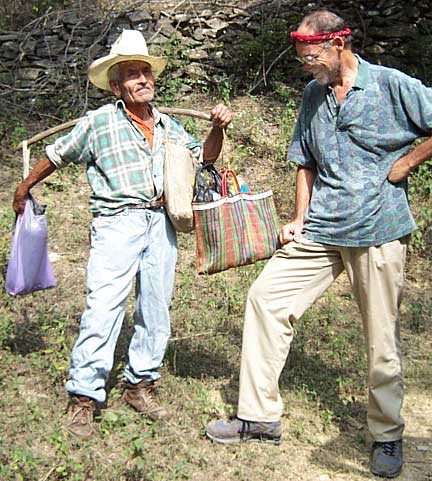
However, the one person we did meet was Margarita's uncle, Don Antonio, coming down the trail with a pole over his shoulder carrying bags in which rode large plastic Coke bottles filled with Don Antonio's homebrewed pulque, which he planned to sell in town. Don Antonio knew what he was doing because that night there'd be lots of Christmas celebrating in town, and pulque is this region's traditional alcoholic drink. Don Antonio had fermented it (not distilled) from sweet sap of the giant agave called Maguey. Pulque and Maguey are important features of traditional society here and I'll tell you more about them later. Meanwhile you can read about pulque at http://www.mezcal.com/pulque.html.
Also, you can see me standing next to Don Antonio at https://www.backyardnature.net/n/06/061229pu.jpg.
Of course Don Antonio insisted that I take a sip. When he opened his Coke bottle, the sweet, foamy, only-slightly alcoholic liquid spewed onto the ground like Champaign. It wasn't bad tasting and I was glad to experience a bit of local tradition, but it's hard to see how some men get hooked on it.
*****
MARGARITA'S TUNITAS
In Margarita's garden there was a tall Nopal Cactus like the one talked about in last week's Newsletter, and it was just covered with flowers and flower buds. When Margarita saw this she was delighted and said we had to get to work gathering our next meal. I was confused, for I didn't see a mature fruit on the whole cactus.
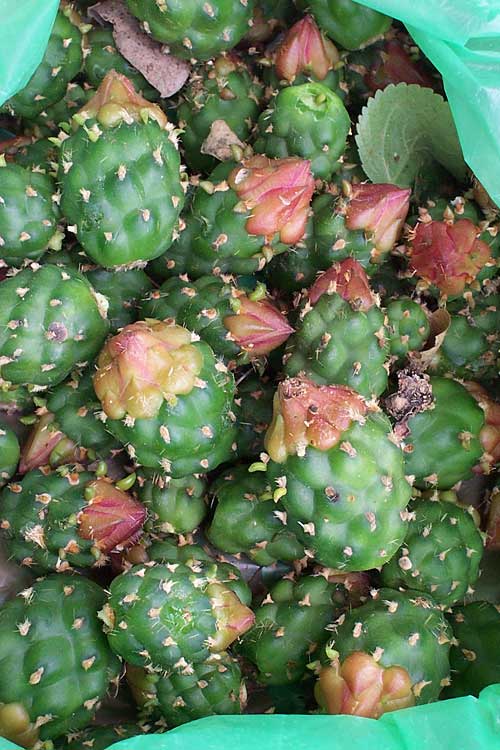
Margarita fetched a long bamboo pole and began knocking off flower buds -- actually the ovaries of the flowers before flowering had occurred. She said that after flowering the fruits would be too fibrous to eat. She also explained that this was one of the many varieties of Nopal Cactus, one producing edible flower ovaries instead of edible fruits. You can see a pretty picture of what we collected that day at https://www.backyardnature.net/n/06/061229no.jpg.
In that picture you can see that each ovary bristles with tufts of glochids -- the minute, very sharp spines I told you about last week. Even wearing plastic bags over our hands while retrieving the ovaries -- referred to as tunitas -- we got glochids in our fingers.
When we got back to town we dropped by the house of Margarita's aunt and asked if we could prepare an impromptu meal of tunitas in her kitchen. We were completely unexpected but this is Mexico and it's something special to have a bag full of tunitas, so the aunt was delighted with the idea, and immediately preparations began.
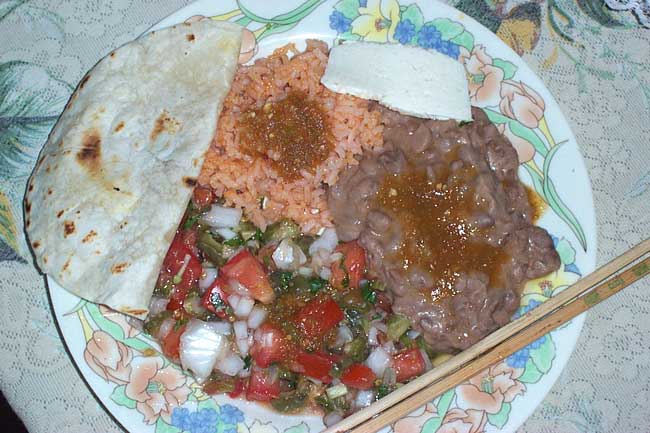
The tunitas were placed on the ground and switched just as described in my last newsletter, to remove the glochids. Then they were washed and once absolutely glochidless they were cut up and sautéed in a skillet while onions, tomatoes, garlic and cilantro were chopped. The diced tunitas cooked up just like okra -- slimy. The finished dish also tasted as good as any okra dish, with a slightly sour taste. You can see a plate of it, along with the obligatory beans, tortilla, white cheese, and even some rice, all generously spritzed with hotsauce, at https://www.backyardnature.net/n/06/061229n2.jpg.
Don't wonder at the chopsticks on the plate. I always carry chopsticks just in case a good eating experience arises.
*****
HOYA DE LA LUZ
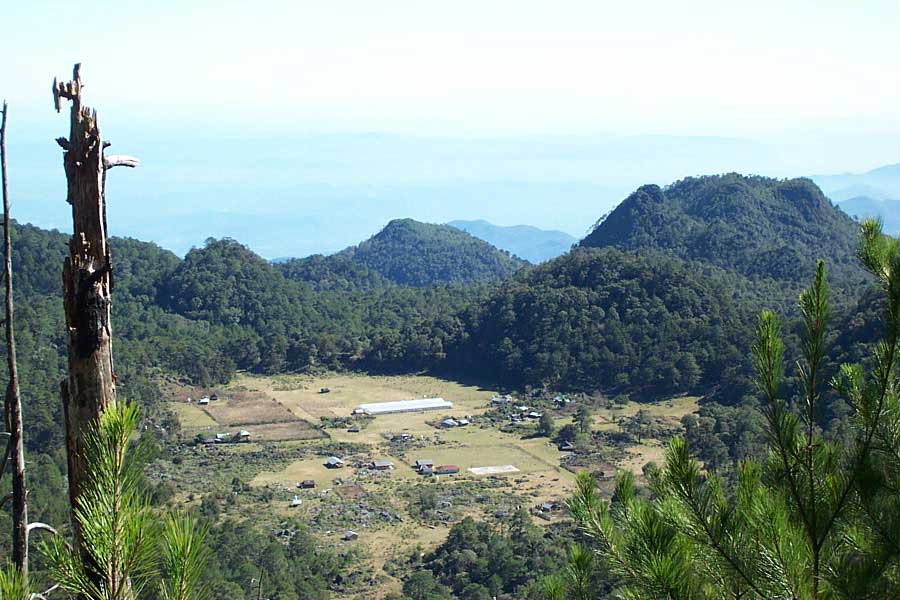
Last Saturday, the 23rd, my friend Roberto drove me across the main Sierra Madre ridge onto the Gulf Slope just beyond the Querétaro border, into the state of San Luis Potosí, near Xilitla. In the four-wheel-drive Jeep we took a one-lane road steeply upslope to its end, then hiked a very steep trail for two hours to the isolated settlement of La Trinidad. La Trinidad is another little village, of about 15 families, we're helping develop ecotour infrastructure, with rustic bungalows. How wonderful those folks were, and how delicious the Christmas tortillas-and-beans, and thick bean gorditas they regaled us with.
You can see spread-out La Trinidad from a slope above town, with the Gulf Lowlands toward the east beyond town, and get a good feeling for the lay of the land at https://www.backyardnature.net/n/06/061229lt.jpg.
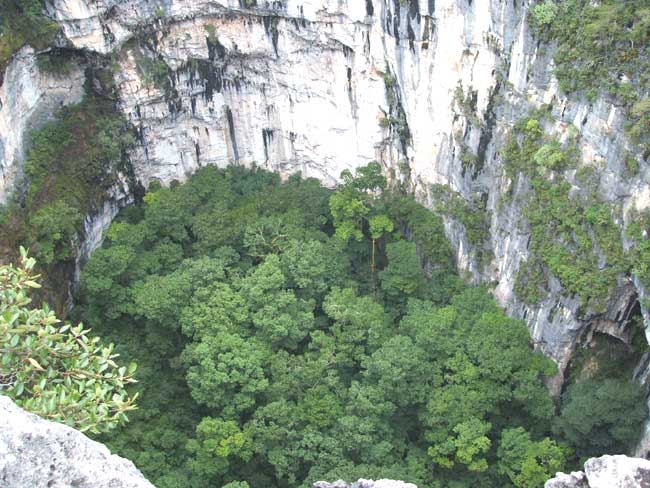
Roberto left me at La Trinidad, for my wish was to climb higher into the mountains and wander a bit. Consequently, on Christmas day I found myself at about 7500 feet in elevation (2300 meters) perched precariously at the lip of the most spectacular sinkhole I've ever seen, known as Hoya de La Luz. Hoya de La Luz is internationally famous among rappellers but seldom visited, because it's so hard to get to. Folks at La Trinidad said it's been about ten years since anyone has tried descending into it. You can see its picture, though the image hardly conveys the toe- curling enormity of the hole, at https://www.backyardnature.net/n/06/061229hl.jpg.
The drop into the pit is officially given as 591 feet (180 meters), which actually isn't all that deep compared to other Mexican holes. On a web page called "Deep Pits of Mexico," provided in PDF format, you can see at http://www.amcs-pubs.org/longanddeep.pdf that Mexico's deepest pit, at 1345 feet (410 meters), is El Sótano de El Barro, which also is located here in Querétaro State. Well, if any rappellers out there want to dip into our deep pits, contact me, for I know plenty of folks eager to guide and provide packhorses, and believe me you'll need guides and horses.
One account of an entry into the pit by some appropriately wild-sounding gringos reports on conditions at the pit's bottom: "It was massive. Grass, waterfalls, streams, shrubs, and trees over 100' tall. The tallest tree was about 175' tall, judging from the markings on the rope." You can read that report at http://www.caves.org/grotto/cullman/pages/Newsletter/donde.html.
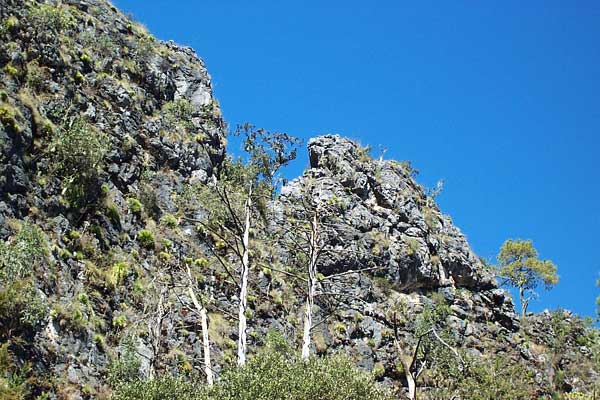
Hoya de La Luz is so enormous that I have problems explaining it as a simple sinkhole, though I suppose that that's what it is. The area's geology is tortured- looking. It's the Cretaceous limestone I told you about the last time, but by no means is this limestone anything like the dignified, more or less horizontal, white strata that so prettily framed the Kentucky River this summer. I photographed a ridge of squeezed, folded, eroded rock but the image doesn't convey the dimensions and feelings of things. Maybe if you study it you can feel it. It's at https://www.backyardnature.net/n/06/061229rx.jpg.
I kept expecting the most tortured, loopy-looking outcroppings to be basalt -- cooled volcanic magma. However, whenever I chipped off a piece my handlens revealed dainty little rhomboid crystal faces of calcite, the stuff of limestone.
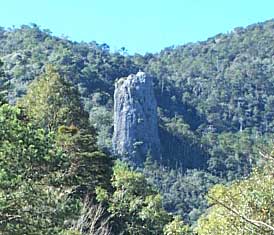
But there's one feature easily visible from La Trinidad which I think may be an ancient volcanic neck that's had the limestone eroded from around it. I couldn't get to it to see what kind of rock it's made from. You can see the thing at https://www.backyardnature.net/n/06/061229nk.jpg.
You can see other known volcanic necks and read how they and other volcanic structures are formed at http://volcano.und.edu/vwdocs/volc_images/north_america/arizona/navajo.html.
*****
THE BIRDS OF CHRISTMAS
Longtime readers of this Newsletter may recall my tradition of taking a birdwalk on Christmas Day, and telling you which birds I see. This year on Christmas Day I was in a high-elevation landscape with relatively few bird species. Last year in the Yucatan I listed 31 species. This year I have 11. Here they are, listed as I saw them, starting at dawn at the grassy, flat edge of La Trinidad:
1) MEXICAN JAYS, 3 crestless, pale blue and gray birds nosey and alert like any jay but with a softer, friendlier call than others, WEENK? WEENK? WEENK?... See http://www.fishcrow.com/mexican_jay.jpg.
2) YELLOW-EYED JUNCOS, 5 or 6 spooked from a small, weedy sinkhole, their yellow eyes shining demonically in dim morning light. See what I mean at http://www.geocities.com/tgrey41/PagesBirdsMexico/YelloweyedJuncopm.html.
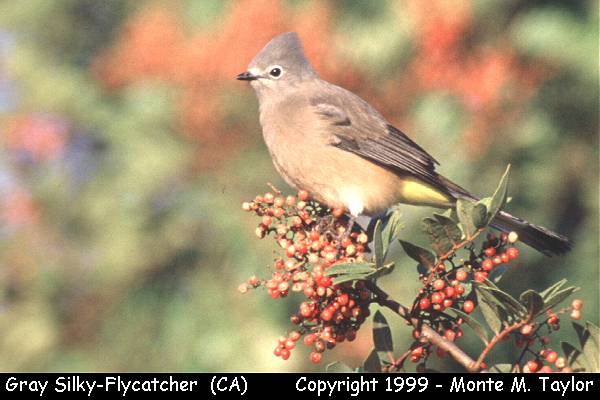
3) GRAY SILKY-FLYCATCHERS, a flock of mousy-looking little titmouse-like birds with weak, high-pitched calls: http://www.tsuru-bird.net/wagtails/silky-flycatcher_gray1.jpg.
4) CHIPPING SPARROW, silent, in tree inside the village
5) WESTERN BLUEBIRD, silent, in tree inside the village
6) NORTHERN FLICKER, red-shafted form, flying from tree to tree, making his squeaking call
7) TURKEY VULTURE, circling above the village
8) KESTREL, circling above the village
9) RAVEN, in the mountains, surrounded by high, treeless peaks, I hear his croaking but don't see him.
10) ACORN WOODPECKER, common at these elevations where the oak Quercus affinis has dropped an enormous harvest of mast on the ground, like walking on marbles
11) CRESTED GUANS. More about this below.
*****
CRESTED GUANS
I'd never seen a Crested Guan. Formerly they were common from Mexico to northern South America, but they are large, turkey-like birds and have been hunted so thoughtlessly that over most of their former distribution area they've been wiped out. You can see the handsome bird at http://www.greglasley.net/crestguan.html.
So, toward dusk I was hiking through a very dense, shadowy stand of Mexican Cypress trees (Cupressus lusitanica) with a few oaks (Quercus affinis). Suddenly out of the chill gloominess there erupted several very loud, sharp QUONK-QUONK-QUONK calls almost like the sound of a wet finger stroking a wet balloon. Then there was heavy flapping and movement all around. Six to eight Crested Guans moved away from me from the ground and low branches to higher branches, looking like they didn't really want to fly, taking their time getting away and glancing over their shoulders as if hunters and guns didn't exist. In this light they looked totally black and the size and shape of Wild Turkeys, but with very conspicuous, bright-red wattles. Books show them with lines of white speckles on their chests but I would have sworn they were totally black.
Another few minutes of walking brought me into another flock sounding and behaving the same.
At dusk, in the bottom of a dark little valley, I set up my tent on a solid floor of acorns beneath Quercus affinis. The acorns were small so my bed didn't feel nearly as uncomfortable as it sounds. The moment I pulled the sleeping bag's hole shut there came a QUONK. Then more, then many more, stereophonic QUONKING, gloriously surrounded by birds I'd never chanced to see until this very Christmas Day!
*****
CLOUDFOREST PLANTS
Certain ridges above La Trinidad were mantled with cloudflorest. This is where
"clouds run into ridges and peaks," keeping the air so moist that special plants grow.
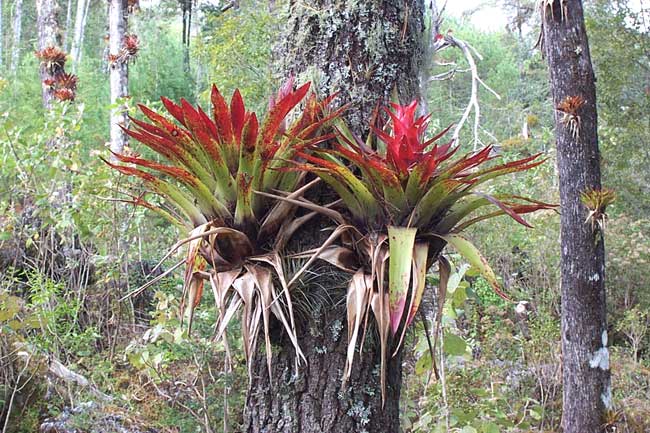
For instance, on tree trunks right outside La Trinidad grow some the most colorful bromeliads I've ever seen. I think they're TILLANDSIA IMPERIALIS, and if they're not they're certainly very close to that species. I'm a little uncertain about the identity because La Trinidad's plants are much more colorful than those I find under that name pictured on the Internet. Look at two of them at https://www.backyardnature.net/n/06/061229ti.jpg.
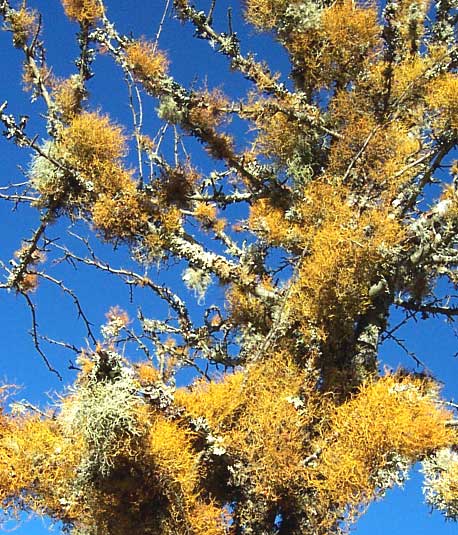
Certain trees were very heavy with the lichen I assume to be "Wolf Moss," genus LETHARIA, which I told you about -- including why it's called Wolf Moss -- in my August 21, 2005 Newsletter, written from California. My picture is at https://www.backyardnature.net/n/06/061229wl.jpg.
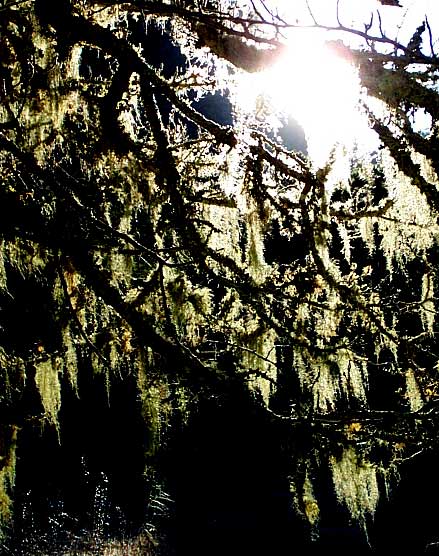
Look at "Old Man's Beard Lichen," genus USNEA, draping a tree at https://www.backyardnature.net/n/06/061229us.jpg.
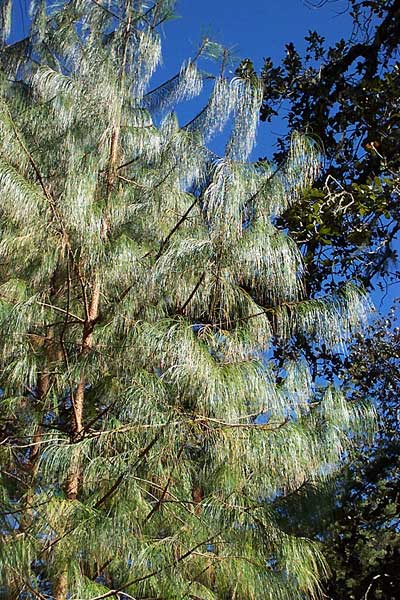
The pines are "Mexican Weeping Pines," PINUS PATULA, with curious long, drooping needles. Why would a pine "weep"? I think it has to do with the high humidity, the drooped needles making it easier for condensation to drip off. See https://www.backyardnature.net/n/06/061229pi.jpg.
*****
FLORA OF THE CAROLINAS & BEYOND
An amazing free download has become available that can be of enormous value to plant identifiers in the entire US Southeast and beyond. The "Flora of the Carolinas, Virginia, Georgia, and surrounding areas," also known as "Weakly's Flora," is freely available in PDF format at http://www.herbarium.unc.edu/WeakleysFlora.pdf.
The two wonderful things about this flora are its comprehensiveness, and its attempt to keep its keys relatively simple, focusing on easy-to-see characters when possible. Still, you need to know basic botany to use the keys. A randomly selected line from a key reads "Tepals 2-9 mm long; ovary 3-celled, each with 1-2 ovules; fresh plant with an onion odor; [subfamily Allioideae]." If you're identifying a Wild Onion, you have to plow through that.
The unfortunate thing is that the online edition of the flora is without illustrations. The way I use it is to key out something, then check my identification on the Internet using the Google or Yahoo Image-Search option.
Another great place for identification-checking is at the "Atlas of Florida Vascular Plants" at http://www.plantatlas.usf.edu/browse.asp.
At that site plug the scientific name into the search box on the right, then on the resulting page note the "Photos" icon on the right, which you click to see a photo.
Folks in western North America can use California's "The Jepson Manual" which also uses scientific names. It's at http://ucjeps.berkeley.edu/interchange/I_treat_indexes.html.
*****
AWAKENING ON LLANO DE CABALLO
A feature of the La Trinidad area's physiography is that here and there among the soaring peaks you encounter small flatlands such as the one on which La Trinidad is established. These flatlands are called llanos (YAH-nos), the adjective "llano" meaning flat. On Wednesday morning, my last day in the mountains, at around 7000 feet, I awoke on LLano de Caballo, or "Horse Flat," as it might be called in Wyoming. My tent was white with frost, the nylon above my head a solid sheet of ice where my breath had frozen. It was 25°F (-4°C). Through a slit in the tent's door I peeped outside and saw that the llano's grass was white as if covered with snow. I lay in the sleeping bag until a sunlight sliver stabbed onto the flat from between two peaks.
My tent is for summer camping. Its top is open netting to keep out mosquitoes while letting me see the stars. My sleeping bag is for summer camping, too. Despite wearing trousers over running pants, seven shirts and three pairs of socks, I was cold, but not as cold as you might expect. Instead of placing the tent's flysheet over the tent I'd wrapped it around me. It was amazing how such a thin sheet of nylon made such a big difference. During the night when it'd slip off I'd immediately awaken because of the cold. Little tricks like using that flysheet can mean a lot under extreme conditions.
I went and stood in the sunlight. The llano's grass sparkled like a world of diamonds. The freshness of the air filled me with wonder and a kind of nostalgia -- wishing to share it with someone, knowing it was all about to melt away, knowing that as I approach 60 my vision, hearing, smelling, all are dimming, all are dulling, and what I feel at the present will never again be as intensely felt as now. All melting away.
My breath didn't make a fog. When I peed, steam didn't rise from the wetness. I'm guessing it was because droplets of steam need nuclei around which to form, such as particles of dust or pollution, and in this pure mountain air there were no impurities. Man that's pure when it's so cold, but your pee doesn't even steam.
When the sunlight shined on me and my body warmed, you should have seen the dust particles off my clothing waft into the air on vagrant curls of convecting warmth and soar upward, in the intense sunlight with black mountains behind streaking like incandescent sparks at midnight. What a dustbin I was, but now I was being purified by coldness and sunlight.
What did it all mean?
This was my celebration hike for the beginning of the New Annual Cycle, which started with the Winter Solstice on December 21. I accepted the gift of the moment as an auspicious new beginning for a new year full of things to behold and treasure.
In this New Year may we all be purified and renewed the same.
LLano de Caballo proves that even old dustbins can be rehabilitated and filled with delight.
*****
Best wishes to all Newsletter subscribers,
Jim