April 17, 2005
MULE DEER & WHITETAILS
I see lots of deer here, as well as deer damage. Last fall I planted a small fig next to my trailer looking forward to watching it leaf out now. Instead, it's just standing there with its topmost bud neatly snipped off.
I'd been thinking of these deer as the same as those with whom I've coexisted in the East, but the other morning when one spooked along the road instantly I saw that they were not the same. Instead of leaping up with one paw extended beyond the other, it kept the lower parts of its front legs bent backwards and its body more or less horizontal all the time. The deer appeared to be bouncing from spot to spot, using its legs like springs instead of running on them.
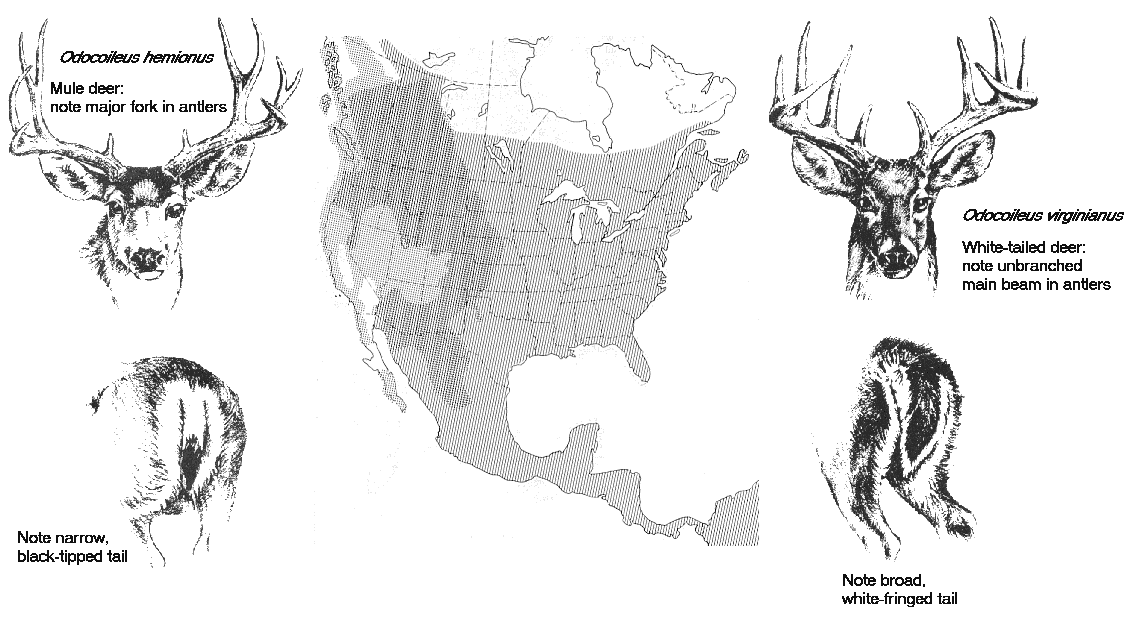
These were Mule Deer, ODOCOILEUS HEMIONUS, not Whitetails, ODOCOILEUS VIRGINIANUS. The two species are similar, which might be expected since they belong to the same genus. The easiest-to-see difference is that the Mule Deer's down-hanging tail is narrow and white but black-tipped, while the Whitetail's down-hanging tail is wider and black with a white fringe. You can see these and other differences, plus a distribution map at www.mun.ca/biology/scarr/Odocoileus_variation_&_distribution.gif
The above map shows that Whitetails occur across North America, clear through Central America into South America, while Mule Deer are strictly a Western species. In the map, the darker area represents the Mule Deer's distribution almost entirely inside the Whitetail's. Mule Deer favor coniferous forest, desert scrub and grassland with shrubs while Whitetails live in forests, swamps, open brushy areas and, nowadays, suburbs.
I've also seen Whitetails here. I read that during the summer Whitetails stay at the higher elevations but during cold months they move lower. Right now the Sierra Nevada peaks and plains above us lie beneath a snow pack about one-third deeper than usual, 26 feet in places.
*****
WILD TURKEYS IN CALIFORNIA
Several times this week a Wild Turkey has come around my trailer. As with the Mule Deer, the moment I saw her I knew she wasn't like a Mississippi turkey: Even when I walked fairly near, she wouldn't fly away. I'm used to turkeys hiding themselves masterfully and flying away at the merest hint of anything unusual.
When I saw the turkey I recalled a map showing the species' original distribution and I was pretty sure that it had indicated that the bird was essentially an eastern North America species, but introduced in many areas outside its range. After a little Googling I found that the topic of "the Wild Turkey's original distribution" is a hot topic.
If we say that its original distribution is what it was in Columbus's time, then most experts seem to agree that originally Wild Turkeys were not present in California. However, if we go back to the Ice Ages and before, then there's good evidence that California once had them. The turkeys I'm seeing now, however, result from introductions made by the California Department of Fish & Game. There's a fine article on this matter with a distribution map and references to the fossil record at www.montereybay.com/creagrus/turkey-in-CA.html
The question of whether Wild Turkeys are native or not is important. Wildlife managers use the rule of thumb that the introduction of a non-native species usually is bad because the local ecology didn't evolve to accommodate the species, while the reintroduction of an extirpated species usually is good because it adds diversity and stabilizes the local ecology by "filling in holes" in the local ecosystem's web of life.
******
AUDUBON'S WARBLERS AT DAWN
I'm still surprised to be seeing so few spring migrants. One reason may be that birds are most active in early morning, and that's just when it's so windy here at the canyon's edge. Wind tends to cut down on bird activity.
Probably the main reason, however, is that here we're not within a major bird-migration flyway as was the case when I was in Mississippi and western Kentucky. A map showing the Pacific, Central, Mississippi and Atlantic bird-migration flyways at www.pwrc.usgs.gov/BBL/homepage/bigbndc.htm indicates that here we're on the ragged west edge of the Pacific Flyway.
All through the day here I do hear a pretty, high- pitched, warbling call I associate with migration. In the East I'd unhesitatingly identify it as the call of the Yellow-rumped Warbler, but here the bird making the call has a yellow throat instead of the eastern Yellow-rumped's white throat, plus our bird bears a large white patch on its wing, which the eastern Yellow-rumped doesn't.
The deal is that here we have the western subspecies of the Yellow-rumped Warbler, and I'm accustomed to the eastern subspecies. When my old Peterson fieldguide was published in the 60s, it considered the two subspecies as distinct species, and referred to what we have here as the Audubon's Warbler, DENDROICA AUDUBONI. However, later it was recognized that where Audubon's Warbler meets the eastern subspecies -- then called the Myrtle Warbler –- they hybridized producing intermediate individuals, so the two populations were lumped into the Yellow-rumped Warbler, DENDROICA CORONATA. You can see an "Audubon's Warbler" at www.pikespeakphoto.com/warbler.html.
On chilly mornings, how nice seeing this bird flying through stiff breezes from one sunlit Ponderosa Pine top to another, calling his pretty song. You can hear it yourself at www.naturesongs.com/yrwa2.wav.
*****
POISON OAK & BEYOND
Poison Oak is about as abundant here as Poison Ivy back in the East. Moreover, here in early spring it's so attractive that you're tempted to pick a sprig and taste it. The leaves are glossy, succulent and reddish, a little like Oak-leafed Lettuce. You can see such leaves at www.odsa.com/images/oak1.jpg.
When I was a kid I learned that "Poison Ivy grows in the East, Poison Oak in the West." Now I know it's more complex than that.
For instance, we have Pacific Poison Oak here, TOXICODENDRON DIVERSILOBUM, which doesn't make it as far east as Utah, and then in the US Southeast there's Atlantic Poison Oak, T. PUBESCENS. Eastern Poison Ivy, T. RADICANS, occurs in eastern North America, but there's also a Western Poison Ivy, T. RYDBERGII found in both the West (but not California) and the northeastern and north-central states. Maps showing the distributions of these species appear midway down the page at http://plants.usda.gov/cgi_bin/topics.cgi?earl=plant_profile.cgi&symbol=TOXIC.
****
YELLOW STAR TULIPS GALORE
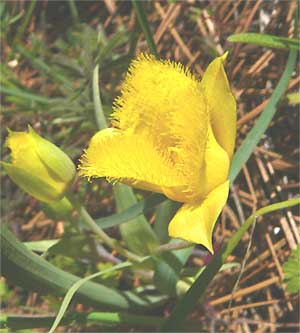
I'm seeing lots of wildflowers that are new to me. On grassy slopes around my trailer the most conspicuous one right now is what the locals call Pussy Ears, but the books also call Yellow Star Tulip and other names. It's CALOCHORTUS MONOPHYLLUS, of the Lily Family. You can see a picture I took of one at www.backyardnature.net/sierras/calochor.jpg. That picture highlights what is behind the name "Pussy Ears": The blossom's three, cat-ear-shaped petals are strikingly fuzzy with long, yellow hairs. If you look closely at the hairs you can see that they are enlarged at their tips, like matchsticks. I suspect these tiny knobs help pollinators hold onto the petal as they enter the flower to gather nectar. The plant in my picture is about six inches high but they get taller.
The genus Calochortus embraces species whose slender leaves and stems arise from bulbs, and it seems to be very characteristic of the Sierra Nevadas. Six species are listed in Storer & Usinger's "Sierra Nevada Natural History." I don't recall running into the genus in the East.
Our Yellow Star-tulip is strictly a Sierra-Nevada- foothill species, occurring only in the Ponderosa- Pine-dominated zone between 1200 and 3600 feet. Its distribution map is at the bottom of the page at http://ucjeps.berkeley.edu/cgi-bin/get_JM_treatment.pl?Calochortus+monophyllus.
By the way, if you're as impressed with the above page as I was you may want to look at its home page at http://ucjeps.berkeley.edu. This site provides an enormous amount of information on the California flora.
*****
GROWING ALFALFA SPROUTS
One of the pleasures of living here is that my friends and I share many opinions with regard to food and eating. They also are vegetarians, also pay close attention to their daily nutritional intake, and also enjoy experimenting with foods. As Diana said with regard to paying close attention to her nutrition, "It's almost like a hobby."
My friends grow alfalfa sprouts continually (they also drink juice containing wheat-grass but that's another story), like I've done much of my life. Since sprouts are exceptionally nutritional, growing them is easy and fun to do, and my friends let me use their dandy digital camera, this week I've created a nicely-illustrated web page showing how to grow alfalfa sprouts. You can view that page at www.backyardnature.net/simple/alf-spr.htm.
An article in Mother Earth News called "Cooking with Sprouts" reviews many kinds of beans sprouts and provides several recipes (but inexplicably referring to alfalfa, radishes and clover as grasses) at www.motherearthnews.com/library/1993_April_May/Cooking_with_Sprouts.
A overview of the health value of alfalfa sprouts is at www.living-foods.com/articles/sproutbenefits.html.
Most health-food stores sell alfalfa seeds for sprouting. One place online to buy seeds, sprouts and growing paraphernalia is www.sproutpeople.com/.
*****
WENDELL BERRY OF KENTUCKY
Friday night the local Public Radio station in Sacramento aired a presentation by writer Wendell Berry of Kentucky, recorded during a visit here. I first heard of Wendell Berry during the early 1970s when I was at the University of Kentucky. I remember seeing him sitting up front at concerts and lectures, a handsome man with a good tan, always surrounded by attentive admirers.
All I knew about him then was that he was a writer. At that time I was so absorbed in my own studies that I never sought out his works. During years since then people have mentioned him to me, but only a few years ago did I learn that he writes on topics of interest to me, such as simple living and farming. I am a little embarrassed to admit that, largely because my life has been spent on the move, on the cheap, and apart from society, to this date I've never read a single word he's written.
But Friday night I lay in my trailer listening as the wind flowed through the pines around my trailer and he read from one of his works -- an essay particularly appropriate for our time, about "ignorant arrogance."
Wendell Berry's spoken accent sounds very comfortable to my ears, like someone's from just down the road from where I grew up in rural western Kentucky. His thinking patterns are just as comfortable. His depth of insight and ability to express himself are a joy to experience. Now I understand why all those admirers sat around him at concerts and lectures, and I wish I'd gone and sat near, too.
I intend to check him out now, a little late. You can do the same thing at http://brtom.org/wb/berry.html where many works about him and by him are presented.
*****
EDGINESS
I remember what it was like in Mississippi this time last year, and the Aprils of other of my hermit years there -- awakening each morning to the chorus of birdsong, my campfire breakfasts, the forests and fields always so head-swimmingly green, feeling so enmeshed in the bedrock of the cycle of the seasons around me...
Here I don't have campfire breakfasts because each morning at dawn it's too windy. We're at the edge of a big canyon and at dawn cold wind from upslope drains into the canyon below us, gushing around us, filling the Ponderosa Pines around my trailer with wind sounds and sometimes even nudging my trailer like a big hand. My friends warm their house with a large wood-burning stove so now each morning I just place my skillet atop their stove and after awhile my concoction is cooked.
Above us there's a big national forest but at dusk I can see houselights across the canyon and beyond them there's an ocean of more lights, where many thousands live in the Sacramento Valley. I'm on the edge of both a vast wilderness and a vast urban area.
Even the forest and the air itself strike me as having a certain edginess. Back in Mississippi, spring forests are moistly lush and softly yellowish- green, but here the spring forest, even after a rain, has a certain crisp feeling, and it's gray-green in a reserved, almost stingy-feeling way. Sometimes I think I even feel the tension between the land wanting to be covered with forest, and the dry air insisting that it make do with scrub.
Fire behaves differently here. This week I was burning slash when a rogue flame shot up, swirled around as if gorging on the air itself, and singed off what little hair-fuzz I had left atop my head. The same brush-pile in Mississippi would have burned more congenially, burned with a decent reserve, almost respectfully. Fire here gives me the creeps, and it's not even the dry season yet.
In fact, nearly everything here feels edgy and I seem to be on the edge of everything. Sometimes I wish for old routines, being embedded in familiar ways of familiar things but, most of the time, I'm glad to be experiencing new perspectives, to be reshuffling myself, evolving. Maybe I needed to have that fuzz singed off.
*****
Best wishes to all Newsletter subscribers,
Jim