NATCHEZ NATURALIST
NEWSLETTER:
from the woods near Natchez, Mississippi, USA
November 23, 2003
DAY OF THE BUOYANT CRYSTAL CROW
The big storm front that moved across Mississippi Monday and Tuesday wasn't nearly as violent here as elsewhere. The four to six inches of rain we received was welcome after so many weeks of drought. I'm not sure how much it rained because the tin cup used to measure it overflowed long before the rain ended.
Wednesday morning dawned with an exquisite, washed- clean, freshened-up feeling. The air was cuttingly clear with sharp yellow sunlight avalanching in from the east. Though wind had shaken only a few tree leaves off, the forest surprised me with its new relative openness, its sparkling airiness. Somehow the morning's glaring, puckery light made tree leaves look smaller and harder. Summer's warm, soft greens had clotted to hard, glossy greens splattered with stark black shadows, all overlaid with random speckles of yellow and red. Now clear air and light steamed where just a few days ago suffocatingly humid and hot shadows hung in trees spewing mosquitoes and bats.
So here was a kind of day worth celebrating. It seems strange to me that in our culture we don't formally recognize such special days. Certainly we seem to crave celebrations. People hang cardboard skeletons from trees and place huge plastic pumpkins in their lawns a month before Halloween, and by Halloween already Christmas decorations are up.
Nietzsche once said that most people don't see something until it has a name, and I think that that's right. So Wednesday morning as I sipped steaming mint tea from a mug, I sat thinking up a name appropriate for a season's first day of the kind we had Wednesday, a name that would help people actually see such a day and appreciate it the next time one rolled around. Gradually my idea for a name built toward "Day of Wind-chill, Washed-blue Sky and Open Forest."
But, then a crow flew overhead, white feather-gloss rimming his wind-buffeted, black body, and when that crow looked down at me and laughed, I understood his opinion of my name, and I knew what name he was offering himself:
Henceforward I shall celebrate such days as "Day of the Buoyant Crystal Crow."
*****
WIND-DISPERSED SEEDS EVERYWHERE
My breakfast campfires are on the trailer's eastern side so the sun comes up right there in front of me. Sunlight fractures while passing through tree limbs, then shows up as slender, straight sunrays stabbing through my campfire's smoke. From my perspective the rays radiate from the sun like spokes of a wheel, exactly as in those pictures on funeral-home calendars showing Jesus walking on water beneath a stormy sky with the sun just breaking through.
With the morning sun in my face, whatever stands between the sun and me is backlighted. If the object is solid like a crow, it makes a black silhouette encased in a close halo. If the backlighted thing is fuzzy, the fuzz explodes in the light like a spark in the wind.
Wednesday, wind coming from the west bore untold numbers of tiny parachuted fruits of goldenrod and Little Bluestem, from the Loblolly Field. As the fruits sailed past me sitting in the trailer's wind- shadow and facing the sun, the closer they drew to the sun, the more light they gathered, until finally I had to avert my eyes.
After breakfast I went to see if the newly sowed mustard green seeds were sprouting. When I got my face down next to the ground I was amazed to see the numbers of goldenrod and Little Bluestem fruits that had parachuted there, along with a few fruits of aster and eupatorium.
All summer these plants had grown green leaves and stems, then in the fall they'd adorned themselves with flowers that painted the landscape with bright colors, especially the goldenrod I told you about, and then for weeks the flowers had matured into shaggy fruiting heads, and finally the plants waited for such a day as this, a very windy day with dry air.
If the Day of the Buoyant Crystal Crow was worth my celebrating, then how much more were the goldenrods, Little Bluestems, asters and eupatoriums rejoicing as they accomplished their last task of life in such a beautiful manner as I witnessed Wednesday?
*****
THE CLIMATE OF EARLY 19TH CENTURY NATCHEZ
On the Internet I tried to find the official rainfall numbers for Monday and Tuesday in Natchez, but only succeeded in Googling up a brief paper on another topic, published by the US Army Corps of Engineers. Apparently someone in the Corps had found weather data kept at Natchez back during pioneer days from 1798 to 1819, and these data were compared to those of today.
The author concluded that, in general, the climate then was distinctly cooler than today. The average annual temperature for the era was 64°F (18°C), which is nearly 2°F (1°C) lower than during the period from 1961-90. Analysis of frost data implies a much shorter growing season back then. Rainfall at that time in Natchez averaged only 84% of what it is now. Interestingly, the year 1816, known in US history as "The Year Without A Summer" because it remained so cold all summer in New England, down here was hot and dry.
The page reporting this information can be accessed at http://ams.confex.com/ams/May2000/12Applied/abstracts/13507.htm
*****
SOUTHERN PRAIRIES
Last week's mention of Little Bluestem and its connection to North America's prairies inspired some great posts at the new NatNat forum. Sue Nell in Louisiana sent this:
At one time, Louisiana had over 2.5 million acres of tallgrass prairie. Today - only about 200 acres remains and that is along abandoned railway rights of way. The prairie country formed a triangle with the points of the angles located at Vinton, Ville Platte, and New Iberia. The prairie developed in an area of flat terrain that averages 50 inches or more of rain a year. Located 8-15 inches beneath the thin loess soils is a densely packed hard clay layer that is not penetrated by the roots of trees and herbaceous plants but is ideal for the growth of prairie plants. Studies of pollen, fossil plants, and diatoms in sediment cores done by Dr. Miriam Fearn, suggest that this area of tallgrass prairie has neither expanded nor contracted in the last 6000 years and that fire has contributed to its maintenance. Today this area has been cultivated and planted in rice and sugarcane and so has gone the way of the tallgrass prairies in the west. Remnant strips of prairie have been surveyed for plants, butterflies, and dragonflies. I am amazed at the diversity that shows up in just these small isolated pockets of prairies. Flora - 512 taxa representing 92 families and 277 genera. 92 species of dragonflies and damelsflies. 54 species of butterflies. And that is in the 'leftovers.' Imagine what the 2.5 million acres was like!
Sue Nell sends along a link to a fine site about "Louisiana's Cajun Prairie," at www.cajunprairie.org
Sue Nell's posting prompted Jerry in Pelahatchie, Mississippi to speak up about Mississippi's own prairies:
Mississippi has also lost most of its prairies. Ours are black belt with many species. Some causes of loss are soil disturbance, no fire maintenance and movement of species that out compete. Our most prominent site is Harrell Prairie, 200 acres, in Bienville National Forest outside of Forest, Mississippi (very near I-20 if you are driving through). It is a public place but because of activities the site is maintained locked. It is accessible on request. Contact me if you want information. May - July is best but you can find things there year round. It is fire maintained and the botanist is enthusiastic to have visitors. We have many remnants of this system across central MS and into Alabama. Size of sites differ with most small. The botanist explains the soil is unique in the small zones and does not support the species of plants and trees, usually thick pine forest, that rim most of these prairies, usually located on tops of rolling hills. I think he said it is very alkaline. Grasses and flowers, usually waist high, some persimmon, and an occasional Loblolly Pine in stunted growth.
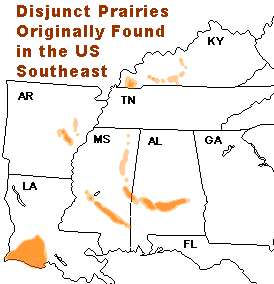
Sue Nell and Jerry make the point that extensive prairies once existed in Louisiana, Mississippi and Alabama. The same can be said of Arkansas and Kentucky. Unable to find a good map on the Internet showing the location of the Southeast's larger prairie patches, I drew one myself, which you can see at www.backyardnature.net/n/03/031123.gif
A map showing North America's main prairie body is at www.botany.utoronto.ca/courses/BOT307/graphics/NAgrasslands400.jpg
*****
SHUMARD OAK
Though not many leaves have fallen yet, and our leaf fall in this area never equals the all-at-once dumping experienced farther north, the forest's leaf litter is indeed beginning to renew itself, and it's fun to watch for out-of-the-ordinary leaves. Sometimes an uncommon leaf blows right past my trailer.
That was the case Thursday when a particularly large oak leaf blew by. It was very deeply lobed with the lobes being unusually spiny-margined, as shown at www.noble.org/imagegallery/Woodhtml/wood1-66/W532.JPG
In our forest the really abundant oak is the Water Oak, with Black Oaks and Southern Red Oaks also being common, and occasionally you run into Swamp Chestnut Oaks and White Oaks. The leaf that blew by Thursday was close to a Black Oak's, but it was much more papery and its underside was smooth and hairless. It was the leaf of a Shumard Oak, QUERCUS SHUMARDII, and the parent tree was discovered right beside the little stream coursing by the barn.
Though most folks haven't heard of Shumard Oaks, the species has a broad distribution in eastern North America and in many places is common. It specializes in moist bottomland soils and grows over a hundred feet high (30 m), so it's really a substantial tree.
I suspect that most loggers just call it "red oak" and don't notice that it's different from others. You can read more about it and see its distribution map at www.na.fs.fed.us/spfo/pubs/silvics_manual/volume_2/quercus/shumardii.htm
*****
DATABASE OF USEFUL PLANTS
Hillary down on the Mississippi Gulf Coast sends us a link to a site produced by the University of Michigan called "A Database of Foods, Drugs, Dyes and Fibers of Native American Peoples, Derived from Plants." It's at http://herb.umd.umich.edu/
This database is fun to explore. For example, lately I've been cracking and eating some of the black walnuts I've told you about, so my fingers are nicely dyed yellowish-brown, and I've had natural dyes on my mind. I typed "black walnut AND dye" into the keyword box at the above address and was rewarded with a page listing sixteen annotated references to publications in which Black Walnuts were mentioned as being sources of dyes used by Native Americans.
For example, from the annotations on that page I learn that the Cherokee used Black Walnut bark, roots and husks for making a brown dye, and leaves for a green dye. The Kiowa used Black Walnut roots to make a bluish, black dye for buffalo hides. The Pawnee used the nuts for making a black dye.
*****
LONG-TAILED SKIPPER IN THE BASIL
Maybe the most pleasant spot in any of my gardens is the basil patch, where three kinds of basil are grown. Right now the very bushy, summery-green plants stand about 3 feet high and bristle with flowering and fruiting spikes. Not only does the basil patch smell good when I walk past it, and often basil leaves go into my omelets and cornbread sandwiches, but also the plants' flowers are magnets for many kinds of pollinators.
Mostly there are bees (at least 3 species), butterflies and moths. For the last few weeks one very handsome visitor has been the Long-tailed Skipper, URBANUS PROTEUS. This is a mostly-tropical species ranging from the Mississippi Valley and all across the southern US, south to Argentina. It's easy to recognize because it is a skipper (large, thick body with small wings) with its back wings much elongated into a conspicuous "tail" and, when seen from above, its back area displays an intense, bluish-green sheen. You can see a fine photo showing all of this at www.duke.edu/~cwcook/pix/longtailedskipper.html
Gardeners may well may be more familiar with the damage this skipper's caterpillar stage does to beans and peas than with the skipper itself. The caterpillar, a green one with narrowr yellow and dark longitudinal stripes, is known as the "Bean-leaf Roller." On your bean-plants' leaves you may have seen where these caterpillars have cut small sheets of bean leaf at the margins, rolled the sheets into coiled canopies, and then entered the shelters. You can see what such a "shelter-flat" looks like at http://creatures.ifas.ufl.edu/veg/bean/BL_damage.htm
I'm already dreaming about all the beans I plan to grow next year, and of having a much-expanded basil patch. Maybe this time next year we'll have a lot more Long-tailed Skippers than we do now.
*****
HELP NEEDED ON THE CHIGGER/ RED BUG QUESTION
In our NatNat forum, Stephanie up in Nashville, Tennessee posted a response to my use last week of the term "redbug" instead of "chigger." She wrote:
I never heard chiggers called redbugs until I married Wendell. He's from Alabama and he says everything wrong. I always pitied him, not being from Tennessee and knowing that a chigger is a chigger. Naturally I assert the superiority of my own term. I am surprised to find a Kentuckian in cahoots with an Alabamian linguistically. Or maybe you've picked up the 'wrong' bug names living in Mississippi.
Stephanie goes on detailing years of confusion, including at one time wondering if the itching-welt- causing-thing we're talking about might even be spider mites.
I have experienced the same confusion. When I was a kid in Kentucky everyone called the itch-making things chiggers and there was no doubt about what people were talking about. I'd heard that Mississippians called chiggers "red bugs" so when I came here I asked one if that were true, and he said it was. So now I try to say "redbug" if I'm talking to a Mississippian, though in my heart I know it's a chigger.
The Internet doesn't help. Bartleby.com, an online dictionary providing word etymologies, muddies the issue by stating that besides "chiggers" and "redbugs" also they can be called "chigoes," "jiggers," "harvest bugs," and "harvest mites." It does at least say that the word "chigger" is derived from the word "chigoe," which, etymologically, they say, may be a corruption of the word "chico" in the Galibi language, or else of African origin. Galibi is an American Indian language spoken in French Guiana. Since "chico" is also Spanish for "small," I wonder why they think "chico" comes from French Guiana when all of Latin America calls every little thing by that name. Etymology is an obscure science.
Anyway, it seems to be up to this Newsletter's readers to help the world figure out where the word "chigger" is used, and where "red bug" is used, and whether those other names are actually employed by real people. Therefore, I invite our widespread Newsletter readers to drop me a short mail telling me where you are and what you call those almost-microscopic critters that make itching welts on your skin. Send your mail to chigger@earthfoot.org