NATCHEZ NATURALIST
NEWSLETTER:
from the woods near Natchez, Mississippi, USA
March 24, 2002
WEEK OF THE BIG CHANGE
During the whole year there will not be a week during which the forest's appearance alters more than during this last one. A week ago the forest was gray and brown but now it is definitely green as leaves burst from their buds. Many trees are flowering. Redbuds and Dogwoods explode at woods' edges, and along streams Cottonwoods drop finger-sized, wormlike, red catkins. Plum trees look like large bouquets of white blossoms with black stems, and the oaks issue millions of honey-colored catkins of male flowers. Pawpaw trees bear their curious three-symmetry brown blossoms and in the forest's understory Red Buckeyes surprise the eye with luscious yellow-green leaves and spectacular clusters of red blossoms. If you are unfamiliar with Red Buckeyes you can see a flowering branch at www.missouriplants.com/Redopp/Aesculus_pavia_peg.jpg
Wisteria vines are heavy with drooping lavender flower clusters you can smell from a hundred feet away. Saturday at dawn as sunlight-dazzle melted frost from green grass and charmed the icy blue air, imagine how those Wisterias smelled, with a hint of plum-blossom from down the road. Smelling this, with the eye on sherbet-flaming azaleas along the drive, a hermit on his bicycle laughs and just peddles on through the orchard's steaming wet grass, which has its own odors, textures and meanings.
*****
POKE WEEK
Also this is the week when poke sprouts got big enough to eat. A well prepared dish of poke is as good as any plate of asparagus and in some ways better. Poke-picking time has always been important to my Kentucky family. When my mother was alive every year at this time she, my grandmother and I would pile into the old Chevy and drive miles to certain spots we knew about, where poke grew in profusion. Poke sprouts from large underground roots, and you pick them when they are up to a foot tall. You can cook them like asparagus or -- even better -- pickle them. What a wonderful thing is pickled poke on a mid-winter fried-egg sandwich!
Poke is known botanically as Pokeweed, PHYTOLACCA AMERICANA. It's such a strange and peculiar plant that it has it's own family, the Pokeweed Family, or Phytolaccaceae. A pretty picture of poke berries, leaves and stem is at www.rce.rutgers.edu/harmfulplants/images/pokeweed.jpg
The best place to find Pokeweed is where somebody has bulldozed a pile of trees. Pokeweeds like recently disturbed, rich soil, open to the full sun. You locate plants by spotting last year's white stems, now bent to the ground as if they had melted. Stems of Giant Ragweed also are white and in similar places, but those stems are more slender and straight. You pick only green pokeweed sprouts, for when the stem's skin turns purple and tough, it's poisonous.
I seldom pick poke here because it's relatively uncommon around Natchez. I'd rather just let it grow unmolested. However, if this week I had been back in Kentucky in some of my old picking grounds, and if I had had a way to can it, I'd have picked several bushels, and I'd have a pot of it cooked up right now!
*****
GLORIOUS AZALEAS
The azaleas planted at Laurel Hill are so pretty that they seem unnatural. I've been in Natchez during this time of year and I know that there the azaleas put on a show.
When my European botanist friends visit America they always express amazement to see azaleas simply growing in the woods, for Europe doesn't have wild ones. In fact, I haven't seen wild azaleas at Laurel Hill, either, though just a few miles east of here, at Pipe Lake, in Homochitto National Forest, they are common. Here the soil, being derived from loess which has a high calcium content, is not acid enough for them. At Pipe Lake the loess is so thin that the soil is acid the way azaleas like it.
You can get obsessed about azaleas, for they comprise a world unto themselves. If you'd like to get a good education on them, go to the Azalea Society of America's home page at http://www.azaleas.org/ Notice that they have a "Frequently Asked Questions" page at http://www.azaleas.org/faq.html
****
GREEN ANOLES AND SPIDERLINGS
Last Sunday I noticed two Green Anoles -- "chameleon lizards" -- at the corner of my trailer, a male and one of his ladies, snapping up one tiny meal after another. Up close I could see that they were feeding on tiny spiders crawling up the trailer's side.
The spiderlings were smaller than a pin-head and they climbed antlike, in single file. I followed their line to the trailer's base, saw how here and there their trail crossed silks stretched like bridges between grassblades, and eventually the line went below the trailer where undoubtedly a cocoon filled with hundreds or thousands of spiders had overwintered.
The migration route ended at a top corner of the trailer, where a dozen or so spiderlings walked around with their tiny rear-ends poked skyward, ejecting sun-catching flares of silk that wafted into the air like kites. As the silks grew longer, the wind's tug increased, a spiderling's rear-end rose higher and higher until the little arachnid stood on tiptoes, and then a certain puff of wind would come along, the creature would release its hold, and away it would drift on the wind. Most ended up just a few feet away in young Sweetgum saplings, but maybe some drifted high into the sky where they may have "ballooned" many miles, for "ballooning" is what this form of spiderling transportation is called.
Before I had approached, the anoles had been eating every spiderling that came along. The ones who ballooned into the sky were just those who made it to the trailer's top while I was there and the anoles were hiding. As soon as I went away the anoles returned and then again every spiderling coming up the wall was eaten.
Well, this is how Nature is. There's a sort of "rule" in Nature that more highly evolved species produce few offspring but provide a lot of care for them, while less sophisticated ones produce lots of babies and let them fend for themselves. This means that your chances aren't so good if you're a spiderling, but it also means that sometimes a couple of Green Anoles enjoy a good meal.
*****
THIS WEEK'S MIGRATING BIRDS
I am beginning my second year of gathering data on migratory birds, for the Gulf Coast Bird Observatory. Each Friday I make a walk of three or four hours -- the same walk every time -- actually counting individual migratory birds. After each walk I upload my numbers to a site on the Internet. Specialists then analyze these data from all along the Gulf Coast. One thing this accomplishes is to document the decline of most of our migrating species as wildlife habitat is destroyed.
We have four kinds of migratory birds here:
Here are the migrating species I saw Friday, March 22:
WINTER RESIDENTS
2 Yellow-bellied Sapsucker
3 Hermit Thrush
10 Ruby-crowned Kinglet
6 Yellow-rumped Warbler
2 American Goldfinch
19 White-throated Sparrow
SUMMER RESIDENTS
4 White-eyed Vireo
6 Yellow-throated Vireo
19 Northern Parula
1 Black-and-white Warbler
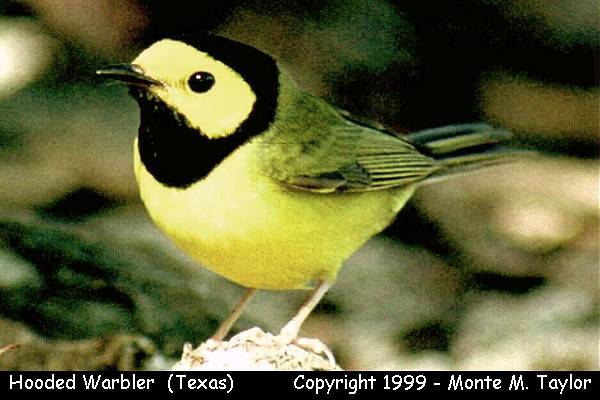
1 Hooded Warbler
1 Yellow-throated Warbler
TRANSIENTS
none
PERMANANT RESIDENTS
1 Brown Thrasher
If you don't know what the Hooded Warbler looks like you should look at the one at www.tsuru-bird.net/a_potpourri/warbler_hooded_male1.jpg This is one of our prettiest birds but few of even the most fervent backyard bird-feeders know it since iit is a forest dweller, and likes to stay low and in dense bushes. Hooded Warblers are common here, but more often heard than seen. A lot more birds would have been spotted on the Friday walk had not it been windy and so cold that at the end of the walk my cramped fingers could hardly grasp the binoculars!
I'll be reporting on the migrants each week. It'll be fun watching the numbers and species ebb and flow.