PLANTS | ANIMALS | ECOLOGY | FUNGI | GEOLOGY | GARDENING | TOOLS
MEXICAN PLANTS & ANIMALS HOME

Adapted from Jim Conrad's online book A Birding Trip through Mexico; This excerpt from "Borderline Cloudforest at Yerba Buena Clinic," in upland Chiapas state
ACORN WOODPECKERS
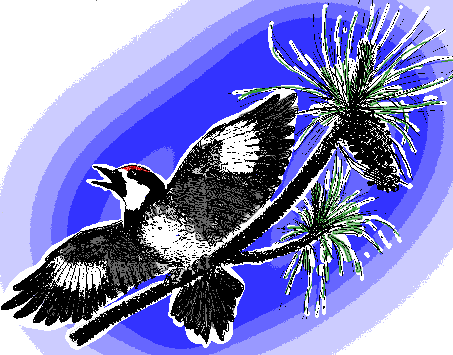
One of the most characteristic birds of the oak-pine forest here is the Acorn Woodpecker, a fairly common species along much of the US West Coast, the US's Desert Southwest, Mexico's western mountains, and in the highlands on down to Colombia. It's a pretty bird, boldly marked black and white, with a red cap and white eyes on a black background.
Here Acorn Woodpeckers constantly fly around making high-pitched fussing notes. There is no way you can see this bird without thinking about its social structure.
Acorn Woodpeckers are cooperative breeders. They live in flocks composed of up to six "cobreeder males," three "joint-nesting females," and several "nonbreeding helpers" of both sexes. Cobreeder males are brothers and/or fathers and their sons, and they compete to mate with the joint-nesting females, who are sisters or a mother and her daughters. The females lay their eggs in the same nest cavity. Offspring produced from this communal nest may remain in their home flock several years as nonbreeding helpers, during which time they help feed younger siblings.
This kind of mating system is known as polygynandry. All individuals within the group are close relatives except that cobreeder males are not related to joint-nesting females. Incest is avoided because helpers only become cobreeders when breeders of the opposite sex die and are replaced by unrelated birds from elsewhere. Reproductive vacancies are often filled by a unisexual set of siblings who compete against other sibling groups in spectacular power struggles. Winners of power struggles become cobreeders in the new group, while losers return home and resume nonbreeding helper status.
But, I don't see any of that here -- not that I know of. It took naturalists a while to figure all that out.